CHAPTER 2: THE COLD IRON
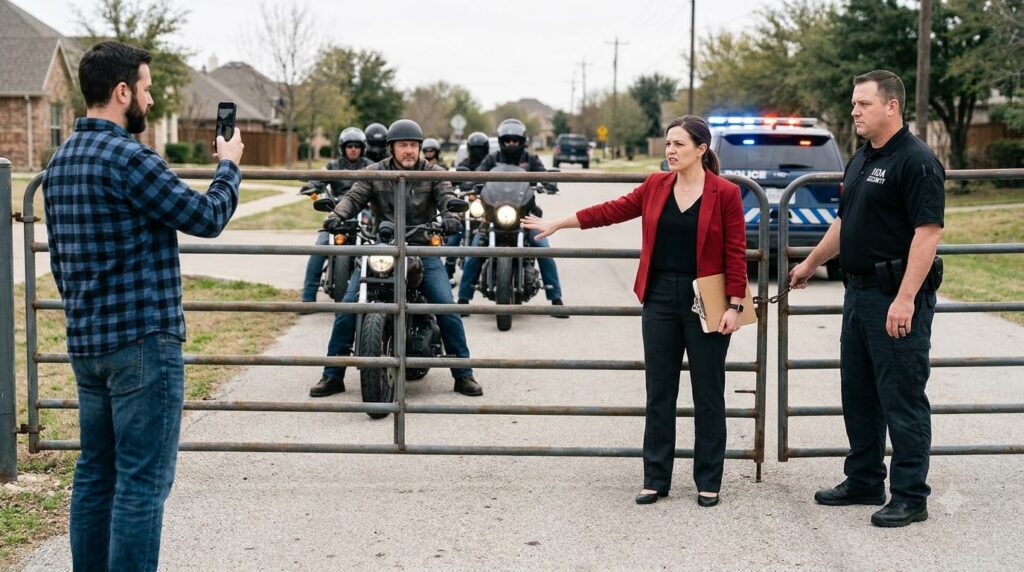
“Put the phone down, Mark,” Evelyn said. Her voice didn’t pitch up; it dropped into a flat, practiced register—the tone of a woman used to getting people to sign petitions at the end of a driveway. “You’re escalating a simple access verification into a public nuisance.”
Mark didn’t lower the glass. The camera lens stayed level with the center of her red blazer, catching the glare of the noon sun off her plastic lapel pin.
“You chained a public road, Evelyn,” Mark said. The words came out slow, rhythmic, measuring the distance between his boots and the heavy iron rail. “That’s not verification. That’s obstruction.”
To his right, Harris shifted his weight. The leather of his duty belt creaked—a dry, stiff sound like an old saddle—and the thick rubber soles of his work boots ground a handful of loose granite chips into the soft asphalt. He didn’t look at Mark’s face. He kept his eyes fixed on the motorcycle riders bunched outside the gate, his large, sun-reddened hands resting near his waist.
Mark stepped closer to the barrier, the toes of his work boots stopping an inch from the iron frame. He reached down with his off-hand and picked up the heavy brass padlock hanging from the galvanized chain.
The lock was hot to the touch, scorched by the midday sun, but what caught his eye wasn’t the heat—it was the shackle. The dull brass plating had fresh, bright silver gouges near the tumbler, as if someone had used a pair of locking pliers to force the latch closed over a chain link that was too thick for it. The plastic keyhole shield was missing entirely, exposing the dark, grease-stained brass underneath. This wasn’t an official county lock. It was a hardware-store heavy-duty special, slapped on in a hurry before the morning commute.
“Where’s the key, Harris?” Mark asked softly.
Harris swallowed. His throat moved behind the tight collar of his black polo shirt, but he didn’t answer. He looked at Evelyn.
“He doesn’t answer to you, Mark,” Evelyn snapped. She stepped up to the inside of the gate, her red blazer brushing against the rusted iron pickets. She brought her clipboard up, tapping the metal clip with a manicured thumbnail—click, click, click—a sharp, rhythmic tick that sounded like a dying clock. “He answers to the board. And as the designated director of perimeter safety, I am instructing him to hold this line until the county deputy arrives to clear these vehicles off private property.”
“Private property,” Mark repeated. He turned his phone slightly, capturing the stretch of road behind her—the two narrow lanes of cracked asphalt, the gravel shoulders, the pine trees growing right up to the drainage ditches. “You’ve lived here six years, Evelyn. You know as well as I do that the subdivision plat ends fifty yards back at the stone pillars. This stretch here? This is the pass.”
“The board amended the perimeter boundary in ninety-eight,” she said, her voice tightening around the dates like she was reading from a holy text. “We hold the maintenance contract. We pave it, we clear the fallen timber, we manage the brush. That gives us operational control.”
“Operational control isn’t ownership,” Mark said.
Behind the gate, Dave Kowalski cut the engine of his touring bike.
The sudden silence was heavy, dropping over the road like a wet wool blanket. The idle of the other seven bikes died one by one, leaving only the high, dry buzzing of cicadas in the canopy overhead and the distant, rhythmic thump of the approaching police cruiser’s tires over the asphalt expansion joints.
Dave swung a heavy leg over his saddle, his leather riding jacket creaking as he stood up. He walked to the center of the locked gate, his dark helmet visor flipped up just enough to reveal a pair of tired, dust-rimmed eyes. He didn’t look at Evelyn. He looked directly at Harris.
“My boy’s got a insulin delivery coming up this road at one o’clock, Harris,” Dave said. His voice was low, gravelly, carrying the thick, flat vowels of a man who had worked thirty years in the county quarry down in the valley. “The pharmacy van uses the pass because the highway bridge is down to one lane for paving. You planning on turning the pharmacy van around too?”
Harris’s mouth tightened into a thin, pale line. “I’m just enforcing the posted notice, Mr. Kowalski.”
“You’re standing on public dirt,” Dave said quietly. He placed one heavy, gloved hand on the top rail of the gate, his fingers curling over the iron. He didn’t push. He just let the weight of his arm rest there. “Evelyn doesn’t pay your legal defense if you block a medical delivery. The HOA insurance policy explicitly excludes criminal obstruction.”
Evelyn’s face flushed a deep, mottled crimson under her light brown hair. “That is a mischaracterization of our legal coverage! The board has full indemnity—”
“The board has three people and two thousand dollars in a reserve account, Evelyn,” Mark interrupted, lowering his phone just an inch to stare straight into her mirrored sunglasses. “And when the deputy steps out of that car in ten seconds, he’s not going to ask about your reserve account. He’s going to ask who put the chain on the gate.”
The white-and-blue county SUV rounded the final curve, its tires crunching onto the loose gravel shoulder fifty feet back. The red and blue strobe lights flashed against the dusty glass of the windshield, washing over the iron gate, the red blazer, and the tight, silent knot of men standing on the asphalt.
The driver’s door swung open. A pair of worn leather service boots hit the ground first, followed by the tall, rounded frame of Deputy Miller—no relation to Mark, but a man who had patrolled this district long enough to know every unpaved boundary line between the river and the ridge. He adjusted his heavy duty belt, his thumb hooking casually into his buckle as he took in the scene: the locked iron barrier, the bunched motorcycles, Mark’s raised phone, and Evelyn Vance standing behind her clipboard like a shield.
Deputy Miller didn’t hurry. He walked with the slow, deliberate pace of a man who knew that running only made people panic faster. He stopped three feet from the gate, his gaze dropping briefly to the brass padlock hanging from the rail, then moving up to Evelyn’s face.
“Evelyn,” the deputy said, nodding once. “Mark. Dave.” He looked at Harris’s black shirt, taking in the generic security patch. “Afternoon.”
“Deputy,” Evelyn said immediately, her voice rising half an octave as she stepped forward, her hand reaching through the iron bars to point a finger toward the motorcycles. “I called dispatch twenty minutes ago. I need these men cited for unlawful entry and failure to disperse. They are obstructing a private residential access lane and refusing to clear the turn-around area.”
Deputy Miller didn’t look at the motorcycles. He looked down at the road beneath his boots, then looked at Mark.
“What’s the situation here, Mark?” the officer asked quietly.
Mark held up his phone, his thumb tapping the screen to bring up a split view: the live camera feed on top, and a high-resolution PDF document on the bottom—a blue-lined county tax map with a bright yellow highlight running right through the center of the Oakridge Pass gate.
“The situation, Deputy,” Mark said, his voice steady against the heat, “is that Evelyn put a hardware store lock on a deeded county emergency easement. And she’s using contract security to keep twenty residents from reaching their homes.”
Evelyn slammed her clipboard against the iron rail with a loud, metallic clack. “That map is outdated! We have a signed agreement from ninety-eight!”
Mark didn’t argue. He simply angled his phone screen toward the deputy’s eyes, pointing to a single, stamped silver seal in the lower corner of the digital document.
“Look at the recording date, Deputy,” Mark whispered. “Ninety-eight doesn’t touch it.”