
CHAPTER 10: THE UNBROKEN PASS
The glass doors of the courthouse vault clicked shut behind Mark Miller, leaving Evelyn Vance and her attorney standing in the dim limestone corridor beside the heavy oak counter.
Outside, the late-afternoon sun had softened into a deep, amber haze that stretched across the valley floor. The air coming off the mountain carried the scent of dry pine sap, hot asphalt, and cooling earth. Mark climbed back into the cab of his truck, slid the heavy, glassine-encased certified deed into the glove compartment beside his registration, and turned the ignition.
The engine rumbled to life, smooth and steady. He drove up the winding switchbacks of Oakridge Pass Road, watching the mile markers blur past in the golden light.
When he reached the boundary line at four-forty, the scene had completely transformed.
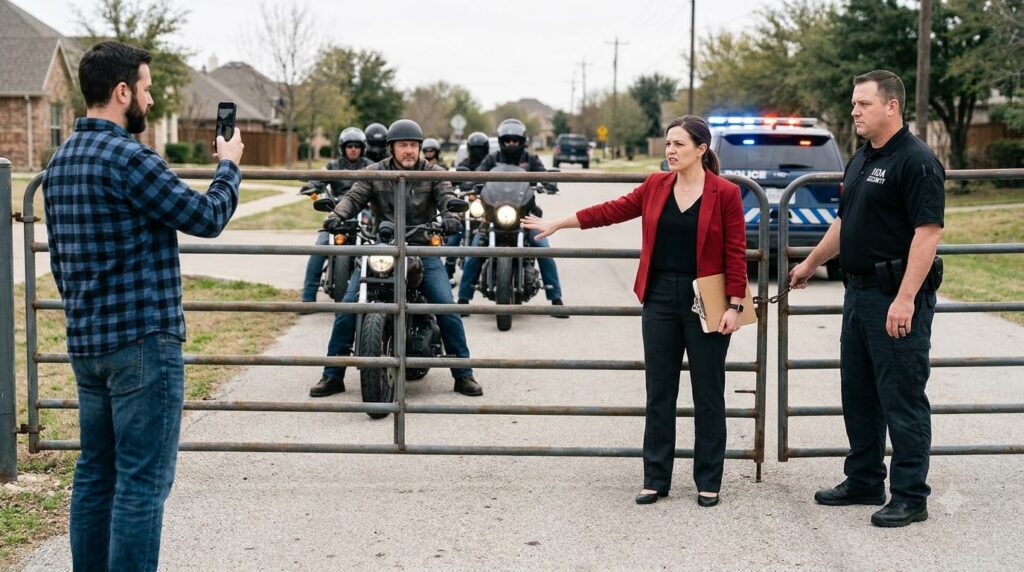
The heavy iron ranch gate stood wide open, pushed all the way back against the pine timber with a wooden wedge jammed under the lower rail to keep the wind from moving it. There was no chain, no brass padlock, and no contract security guard standing in the drainage ditch.
Parked along the gravel shoulder were six pickup trucks and five motorcycles. Dave Kowalski sat on an inverted five-gallon paint bucket near the edge of the pavement, a thermos of black coffee resting between his boots. A dozen neighbors—men and women from down the pass who had spent years turning their cars around or paying unapproved HOA tolls—stood in quiet groups along the asphalt, talking in low, easy tones as the evening breeze rustled the canopy overhead.
As Mark’s truck pulled to a stop beside the county survey monument, the crowd went silent.
Mark stepped out of the cab, shutting the heavy door behind him. He didn’t say a word. He reached into his flannel shirt pocket, pulled out his phone, and tapped the screen to open the neighborhood community portal—the same digital bulletin board Evelyn had used for three years to post violation notices, access bans, and threats of legal fines.
He attached the unedited video recording of the morning confrontation, followed by the high-resolution scan of the certified 1984 County Egress Deed, complete with Martha Gable’s raised gold seal glowing under the screen’s back-light.
He typed a single line above the attachment:
Parcel 402-A is a permanent, un-severable public emergency easement. The gate at Oakridge Pass is open, and it stays open.
He hit send.
Dave Kowalski stood up from his paint bucket, setting his thermos aside. He walked over to the open gate rail, resting one heavy, gloved hand against the dark iron pickets that had blocked his boy’s medicine five hours earlier.
“She back yet?” Dave asked, looking down the empty asphalt lane toward the valley.
“Her lawyer’s reading the deed,” Mark said, his voice quiet, carrying the dry, grounded weight of a man who had defended his dirt without throwing a single punch. “She won’t be putting another lock on this iron.”
A silver sedan turned the corner three hundred yards down the pass, its headlights cutting through the growing shadows under the trees. It slowed as it approached the open barrier, taking in the gathering of neighbors, the open iron frame, and the small, severed loop of the brass padlock still resting in the dust by the road edge.
The car didn’t stop at the gate line. It didn’t pull into the turnaround. It kept moving, creeping slowly through the twelve-foot gap in the fence, its tires humming softly over the stamped survey monument set flush in the asphalt.
Inside, behind the tinted glass, Evelyn Vance kept her eyes fixed straight ahead. Her hands were tight on the steering wheel, her red blazer shadowed in the twilight, her wooden clipboard lying flat and forgotten on the passenger seat floorboard.
Mark stood on the centerline of the road, his hands tucked casually into his denim pockets, watching the red taillights of her sedan fade into the pine woods toward the upper development.
Beside him, Dave Kowalski let out a low, satisfied breath. The pharmacy delivery van was long gone, the insulin was in the fridge, and the air coming down the pass was cool, clear, and unburdened by paper.
Mark looked down at his boots, where the silver cap of MON-402-A glinted under the rising moon. The chain was gone. The road belonged to the dirt, the county, and the people who lived along it.








