
CHAPTER 3: THE RUSTED THREADS
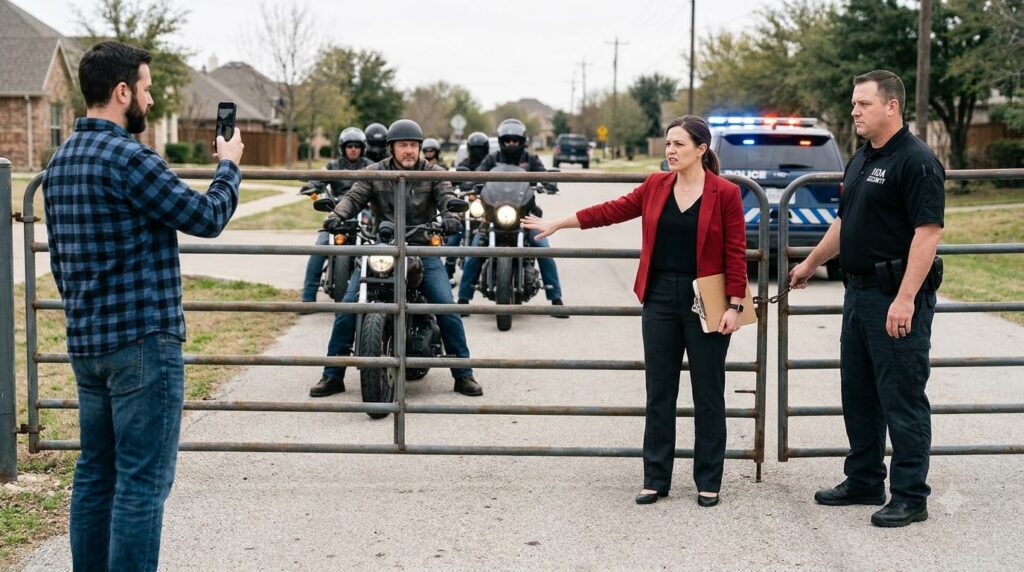
Deputy Miller didn’t lean over the gate. He reached out with two thick, leather-gloved fingers, took the edge of Mark’s phone casing, and pulled the glass three inches closer to his face.
The heat radiating off the phone screen joined the sun beating down on Mark’s forearms. Beyond the iron bars, Dave Kowalski’s motorcycle engine gave a sharp, metallic pop as the cooling fins contracted in the afternoon heat.
“Zoom in on that lower right corner, Mark,” Deputy Miller said. His voice was flat, unhurried, carrying the dry rasping texture of a man who spent eight hours a day swallowing highway dust.
Mark tapped the glass. The high-resolution scan enlarged, bringing into focus a blue-ink county recorder’s stamp dated June 14, 1984. Right below it, etched in fine serif type, was the legal designation: Permanent Public Emergency Egress & Utility Easement, Parcel 402-A.
“That’s a forty-year-old filing,” Evelyn snapped, stepping sideways so her red blazer jammed against the iron latch assembly. She opened her thick wooden clipboard, grabbing a multi-page document printed on heavy bond paper. She thrust the top page straight through the iron pickets, the paper fluttering sharply in the thermal wind blowing off the asphalt. “This is the 1998 Covenant and Maintenance Transfer, signed by the county commissioner’s office and the Oakridge Board! Page three explicitly grants exclusive gate rights to the HOA!”
Deputy Miller didn’t reach for the paper. He let it hover two inches from his uniform chest. “Evelyn, I’m not reading a contract through a fence rail.”
“It’s a legally binding neighborhood agreement!” her voice spiked, the calm corporate veneer cracking to reveal the sharp, jagged pride underneath. “We paid sixteen thousand dollars out of the improvement fund to resurface this approach six years ago! The county hasn’t poured a single load of cold-patch on this road since the ninety-something floods! You can’t tell me we don’t own the barrier!”
“Paving a road doesn’t buy you the dirt under it, Evelyn,” Mark said softly.
He didn’t lower his camera. The lens stayed trained on the paper in her hand. From three feet away, his eye caught a detail that made his thumb freeze on the screen’s recording control: on the corner of the 1998 document Evelyn was waving, right over the blue-ink notary stamp, a heavy line of black ballpoint pen had been dragged back and forth across a handwritten amendment clause. It wasn’t an official revision. It looked like someone had tried to scratch out a conditional footnote before running the page through a copier.
“Look at the margin on page three, Deputy,” Mark said, angling his smartphone camera down to catch the paper in focus. “Third paragraph down. Someone tried to cross out the secondary access clause.”
Harris shifted his feet again. The heavy rubber soles of his boots slid across the loose gravel shoulder, revealing a bright silver circle set flush into the asphalt—the county survey pin. He looked down at his own toes, then back at Deputy Miller’s face, his shoulders drooping half an inch inside the black contract shirt. He knew what a survey pin meant. Every security guard who ever worked a gated site knew that standing on a county monument while refusing a deputy’s query was a fast track to losing a state license.
“Harris,” Deputy Miller said, his gaze shifting slowly from the phone screen down to the security officer’s boots. “Take two steps back from the latch.”
“Deputy—” Evelyn began, her voice turning sharp enough to strip paint.
“I said take two steps back, Harris,” Miller repeated, his voice dropping an octave into pure authority. He didn’t unholster anything, but his left hand rested flat against his duty belt right beside his flashlight ring. “I’m not asking you a second time.”
Harris didn’t hesitate. He stepped back two paces, his boots crunching off the asphalt and into the dry weeds bordering the drainage ditch. He left the heavy brass padlock hanging alone from the galvanized chain, its freshly scraped shackle glinting under the glare of the noon sun.
Dave Kowalski stepped up to the outer side of the gate rail. He didn’t pull on the iron. He just set his heavy, leather-clad forearm across the top bar, looking down at Evelyn with eyes that had seen forty years of local weather and fifty miles of local disputes.
“My boy’s insulin van is at the bottom of the hill, Evelyn,” Dave said. The sound of a small diesel motor was growing louder down in the cut—a white delivery truck crawling up the switchbacks, its tires humming against the hot pavement. “You want to explain to the driver why his route is blocked by a hardware store padlock?”
Evelyn clutched her wooden clipboard against her chest like a breastplate. Her face was flushed, dark blotches of crimson spreading up her neck from the collar of her red blazer. She looked at the approaching white delivery truck, then at the deputy, then at Mark’s phone, which was still recording every breath, every twitch, every line of sweat running down her temple.
“This isn’t over,” she whispered, her voice trembling with a mixture of rage and wounded pride. “The board will file an injunction before the courthouse closes today.”
“You can file whatever you want at four o’clock, Evelyn,” Deputy Miller said, reaching into his back pocket and pulling out a heavy, double-bitted key ring. He didn’t use the key on the brass padlock; instead, he hooked his gloved fingers around the top loop of the galvanized chain where it wrapped through the iron pickets. “But right now, this chain comes off.”
He looked directly at Mark, then at Evelyn.
“Evelyn, hand me the key to this lock.”
Evelyn didn’t move. Her thumb pressed so hard against the wooden edge of her clipboard that the knuckle turned white as bone. “I don’t have the key on me.”
Mark let out a single, dry breath. “She doesn’t have the key because she didn’t buy it. The HOA didn’t buy it either.” He looked at the scraped brass tumbler on the lock. “Ask her who put it on at six this morning, Deputy.”








