
Clear the Lane: The Silent Weight of Everyday Boundaries Under Fluorescent Lights
CHAPTER 1: CLEAR THE LANE
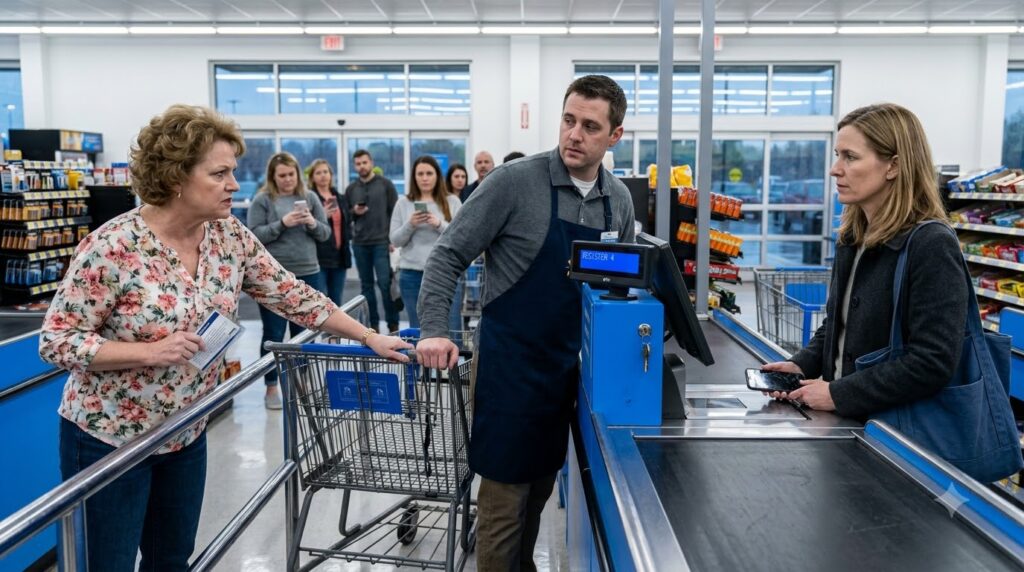
“You don’t belong in this line, sweetie,” the metal edge of the shopping cart struck Clara’s calves with a dull, hollow thud that echoed straight through the rubber mats of Register 4.
The force shoved Clara forward an inch, pinning her coat against the cold stainless steel railing of the conveyor belt. She didn’t jump. She didn’t turn around with a gasp. Eleven years of managing teenagers at the high school library taught her that sudden movements only fed an eager audience.
Behind her, the metal rattled again as Brenda Lawson leaned her full body weight against the handlebar of her cart. Brenda’s floral blouse was crisp, immaculate despite the humid Friday night rain outside, her oversized sunglasses perched on top of stiff, hairsprayed curls like a plastic crown.
“Ten items or less,” Brenda announced, pitching her voice to carry over the low hum of the refrigeration units and the rhythmic beep of distant registers. She pointed a manicured finger at the thirty-plus cans of soup and boxed grains sitting in Clara’s deep cart. “You have thirty. Move along so people who actually follow the rules can get home.”
The aisle went still. To Clara’s left, a tired man in a grease-stained mechanic’s shirt paused mid-reach for a display magazine. To her right, a young mother holding a crying toddler slowly adjusted her grip on her purse, pulling out her phone. The ambient noise of the Oak Park Supercenter seemed to pull back, leaving only the hum of the fluorescent lights buzzing overhead.
Clara kept her hands steady on the cart handle. Beneath her left palm, the faded blue canvas strap of her library tote bag hung heavy over her shoulder, the fabric fraying at the seams from years of lugging discarded paperbacks and canned goods. She felt the cold sweat of the metal through her thin wool coat.
“I suggest you check the overhead display before you push that cart into me again,” Clara said softly. Her voice was flat, dry, stripped of any rising emotion. She didn’t look back to meet Brenda’s eyes; she kept her focus on the small black terminal screen mounted beside the scanner.
“Oh, don’t give me that passive-aggressive nonsense,” Brenda snapped. She reached into her leather handbag, her movements sharp and practiced, and pulled out a worn, laminated card—a printed copy of the supermarket’s general customer guidelines she kept folded like a badge of office. “I know the policy. My husband was on the municipal board for six years. We don’t let people run over the queue just because they feel entitled.”
Brenda jammed the cart forward another fraction of an inch, wedging Clara tighter against the rubber belt. The crowd shifted closer, a quiet perimeter of raised screens and watching eyes forming around the mouth of Lane 4.
Clara reached into her right coat pocket. Her thumb slipped over the cracked glass of her phone screen, unlocking the display to reveal a glowing blue bar across the store’s mobile app. She didn’t show it to Brenda. She didn’t show it to the murmuring crowd. Instead, her eyes narrowed as she caught a tiny, almost invisible detail on the overhead scanner frame—a fresh yellow inspection sticker slapped over the blue express light, bearing a date that was two weeks expired.
“You can show whatever app you want,” Brenda sneered, stepping around the side of her cart to block Clara’s only path out into the main aisle. “Management is going to clear this line, and you’re going to the back.”
From down the central concourse, the squeak of rubber soles signaled the approach of an apron-clad floor supervisor.

CHAPTER 2: THE SCALE OF THE QUEUE
The squeak of rubber soles against wet vinyl tile grew louder, cutting through the low, electric drone of the overhead light bays. Marcus Vance-Gomez stopped at the lip of Lane 4, his worn manager’s apron slightly crooked, a silver-plated ballpoint pen tucked behind his ear. His clipboard was tucked under one arm, its plastic corners chipped from months of drop-and-grab calls on the sales floor.
“What’s the holdup here?” Marcus asked. His eyes swept the lane, taking in Clara pinned against the stainless-steel rail, the jammed metal nose of the cart behind her, and the crowd that had slowly pooled near the display racks of batteries and chewable mints.
“I’ll tell you what the holdup is, Marcus,” Brenda snapped before Clara could draw breath. Brenda didn’t back off the cart handle; if anything, she leaned her hip harder into the frame, wedging Clara’s coat further beneath the rubber divider edge. She held out the laminated store policy sheet like a court summons, her manicured nail tapping violently against a red-bordered box near the top. “Your cashier isn’t enforcing the register limits. This lane is posted for ten items or less. She has thirty-two. I counted while she was stacking them up.”
Marcus shifted his weight, the leather of his work boots creaking. He looked at Clara’s cart, then at Clara. His forehead creased with the visible arithmetic of an assistant manager three hours away from a shift change on a rainy night. “Ma’am,” he said to Clara, his tone dropping into the careful, neutral cadence of a corporate script, “the sign overhead is pretty clear. Peak hours mean strict item caps so we can keep the front end moving. If you’ve got a full basket, I’m going to have to ask you to pull around to Lane 9.”
“She knows she’s over,” Brenda chimed in, a sharp, triumphant edge in her voice that reached the three shoppers now standing motionless in the adjacent aisle. “She saw the line long enough to cut through, and she figured nobody would say anything. People like this rely on everyone else being too polite to make a scene.”
Clara didn’t flinch. She felt the heavy, cold pressure of the metal frame against her lower calves, the dull ache settling deep into the bone. Beneath her coat, her pulse beat steady, measured, unhurried. Her fingers remained resting flat on her phone, the screen dark against her palm.
“Marcus,” Clara said, using his name off the faded plastic tag pinned to his chest. Her voice was quiet, lacking the performative pitch Brenda had used to draw the crowd. “Did you replace the master terminal interface on Register 4 after the storm surge last Tuesday?”
Marcus blinked, thrown off his script. “The storm? No. IT just patched the local network hub.”
“Then the overhead verification light on this lane hasn’t synced with the register terminal since 4:00 PM,” Clara said, her eyes shifting calmly toward the metal frame above them.
Brenda let out a short, bark-like laugh. “Oh, now it’s a technical glitch? Give me a break. You’ve got thirty cans of black beans and four bags of rice in an express lane. You don’t need a computer degree to count to ten.”
“Look at the scanner casing, Marcus,” Clara continued, ignoring Brenda entirely. “The yellow service tag on the frame expired on the fourteenth. The blue express indicator isn’t running on the manual queue toggle. It’s running on the automated priority loop.”
Marcus stepped closer to the counter, his brow furrowing deeper. He leaned over the rubber belt, looking up at the small junction box mounted to the scanner arm. A small, square sticker—faded yellow, peeling at the corners, bearing a grease-penciled date from two weeks prior—sat right beside the optical glass.
“That’s just a maintenance tag,” Brenda insisted, her voice rising half an octave as she felt the momentum stall. She turned to the mother holding the toddler behind her. “Can you believe this? She’s making up excuses about equipment tags so she doesn’t have to push her cart thirty feet to the left.”
A low murmur rippled through the gathered shoppers. A young man in a hooded sweatshirt raised his phone higher, tilting the lens to capture both Clara’s motionless back and Brenda’s stiff, pointing hand. The air in the aisle felt thick, heavy with the smell of wet wool, damp asphalt, and the sharp ozone hum of the register belts.
Marcus reached into his apron pocket and pulled out a small master key ring. “Ma’am,” he said, looking back at Clara, “tag or no tag, the store rule for Lane 4 is ten items unless a floor supervisor manually clears a bulk pass. Did someone at the customer service desk give you a paper voucher before you brought this cart down?”
“No,” Clara said flatly.
Brenda smirked, leaning forward to address the recording phones. “There it is. Straight from her own mouth. No voucher. No permission. Just pure entitlement.”
“I didn’t get a paper voucher,” Clara repeated, her tone entirely devoid of panic. “Because your corporate service desk went paperless three weeks ago.” She raised her right hand, turning the glowing face of her smartphone toward Marcus. “And the override code isn’t on a slip of paper. It’s already logged in your register database.”
Marcus stared at the glowing blue bar spanning the top of her screen, his hand freezing on his key ring.
CHAPTER 3: THE WEIGHT OF AUTHORITY
Marcus stared at the glowing rectangle held steady in Clara’s hand. The blue header bar across the top of the app reads SuperCenter Partner Express — Priority Clearance, framed by a crisp green checkmark that pulsed twice every three seconds.
For two full beats, the only sound in Lane 4 was the steady, wet drip of rainwater falling from a shopper’s umbrella onto the linoleum tiles behind them.
“That doesn’t mean anything,” Brenda declared, her voice slicing through the quiet like a dull blade. She shoved her hip further into the cart frame, leveraging her weight to force the metal cage half an inch closer to Clara’s legs. The cold iron bar bit into Clara’s wool coat, pressing the fabric tight against her shins. “Anyone can take a screenshot of a phone screen, Marcus. You know how these people operate. They find a graphic online, save it to their photo album, and hold it up hoping some kid in an apron gets intimidated into letting them cheat the queue.”
Marcus didn’t answer right away. He reached out, his thumb rough and greyed with newsprint dust, and lightly tapped the corner of Clara’s phone screen to swipe up. The interface didn’t freeze like a static image; it expanded, revealing a scrolling itemized list of pre-scanned barcodes along with a bold, sixteen-digit alphanumeric hash running across the bottom.
“It’s live,” Marcus muttered under his breath. He unclipped the heavy master scanner from his hip holster. The black rubber casing was scarred with deep gouges from years of drop-impacts against concrete loading docks. “Hold it still for a second.”
“Marcus, you are wasting everyone’s time!” Brenda’s voice pitched higher, cracking slightly under the strain of holding her posture. She turned back to the crowd, hands raised in an open gesture of collective exhaustion. “Look at this line! There are eight families waiting here while he verifies a mobile app for someone who couldn’t be bothered to stand in a regular lane like the rest of us!”
A couple near the battery rack shifted uncomfortably, but the young man holding his phone camera didn’t lower his arm. The lens remained fixed on the three-way standoff, the small red recording light on his casing a steady eye in the fluorescent glare.
Marcus pulled the trigger on the scanner. A bright crimson laser grid splashed across Clara’s phone glass, casting a harsh, red net over her knuckles. The scanner emitted a short, high-pitched error tone—two sharp beeps that vibrated off the stainless-steel belt divider.
Brenda let out a loud, triumphant gasp. “HA! Error code! I knew it!” She slapped her hand against the laminated policy sheet still gripped in her fingers. “It’s a fake! Clear her out, Marcus! Get her out of the aisle right now or I am calling Regional Management on my personal cell!”
Clara didn’t pull her phone back. Her shoulder, weighed down by the heavy, frayed canvas strap of the library tote bag, remained perfectly level. She looked down at the scanner screen in Marcus’s hand.
“Read the terminal prompt, Marcus,” Clara said gently, her tone completely level. “It didn’t reject the code. It triggered a security lock.”
Marcus looked down at the small liquid-crystal display on his handheld unit. The screen was flashing a amber warning box: SECURITY OVERRIDE REQUIRED: CODE 402 — COMMUNITY DISTRIBUTION PASS. Beneath the flashing text, a red marker flanked the prompt—an internal flag indicating that the transaction belonged to an authorized institutional account, requiring a secondary manager key-turn to clear the lane.
Marcus looked up, his brow furrowed with a sudden realization that made his mouth go dry. He looked at Clara’s quiet face, then down at the thirty boxes of dry pantry goods, canned vegetables, and fortified oats resting in her cart.
“This isn’t a grocery run,” Marcus said slowly, the words coming out flat as he connected the dots. He looked at the frayed blue canvas bag slung over her coat. “Code 402… that’s the municipal food assistance partnership. The weekend pantry drop.”
“She’s stalling!” Brenda barked, stepping forward until her chest almost hit the side of Marcus’s shoulder. She reached down, grabbing the front lip of Clara’s shopping cart, attempting to physically haul it backward out of the lane framework. “I don’t care what code it is! The sign says ten items! If she has a special pass, she should have gone to the loading bay! She doesn’t get to block paying customers!”
Brenda yanked the cart with a sudden, violent jerk. The heavy metal wheels ground against the rubber floor mats with a sharp screech, the frame twisting sideways and slamming hard against Clara’s hip. The impact knocked Clara’s shoulder against the register upright, her phone slipping from her fingers and clattering face-down onto the cold steel edge of the conveyor belt.
The crowd gasped. The sound of the phone striking the metal echoed through the entire front end of the store like a gunshot.
Clara didn’t yell. She didn’t reach out to grab Brenda’s arm. She simply stood her ground, her hand coming down flat on top of the register belt, pinning her phone beneath her palm before it could slide into the scanner pit. She looked directly into Brenda’s wide, furious eyes.
“Marcus,” Clara said, her voice dropping an octave into a cold, terrifying quiet. “Turn your key.”
Marcus stood frozen for a fraction of a second, caught between the screaming neighborhood treasurer threatening his job and the quiet woman standing motionless over a locked system terminal. The register light above Lane 4 began to flicker violently, its internal relay ticking like a timer.
CHAPTER 4: CODE 402
The ticking of the register light’s internal relay seemed to hit every ear in Lane 4. Marcus’s thumb hovered over his brass key ring, his knuckles white against the dark rubber sleeve of the scanner housing.
“Don’t you dare,” Brenda breathed, her voice dropping into a harsh, vibrating whisper. Her nails dug into the plastic trim of Clara’s shopping cart, her body leaning forward until her floral blouse was crushed against the chrome nose of the frame. “If you override this register for someone who just pushed her way into an express lane, I will have your district manager here before the night shift starts.”
Marcus didn’t look at Brenda. He looked down at Clara’s hand resting flat over the cracked screen of her phone, pinning it to the stainless-steel belt divider.
Slowly, deliberately, Marcus slotted his silver master key into the small keyhole beside the register’s optical glass. He turned it ninety degrees to the right. A sharp, mechanical click echoed through the casing, followed by the deep, rising hum of the master terminal rebooting its queue priority loop.
The terminal screen flickered once, washed out in harsh white light, and then settled into a steady, dark blue interface. The amber warning box vanished, replaced by bold, lime-green typography that stretched across the main display:
OVERRIDE ACCEPTED: CODE 402
ACCOUNT: MUNICIPAL FOOD PANTRY TRUST — DISTRIBUTION PASS #088
REGISTER ASSIGNMENT: PRIORITY LANE 4 / EXPRESS EXPRESSION PERMITTED
STATUS: PRE-PAID & FULLY CLEARED
Marcus read the lines out loud, his voice flat, steady, and carrying across the silence that had swallowed the entire front end of the store. “Manager override code 402 is verified. Her transaction was fully processed three minutes ago.”
Brenda’s hands slipped off the cart rail. She blinked twice, her mouth opening, then closing, like a valve losing air. “That’s… that’s not right. The sign overhead says ten items.”
“The sign overhead is connected to the manual queue,” Marcus said, pulling his key back and clipping it to his apron belt with a heavy metallic snapping sound. He stepped sideways, placing his shoulder directly between Brenda’s cart and the entrance to Lane 4. “The municipal pass assigns high-volume community buys to Lane 4 because it’s the only register equipped with the optical batch-scanner. It was logged into the central database at 4:15 PM today.”
A low, collective murmur rippled through the gathered line. Behind Brenda, the young man holding his phone camera lowered his arm slightly, his eyes tracking from the green terminal text straight to Brenda’s pale, motionless face. Two registers down, a cashier paused mid-scan, her eyes wide as she watched the floor supervisor step firmly into Brenda’s path.
“She wasn’t cutting the line, Mrs. Lawson,” Marcus added, his voice firm, loud enough for every recording phone in the aisle to catch the words clearly. “She was cleared before she even stepped up to the belt.”
Brenda’s chest rose and fell rapidly under her crisp blouse. She looked around the perimeter of watching eyes—the mechanic in his grease-stained shirt who had crossed his arms, the mother holding her toddler who was now shaking her head, the teenagers by the candy display whispering behind raised palms. The public platform she had spent the last ten minutes building had dissolved into a cold, quiet circle of judgment.
“Well,” Brenda stammered, pulling her laminated policy card tight against her chest as if trying to hide the bold red lettering. “Well… the app should have a clearer sign. People can’t be expected to know these things.”
Clara didn’t offer a sarcastic remark. She didn’t raise her voice or demand an apology. She simply lifted her phone from the conveyor belt, slipped it back into her wool coat pocket, and took hold of her cart’s plastic handle with steady, unhurried fingers.
“The lane is clear now,” Clara said softly, her eyes meeting Brenda’s for a single, unyielding second. “Have a quiet evening.”
Brenda took a slow step backward, her cart wheels grinding against the floor tiles as she cleared the way.
CHAPTER 5: THE UNBROKEN LANE
The rubber belt of Register 4 began to move with a low, mechanical whir.
Clara placed her hands back on the plastic grip of her shopping cart, her palm feeling the faint, steady vibration of the motor beneath the counter. Before her, the thirty-two neatly packed boxes of fortified grain, canned legumes, and shelf-stable milk slid smoothly under the overhead optical housing. Each package crossed the glass window with a crisp, low-pitched chime of validation—a rhythmic beat that filled the quiet left behind by Brenda’s retreat.
Marcus stayed standing at the head of the belt, his posture straight, his shoulder still blocking the narrow space where Brenda’s cart had been wedged moments before. He reached out and systematically pulled the heavy paper bags open, lifting the bulk items from the belt with the practiced efficiency of someone who had worked the store’s loading docks before taking a supervisory badge.
“The secondary receipt has already sent to your municipal coordinator’s queue, Clara,” Marcus said under his breath, his voice dropping into a quiet, respectful tone meant only for the two of them. “I added a store manager timestamp flag to the digital file. Just in case anyone at the district office checks the express lane logs tomorrow.”
“Thank you, Marcus,” Clara replied quietly. She adjusted the faded canvas strap of her library tote bag, letting the heavy weight settle comfortably against her hip. “The night drop crew at the shelter leaves at eight. I’ll make sure the manifest matches your log.”
Behind them, Brenda had backed her cart entirely out of the Lane 4 aisle mouth. She stood near the battery rack, her crisp floral blouse looking slightly wrinkled around the sleeves where she had leaned against the metal frame. Her oversized sunglasses had slipped slightly crooked on top of her hair, but she didn’t adjust them. She clutched her laminated policy sheet against her ribs, her eyes darting around the surrounding lanes.
The crowd had begun to disperse, though not with the sudden snap of a finished show. It was a slow, heavy unfolding. The mechanic in the grease-stained shirt picked up his magazine, tossed it into his basket, and stepped forward to take his place in Lane 3. The young man with the smartphone lowered his arm, his thumb tapping the screen to save the video before slipping the device into his coat pocket. The mother holding the crying toddler gave Clara a brief, quiet nod—an unspoken gesture of solidarity passed between women who understood the exhaustion of holding their ground under public scrutiny.
“Cashier nineteen,” the store’s automated overhead speaker chimed in a neutral, synthetic voice. “Please verify lane three.”
Clara watched the last heavy cardboard box pass through the scanner. The digital display at the end of the counter flashed green one final time: TRANSACTION COMPLETE — BALANCE: $0.00 (PRE-AUTHORIZED).
The cashier at the register—a young woman with tired eyes who had watched the entire confrontation in silence—reached for the roll of printed store slips. She didn’t offer a corporate script. She simply tore off a short, white verification slip, handed it to Clara with a small, genuine smile, and said, “Have a good night, ma’am.”
“You too,” Clara said.
Clara pushed her cart forward, clearing the checkout gate and entering the wide, polished concourse near the sliding glass exit doors. The cold, wet air from the parking lot rushed in every time the sensors triggered, smelling of asphalt, damp oak leaves, and fresh rain.
She passed within three feet of Brenda, who was standing stiffly beside a display of impulse-buy items. Brenda didn’t make eye contact. She stared straight ahead at the register lights, her lips pressed into a thin, tight line, her grip on her cart handle so rigid her knuckles showed white under the fluorescent tubes.
Clara didn’t stop to gloat. She didn’t tilt her head or offer a parting word. She simply walked past, the hard rubber wheels of her cart rolling over the metal transition strip at the doorway with a smooth, rhythmic click.
Outside, the rain had settled into a fine, cool mist. Clara pushed her cart toward the faded blue station wagon parked under the yellow glow of the perimeter light pole. The trunk was already lined with clean plastic tarps, ready for the evening delivery.
As she unlocked the tailgate, she looked back once through the glass front of the Oak Park Supercenter. Through the tall windows, she could see Lane 4 moving again. A man with a hand basket of fresh vegetables had stepped up to the counter, and Marcus was leaning over the belt, clearing the scan interface for the next customer. Brenda remained standing further back, isolated in the middle of the concourse, waiting for a space to open in a lane far away from Register 4.
Clara loaded the first box into the wagon, the cold air filling her lungs, steady and unhurried. The lane was clear.







