
CHAPTER 2: THE SCALE OF THE QUEUE
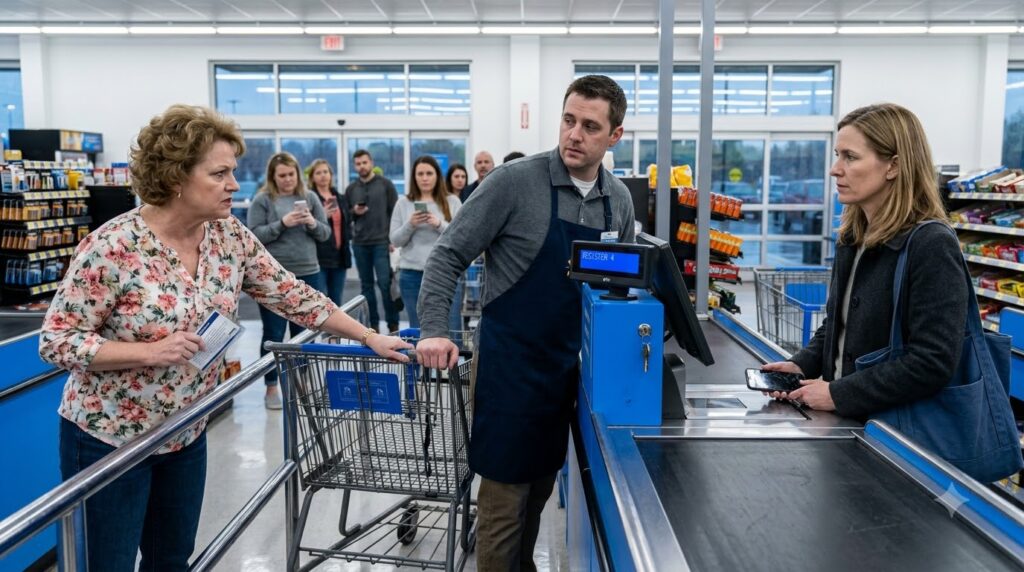
The squeak of rubber soles against wet vinyl tile grew louder, cutting through the low, electric drone of the overhead light bays. Marcus Vance-Gomez stopped at the lip of Lane 4, his worn manager’s apron slightly crooked, a silver-plated ballpoint pen tucked behind his ear. His clipboard was tucked under one arm, its plastic corners chipped from months of drop-and-grab calls on the sales floor.
“What’s the holdup here?” Marcus asked. His eyes swept the lane, taking in Clara pinned against the stainless-steel rail, the jammed metal nose of the cart behind her, and the crowd that had slowly pooled near the display racks of batteries and chewable mints.
“I’ll tell you what the holdup is, Marcus,” Brenda snapped before Clara could draw breath. Brenda didn’t back off the cart handle; if anything, she leaned her hip harder into the frame, wedging Clara’s coat further beneath the rubber divider edge. She held out the laminated store policy sheet like a court summons, her manicured nail tapping violently against a red-bordered box near the top. “Your cashier isn’t enforcing the register limits. This lane is posted for ten items or less. She has thirty-two. I counted while she was stacking them up.”
Marcus shifted his weight, the leather of his work boots creaking. He looked at Clara’s cart, then at Clara. His forehead creased with the visible arithmetic of an assistant manager three hours away from a shift change on a rainy night. “Ma’am,” he said to Clara, his tone dropping into the careful, neutral cadence of a corporate script, “the sign overhead is pretty clear. Peak hours mean strict item caps so we can keep the front end moving. If you’ve got a full basket, I’m going to have to ask you to pull around to Lane 9.”
“She knows she’s over,” Brenda chimed in, a sharp, triumphant edge in her voice that reached the three shoppers now standing motionless in the adjacent aisle. “She saw the line long enough to cut through, and she figured nobody would say anything. People like this rely on everyone else being too polite to make a scene.”
Clara didn’t flinch. She felt the heavy, cold pressure of the metal frame against her lower calves, the dull ache settling deep into the bone. Beneath her coat, her pulse beat steady, measured, unhurried. Her fingers remained resting flat on her phone, the screen dark against her palm.
“Marcus,” Clara said, using his name off the faded plastic tag pinned to his chest. Her voice was quiet, lacking the performative pitch Brenda had used to draw the crowd. “Did you replace the master terminal interface on Register 4 after the storm surge last Tuesday?”
Marcus blinked, thrown off his script. “The storm? No. IT just patched the local network hub.”
“Then the overhead verification light on this lane hasn’t synced with the register terminal since 4:00 PM,” Clara said, her eyes shifting calmly toward the metal frame above them.
Brenda let out a short, bark-like laugh. “Oh, now it’s a technical glitch? Give me a break. You’ve got thirty cans of black beans and four bags of rice in an express lane. You don’t need a computer degree to count to ten.”
“Look at the scanner casing, Marcus,” Clara continued, ignoring Brenda entirely. “The yellow service tag on the frame expired on the fourteenth. The blue express indicator isn’t running on the manual queue toggle. It’s running on the automated priority loop.”
Marcus stepped closer to the counter, his brow furrowing deeper. He leaned over the rubber belt, looking up at the small junction box mounted to the scanner arm. A small, square sticker—faded yellow, peeling at the corners, bearing a grease-penciled date from two weeks prior—sat right beside the optical glass.
“That’s just a maintenance tag,” Brenda insisted, her voice rising half an octave as she felt the momentum stall. She turned to the mother holding the toddler behind her. “Can you believe this? She’s making up excuses about equipment tags so she doesn’t have to push her cart thirty feet to the left.”
A low murmur rippled through the gathered shoppers. A young man in a hooded sweatshirt raised his phone higher, tilting the lens to capture both Clara’s motionless back and Brenda’s stiff, pointing hand. The air in the aisle felt thick, heavy with the smell of wet wool, damp asphalt, and the sharp ozone hum of the register belts.
Marcus reached into his apron pocket and pulled out a small master key ring. “Ma’am,” he said, looking back at Clara, “tag or no tag, the store rule for Lane 4 is ten items unless a floor supervisor manually clears a bulk pass. Did someone at the customer service desk give you a paper voucher before you brought this cart down?”
“No,” Clara said flatly.
Brenda smirked, leaning forward to address the recording phones. “There it is. Straight from her own mouth. No voucher. No permission. Just pure entitlement.”
“I didn’t get a paper voucher,” Clara repeated, her tone entirely devoid of panic. “Because your corporate service desk went paperless three weeks ago.” She raised her right hand, turning the glowing face of her smartphone toward Marcus. “And the override code isn’t on a slip of paper. It’s already logged in your register database.”
Marcus stared at the glowing blue bar spanning the top of her screen, his hand freezing on his key ring.








