CHAPTER 8: THE RETURN TO EARTH
The yellow steel teeth of the county backhoe bucket didn’t glide through the lawn; they struck with the heavy, concussive thud of an artillery piece dropping into raw stone. When the operator pulled the hydraulic levers back, the three-ton bucket bit deep into the manicured fescue of lot forty-two, shearing cleanly through the fresh sod and the underlying gravel sub-base with a deafening, metallic screech. The earth split open in a ragged, jagged red wound, throwing up a shower of dry clay clods and fragmented stones that rattled against the utility truck’s steel fenders like hailstones.
He stood back at the edge of the asphalt, his fingers tucked into the grimy waistband of his tool belt, his chest rising and falling in slow, heavy counts. Time seemed to drag under the weight of the machine’s roar. He watched the heavy steel bucket descend again, tracking the path of the original nineteen-seventy-four benchmark line. The tooth of the bucket caught the top rail of the chain-link fence, the zinc-coated wire screaming as it was twisted into a tight, useless knot of silver hair.
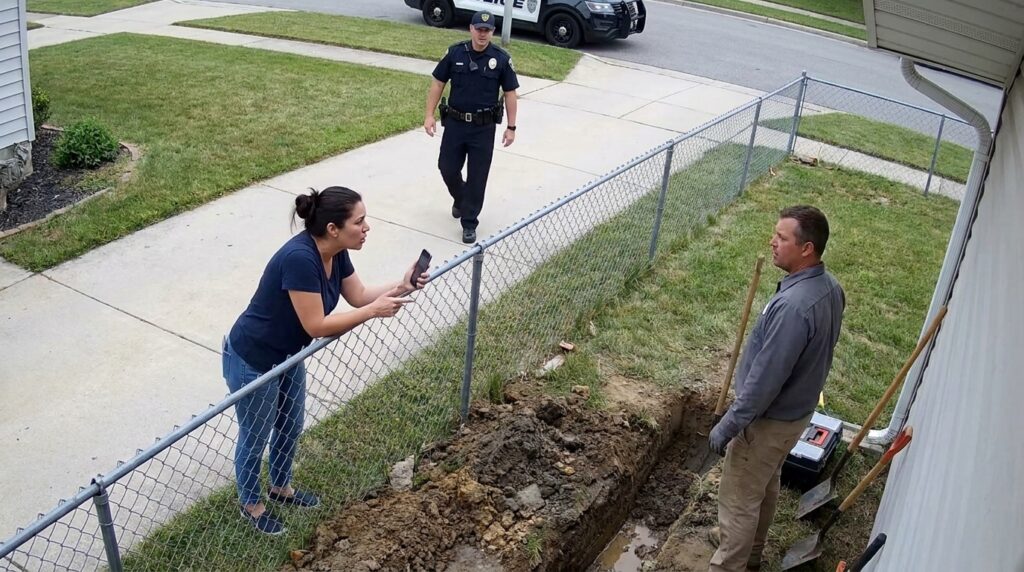
The galvanized corner post—the one she had guarded with her smartphone screen just hours before—didn’t lift out cleanly. It tore from its concrete sleeve with a dull, subterranean boom, ripping up forty square feet of root system and exposing the massive, unmapped concrete casing of the municipal water gate beneath.
The Neighbor Woman came out onto her porch one final time, but the phone was gone. She stood behind the white-painted square pillars of her entryway, her arms hanging limp at her sides, her navy shirt completely darkened across the chest by sweat and dust from the diesel exhaust. She didn’t call out. She didn’t produce any more notary papers. Her mouth stayed closed as she watched the county crew systematically dismantle the perimeter of her lot, the heavy rubber tires of the loader crushing her yellowing arborvitae into a wet, green paste against the clay.
The technician looked down into the widening pit. With the fence post removed, the true layout of the infrastructure was fully visible under the harsh, white glare of the afternoon sun. The five-inch cast-iron water main sat exactly where the yellowed pages of the old ledger had placed it—dead center beneath her former boundary, its rusted surface sweating under the pressure of the district flow.
The illegal black data conduit had been severed by the first pass of the blade. Its silver-plated coaxial core lay exposed in the mud, sparking weakly as the household backup generator finally seized up inside her basement, its ungrounded circuit dying with a series of sharp, mechanical pops that sounded like dry kindling snapping under a heavy boot.
The old man from across the street stepped up beside him, his thick leather slippers covered in the fine, gray limestone dust that had settled over the entire cul-de-sac. He set his empty coffee mug down on the curb, his hands returning to his pockets as he looked at the open trench.
“They’re going to have to do the same thing to every house down to the corner, aren’t they?” the old man asked. His voice was nearly lost beneath the rattle of the excavator’s engine, but it carried the quiet, unyielding weight of a truth that could no longer be kept under the earth.
“Every single one,” the technician said, his voice level, completely stripped of rancor or triumph. He picked up his five-pound iron water wrench from the side box of the truck, the cold gray steel heavy and solid in his grip. “The whole street sits on the county line. The town’s going to clear the entire twelve feet back to the nineteen-seventy-four pins before we can lay the new sleeve.”
The officer stood by his cruiser, his notebook closed, his fingers resting casually on his utility belt as the county crew set their hydraulic jacks into the road surface. He didn’t issue any citations. He didn’t need to. The unyielding logic of the grid had executed its own judgment, the buried iron asserting its right to the ground through three feet of raw clay and thirty years of engineered deceit.
The technician walked toward the edge of the pit, his boots sinking into the loose, red silt as he prepared to descend for the afternoon weld. The air smelled of burnt transmission fluid, wet dirt, and the sharp, metallic tang of oxidized iron. The neighborhood watchers remained on the curb, their faces silent and still as they watched the machine lift the last remnant of the fence wire into the air, leaving the street completely open to the wider, unvarnished horizon of the county road.