CHAPTER 7: THE RUSTED PAPERWORK
The carbon sheet in the regional water board logbook was so dry the upper corner snapped away under the pressure of his thumb. He sat on the metal bench seat of the utility truck, the door flung wide to catch the heavy midday heat, his grease-blackened fingers pinning down the edge of the 1974 plat overlay. The paper had a chalky, sulfurous odor, the product of three decades spent inside an unsealed iron lockbox at the district pump house.
“The county recorder’s office just pushed the digital duplicates to the terminal,” the officer said, leaning his forearm against the truck’s open window frame. The heavy fabric of his sleeve was gray with stone dust from the ditch line, and the plastic edge of his radar unit gave a low, metallic beep as the dispatch network refreshed. “They’re matching the nineteen-ninety-eight variance filed by the builder. The dimensions check out on their screen.”
The technician didn’t look at the officer’s digital display. He took a short, flat steel ruler from his breast pocket and laid it across the hand-inked scale of the old paper ledger. “The builder’s screen is wrong, sir. Look at the benchmark stamp on the lower margin. It’s a two-pin reference, not a three.”
He leaned closer to the page, his thumbnail tracing the dry, red line that marked the absolute boundary of the public utility corridor. The original ink—formulated with copper sulfate before the clean-water regulations took effect—had eaten slightly into the fiber of the page, leaving a faint, green-tinged shadow where the twelve-foot allowance had been recorded.
“The subdivision layout used a three-pin configuration to draw the fence line,” the technician said, his voice dropping into that flat, unyielding register of a man who trusts the metal over the document. “They calculated the easement from the edge of the asphalt instead of the center of the water main. That gave the developer an extra six feet of marketable lot width per house. They didn’t just shift the pins to hide the line—they falsified the primary benchmark to clear the foundation inspections.”
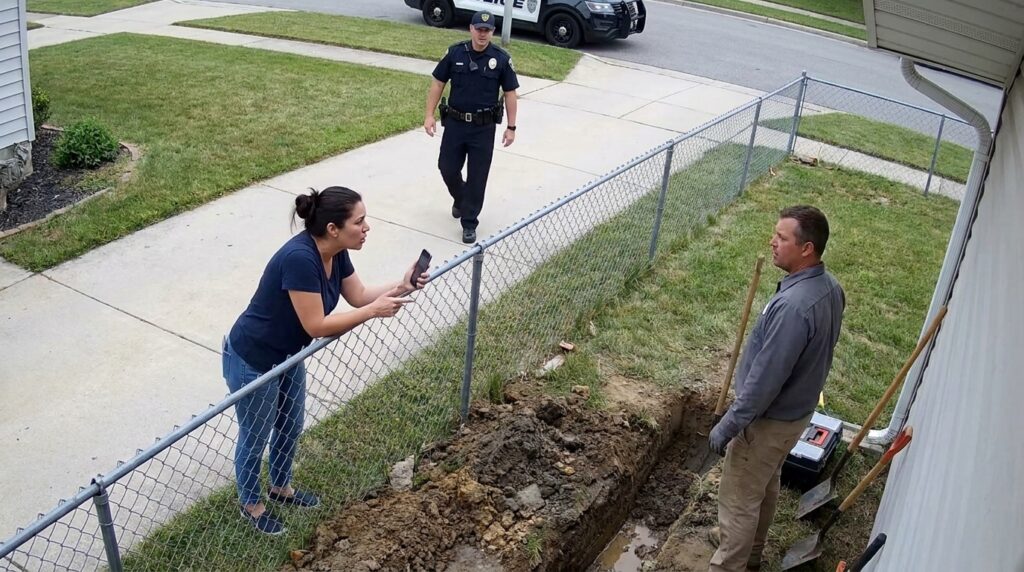
The officer shifted his stance, the heavy leather of his utility rig giving a short, wet creak against the hot steel of the door panel. He looked down the length of Elm Street, where the silver chain-link fence ran in an unbroken, glittering line across five straight lawns. Every single post anchor was set into the exact same red clay layer. Every single driveway was an eight-foot trespass over a five-inch high-pressure main trunk that had been laid down before the first tree had been cut for the cul-de-sac.
The front screen door of lot forty-two remained closed, but the small white generator on the side porch had dropped its pitch. The steady, high-frequency whine had given way to a wet, rhythmic rattling—the distinct sound of an ungrounded system choking on its own residual current. Inside the house, the data terminal was starving, its commercial-grade servers overheating behind the drawn blinds because the iron pipe in the ditch could no longer sink the stolen voltage.
The old man from across the blacktop was still standing by the truck’s tailgate. He had picked up his coffee mug, but he hadn’t taken a drink; his eyes were fixed on the deep red stain running down the sleeve of the technician’s gray work shirt.
“The county inspector’s truck is turning off the state route now,” the old man said, pointing with the handle of his spoon toward the intersection. “They’ve got the heavy trailer with them. The one with the dual-wheel excavator.”
The technician closed the leather-bound book with a heavy, hollow thud that threw a small cloud of grey soot into the cab. He slid his boots back into the red muck of the ditch, the wet clay suctioning against the rubber soles with a wet, heavy smack. The iron water wrench was still cool at the base of the hole, its handle resting against the pitted brass disc that had started the collapse.
The physical reality of the street was no longer a matter of private titles or aesthetic variances. The infrastructure was asserting its own logic, the decaying iron pipe beneath the sod demanding the ground back with every drop of pressure that leaked into the lower subsoil. The neighbor’s smartphone had been a tool of digital surveillance, an attempt to police the surface with a plastic screen, but the true authority was written in the three feet of rotten clay and the ungrounded copper that was currently melting inside her wall.
“We aren’t going to patch it from the ditch,” the technician told the officer, his hand clamping onto the cold iron of the wrench handle. “The electrolysis has taken out the whole section under the concrete footer. When the state crew drops their blade, they’re going to have to rip the entire corner off that lot just to keep the main from blowing the street out.”
The officer didn’t answer. He turned his head as the heavy diesel rumble of the county line truck began to echo through the cul-de-sac, the orange strobe lights on its cab casting a rhythmic, warning glare across the manicured lawns and the silent porches. The neighborhood watchers didn’t scatter; they moved closer to the curb, their faces pale under the midday sun, waiting for the first piece of galvanized steel to hit the turf.