
CHAPTER 2: THE MEASURE OF DECEIT
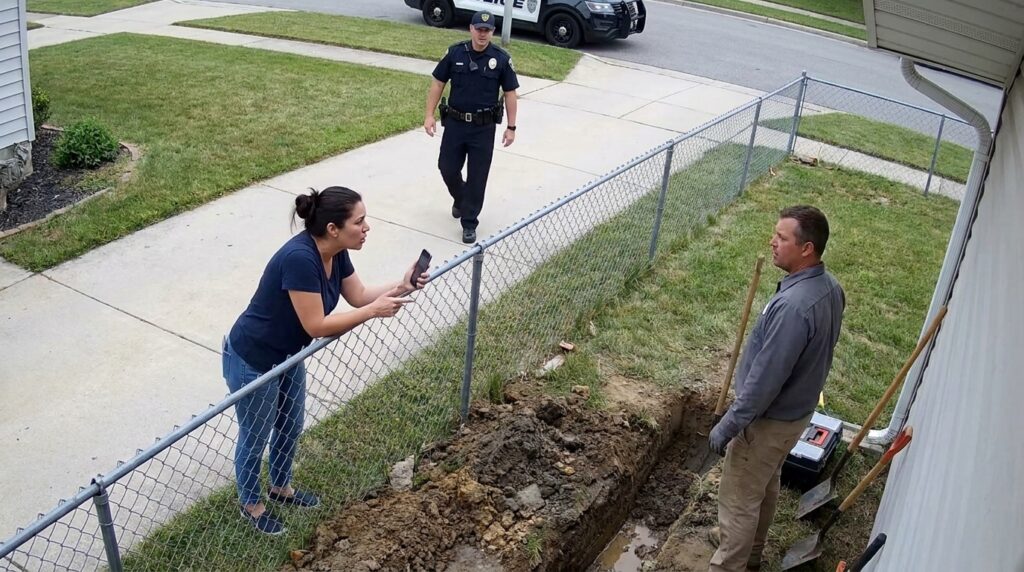
“I don’t need to look at your blueprints,” she said. The smartphone didn’t waver. The plastic casing of her device was clean, a sharp, white rectangle that seemed entirely foreign to the red clay coating his fingers. “I know exactly where my pins are. The town code says municipal contractors must provide forty-eight hours written notice before breaching a private perimeter. You’re an hour early, you don’t have a county flag on your truck, and you’re tearing up private turf.”
He spat into the dry weeds at the base of the post. The dust in his throat tasted like limestone dust and diesel exhaust from the morning route. “The county doesn’t flag easement mains, ma’am. That’s third-party locator work. And this line belongs to the regional district.”
He stepped back down into the trench, his heavy leather work boots sinking an inch into the soft mud around the concrete collar. The weight of his labor was a familiar anchor—the slow, rhythmic ache in his lower back, the way his flannel shirt stuck to the space between his shoulder blades. But the warmth coming off that black conduit wasn’t normal. A low-voltage line for a landscape lighting system or a dog fence didn’t hum against the palm of his glove like a live transformer. It had heat in it. It had the distinct, chemical smell of hot insulation and overloaded copper.
“I’m dialing the non-emergency dispatch now,” she announced. Her voice didn’t rise; it had the flat, practiced cadence of someone who had practiced her complaints in a mirror. “They’ll have a cruiser here in five minutes. Let’s see how much your supervisor likes explaining a property damage citation to the magistrate.”
“Go ahead,” he murmured, not looking up.
He picked up the iron water wrench—the five-pound tool scratched and grayed by twenty years of service in every ditch from here to the county line. The iron was cool, but as he rested the heavy jaw against the concrete casing, the vibration traveled straight through the metal and into his forearm. He wasn’t just working near a leak. Someone had cut into the structural sleeve of the main water trunk to shelter an unrecorded tap.
He could hear her speaking into the phone now, her words drifting over the zinc-coated mesh of the fence. She was using terms like destruction of property, unauthorized sub-contractor, and imminent structural hazard to a private dwelling. She was building her case in real-time, her boots clicking against the concrete walkway as she paced the boundary, never letting the phone camera drop below eye level.
He ignored the noise. He cleared another six inches of clay from the collar, his fingers tracing the rough aggregate until he found the edge of the secondary conduit. It wasn’t standard PVC. It was high-density polyethylene, the kind used for industrial fiber-optic runs or commercial-grade power bypasses. And it didn’t belong to the township.
From three houses down, the low, steady whine of a residential riding mower died out. The silence that followed was heavy, characteristic of a mid-morning suburban cul-de-sac when the ambient noise drops enough for the neighbors to hear the gravel crunching under a strange car. On the porch across the blacktop, an elderly man in an unbuttoned undershirt stepped out into the shade of his awning, a coffee mug balanced on his palm, his eyes locked onto the white utility truck parked at the curb.
They were watching. They always watched when the orange cones went out, but today they were watching for the show.
The sound of an engine came from the turn of the avenue—not the rattling diesel of a city crew, but the clean, muffled idle of a Ford Interceptor. The blue-and-white cruiser slowed as it passed the fire hydrant, its tires throwing up a small spray of loose stone against the curb before coming to a stop directly behind the utility trailer. The driver’s side door didn’t swing open immediately. For ten seconds, the car sat there, its air conditioning compressor clicking under the hood, the dark tint of the windshield blocking the light.
The Neighbor Woman stopped her pacing. She didn’t drop the phone, but her posture straightened, her shoulder blades squaring under the navy shirt as if she were stepping onto a stage she had personally bought and paid for.
“Down here, Officer,” she called out, her voice carrying that sharp, civic clarity. “Right by the lot boundary.”
He didn’t move from the ditch. He remained on his knees, his hands resting on the iron wrench, his eyes fixed on the point where the illegal black line disappeared into the foundation of her chain-link fence. The rust on the bottom rail was fresh, weeping red flakes onto the newly laid sod below. He knew what a standard service map looked like, and he knew that whatever was vibrating beneath his boots wasn’t on any ledger at the town hall. He just needed the clay to clear before the boots on the grass made their decision.








