CHAPTER 4: THE BRASS ANCHOR
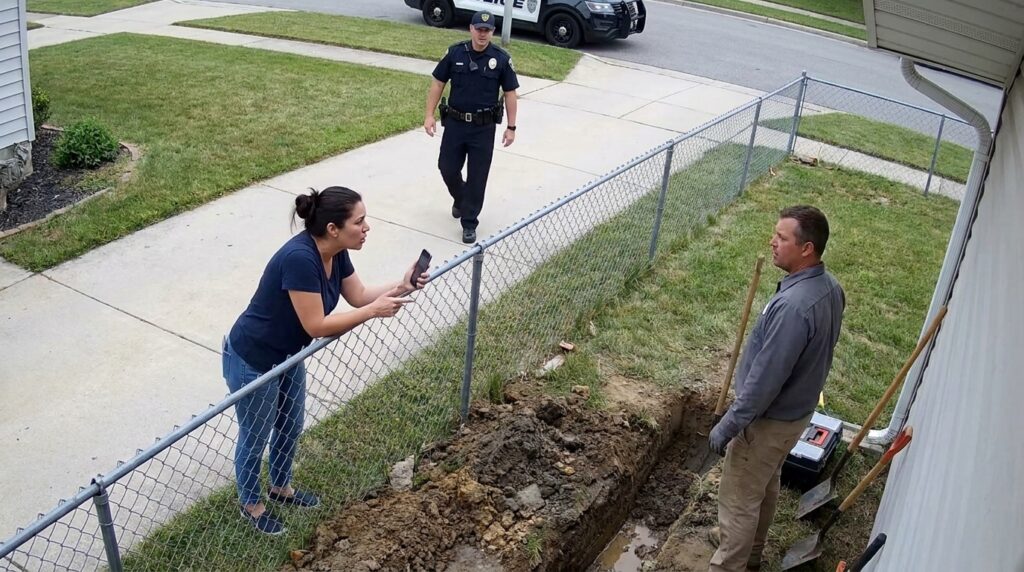
The steel bristles of the hand brush made a harsh, dry screech against the side of the stone block. He didn’t look at the officer’s notepad or the pale screen of the phone that was still trained on his head from behind the zinc fencing. He concentrated entirely on the layer of calcified white crust that had formed where the black polyethylene conduit entered the concrete casing. With every short, violent stroke of his arm, a fine cloud of gray dust rose from the pit, settling into the damp red clay around his boots like dried flour.
“There’s nothing under there but the subdivision ground assembly,” the Neighbor Woman said. Her smartphone remained level, but the tone of her voice had lost its flat, melodic cadence. It was tighter now, clipping the ends of her vowels as she stood on the dry thatch of her lawn. “The contractor who built this phase signed off on the perimeter layout with the county surveyor. If you damage that footing, you’re looking at a structural failure of a code-compliant barrier.”
He didn’t look up. He blew a hard breath into the gap, clearing the loose grit until his fingers found the edge of a flat metal plate embedded directly into the aggregate. It wasn’t standard iron. It was solid municipal brass, pitted by decades of acidic ground runoff but still showing the heavy, block-letter engraving of the original regional water board.
“Hold the light here, sir,” the technician murmured.
The officer leaned over the lip of the trench, his utility belt clicking against the top rail of the chain-link fence as he angled the white LED beam down into the clay. The light hit the brass plate. The engraving didn’t read Lot 42 Boundary. It read District Main Access Trunk—BM 114. Below the designation, a thick, cold line had been machined straight into the brass, marking the absolute center of the public utility corridor.
The fence post wasn’t six inches outside the line. The heavy galvanized post anchor had been driven directly through the eastern edge of the brass disc, shearing through the old county seal to pin the fence wire into the concrete sleeve below.
“That’s a benchmark disc from seventy-four,” the technician said, his fingers tracing the cold, rough edge of the sheared brass. “The subdivision wasn’t even drawn until ninety-six. This marker means the entire main line sits dead center under this fence strip. The whole perimeter rail is built inside the public easement.”
The officer shifted his light from the brass plate to the black conduit running alongside it. The plastic sleeve was vibrating aggressively now, the high-frequency hum clicking against the iron jaw of the wrench that still rested in the mud. He reached down with his gloved left hand and touched the polyethylene surface, then pulled his fingers back slightly from the heat.
“This isn’t a landscape ground line, ma’am,” the officer said, turning his face toward the fence rail. The white beam of his light caught the navy fabric of her sleeve, throwing her shadow long and distorted against the side of her house. “A low-voltage timer doesn’t generate enough resistance to cook the mud around it. What is this line tapping into?”
“I don’t manage the utility routing for the property,” she said, her phone hand dropping three inches until the lens was aimed at the officer’s shoulder rather than his face. “My husband handles the home infrastructure. We purchased the lot with the improvements already certified by the title company. If there’s an administrative discrepancy with an old benchmark, that’s an insurance issue, not a trespass.”
The technician picked up his small hand spade, using the flat edge to scrape away the remaining silt from the top of the black conduit. As the clay came away, it revealed a secondary splice box—a heavy, waterproof commercial fiber-optic junction box bearing a bright orange tag with no corporate logo, only a hand-written tracking number in permanent marker. The line didn’t pull power from the house; it was a high-capacity commercial data bypass, drawing its primary signal directly from the main regional fiber trunk that ran parallel to the water system.
It was an illegal tap, run inside the city’s concrete protective sleeve to avoid the state telecommunication tolls and the township zoning registry. The neighbor’s husband hadn’t just built a fence; he had used the fence line to conceal a private, commercial-grade network connection that cut straight through the municipal infrastructure.
“The line’s live,” the technician said, his voice completely flat as he tapped the orange tag with his spade. “And it’s leaking current into the ground casing. That’s what’s cooking the valve seal on our water main. The electrolysis from this data line is eating the iron pipe from the outside out.”
The silence from the surrounding porches was total now. The elderly man three houses down had stepped completely off his grass, his slippers clicking on the hot asphalt as he walked toward the rear of the patrol cruiser to get a clearer view of the ditch. The woman in the grey sweatshirt stood fifty feet away, her arms crossed tight against her chest, watching the officer’s notebook as he began writing down the serial number from the orange tag.
The Neighbor Woman didn’t move her feet, but her fingers gripped the galvanized rail of the fence until her knuckles showed white under the morning light. The phone in her hand was completely still now, its screen dark, the performance of neighborhood authority entirely shattered by the cold, pitted brass marker that lay three feet below her sod.
“Officer,” she said, her voice dropping into a low, transactional whisper that barely carried over the top wire of the fence. “We need to wait for my husband to come home before anyone touches that line configuration.”
The officer didn’t close his notepad. He looked from her face down to the warm, humming box in the mud, then back to the technician who remained knees-deep in the clay. “Buddy, you have the authorization to shut down the main zone to isolate that leak?”
“I do,” the technician said, his hand moving toward the heavy iron wrench. “But when I drop the pressure to fix the iron, everything running through this sleeve goes dark.”