
CHAPTER 5: THE WEIGHT OF THE LEDGER
The wrench didn’t slip; it bit. When the heavy iron jaw clamped onto the main valve nut, the connection didn’t yield with the clean grease-slip of a maintained municipal asset. Instead, a sharp, violet arc of static snapped out from the concrete collar, striking the steel shaft of the tool with the sound of a dry leather whip cracking against raw stone. The jolt traveled instantly through the thick rubber of his utility glove, a localized explosion of heat that smelled immediately of ozone and scorched canvas.
He threw his weight backward, his mud-slicked boots losing purchase against the bottom of the ditch as his shoulders slammed hard into the dirt bank. The iron wrench dropped into the grey water below, hissing like an anvil dropped into a cooling tub.
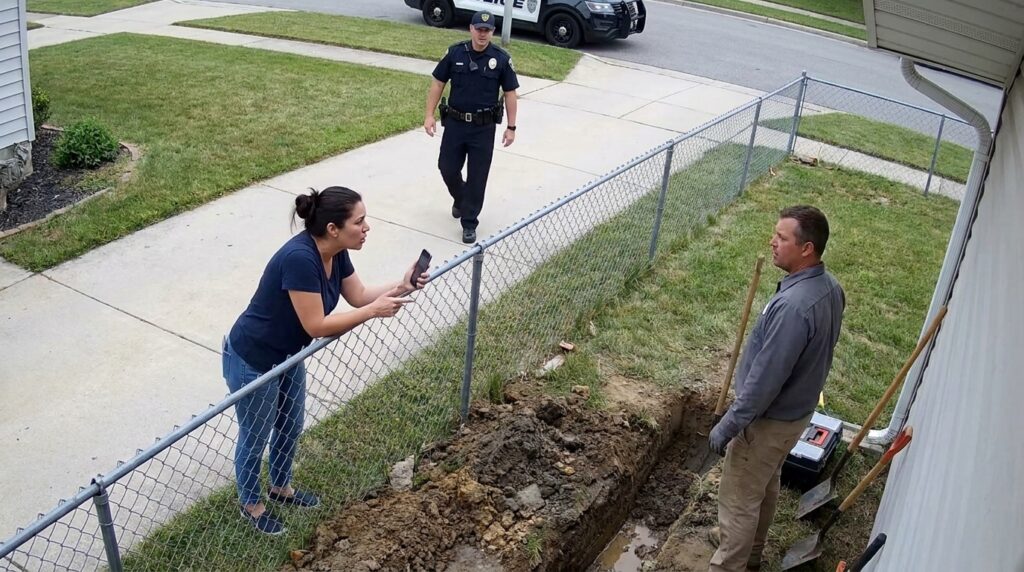
“Step out of the hole,” the officer barked, his right hand instantly dropping to the heavy plastic clasp of his duty belt, his leather shoes skidding on the loose gravel at the lip of the trench. “Don’t touch the iron. Stay clear of the water.”
The technician lay back against the cold clay, his right arm throbbing with a dull, pins-and-needles ache that ran from his wrist straight into the meat of his bicep. The water in the pit wasn’t bubbling from water pressure anymore; it was steaming, a thin, white vapor carrying the foul smell of melting PVC insulation and over-cooked soil. The black polyethylene conduit had split down its seam under the sudden surge, revealing a core of silver-plated coaxial bundles that had no business being within ten miles of a residential water main.
“It’s cross-grounded,” the technician muttered, his throat dry as he rolled his knees beneath him and forced his weight up the sloping edge of the trench. His work shirt was soaked across the ribs, the gray fabric turned black by the foul puddle water. “The house ground isn’t neutral. Someone didn’t just tap the fiber—they used the cast-iron casing of the county main as the primary electrical return for their whole secondary data node.”
The Neighbor Woman hadn’t dropped her phone, but she had retreated three paces up her grass, her white shoes stained around the edges by the red silt weeping through the lower wires of the fence. Her face had gone the color of unbaked lime, the tight knot of her hair slightly frayed where the strap of her sunglasses caught the rim of her ear.
“The system is automated,” she said, her voice rising an octave, stripping away the last remnant of her legalistic cadence. She directed the screen toward the front door of her house, where a low, rhythmic chime had begun to sound through the open screen door—the distinct, mechanical chirp of a commercial backup generator kicking in to handle an unmapped power drop. “It has a regional override code. You can’t just kill the feed without a district supervisor’s signature. There are commercial accounts linked to that terminal.”
The officer didn’t look at her notepad anymore. He walked to the driver’s side of his cruiser, his fingers clicking the plastic latch of his radio mic before his door was even fully open. “Dispatch, this is Unit Four. I need a county building inspector down on Elm Street, lot forty-two. And notify the regional utility desk—we’ve got an unmapped high-draw line tapped directly into the water main sleeve. The casing is live.”
The street was no longer silent. The elderly man from across the blacktop had reached the curb, his slippers crunching over the loose gravel until he stood just five feet behind the officer’s rear bumper. Two more neighbors—one holding a garden trowel, another in an oil-stained work apron—had joined the woman in the grey sweatshirt. They didn’t speak to the Neighbor Woman. They stood in a loose, heavy circle, their eyes shifting between the steaming trench and the pristine white trim of her porch. The performance of suburban order had broken down, leaving only the raw, messy mechanics of the infrastructure underneath.
The technician pulled the blueprint folder from his pocket. The paper was wet now, the blue ink starting to run into the margins, but as he spread it across the hood of the utility truck, the physical reality of the township maps became undeniable. He reached into the truck’s side box and pulled out a secondary document—an older, leather-bound county ledger from seventy-four that he kept for checking old benchmark offsets. The pages were yellow, the ink faded to a dark rust-brown, detailing the original farm tracts before the developers had laid down the first square yard of sod.
He traced the old layout with his thumb. According to the original county clerk’s log, the easement wasn’t six feet wide. It was twelve. The entire property line for lot forty-two had been pushed forward during the ninety-eight construction phase to give the houses a deeper front footage, cutting the public right-of-way in half to satisfy the subdivision’s marketing plan. The fence didn’t just encroach on the easement; the entire front yard of the property was built on land that had been deeded to the township before the neighbor’s house was even a blueprint.
“Look at the ledger margins, Officer,” the technician said, his voice level despite the tremor in his right forearm. He didn’t point with his fingers; he used the wooden handle of his brush. “The developer didn’t just shift the pins. They buried the infrastructure under the lot lines to hide the fact that the houses were built eight feet closer to the water main than state safety code allows.”
The officer turned from his radio, his face dark under the shadow of his patrol cap. He walked back to the fence line, looking at the notary paper she was still holding against her hip, then down at the yellowed page of the seventy-four registry. The contradiction was absolute. The legalistic shield she had used to protect her perimeter wasn’t just flawed—it was a document written over an institutional lie that had stayed buried under her grass for nearly thirty years.
“Ma’am,” the officer said, his voice dropping into that heavy, authoritative register that marked the end of civil mediation. He pointed a leather-gloved finger toward the porch where the generator continued to whine. “I suggest you go inside and call whoever authorized that notary seal. Because when the county inspector gets here with the backhoe, that fence is the first thing that’s coming down.”








