CHAPTER 3: THE STRIDE AT THE BORDER
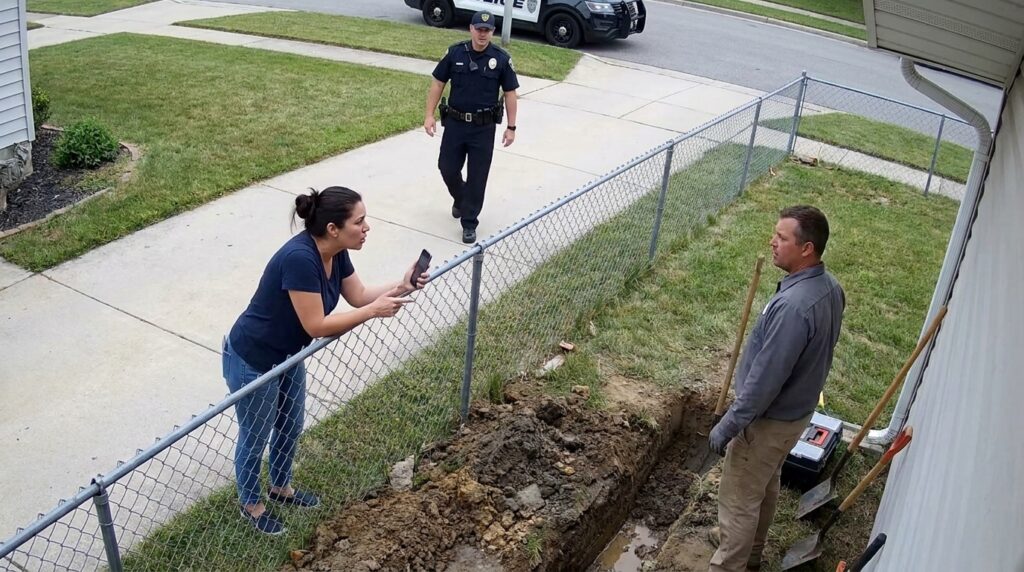
The crunch of tactical soles against the loose road gravel was a dry, heavy rhythm. The Police Officer didn’t hurry. He adjusted the utility belt riding low on his hips, his thumb hooked habitually near the heavy leather holster of his sidearm, his eyes scanning the orange perimeter cones before they ever dropped to the trench. The morning sun was climbing, drawing a sharp line of heat across the blacktop and turning the exhaust fumes behind the cruiser into a visible shimmer.
“Officer,” the Neighbor Woman said, her stride accelerating along her side of the zinc rail. Her smartphone camera stayed level, tracking the navy fabric of the officer’s sleeve as he neared the interaction lane. “I’ve got an unauthorized excavation happening within six inches of my primary property line. No county notice, no municipal flags, and they’ve already compromised the stabilization turf for my hedge.”
The officer stopped at the edge of the asphalt, his shadow falling across the wet mound of excavated clay. He looked at the white utility truck, then at the brass municipal logo stamped on the technician’s gray work shirt. He didn’t look at her screen. “Ma’am, let’s keep the phone back a foot. Let me see what we’re dealing with here first.”
He didn’t answer her directly. Instead, he turned his cap slightly against the glare and looked down into the three-foot ditch where the iron water wrench rested against the concrete collar. “You with the district water authority, buddy?”
“Yes, sir,” he replied, remaining on his knees. He reached back and pulled the thick, grease-smeared folder from his hip pocket, the thick municipal blueprint unfolding with a crisp, fibrous snap. He didn’t try to climb out of the red muck. “We’re tracking a main-line pressure drop between the street gate and the cul-de-sac. This is the regional district’s primary right-of-way easement. Six feet from the curb centerline belongs to the utility corridor.”
“That easement was restricted during the ninety-eight subdivision expansion,” she interrupted, her voice dropping into a hard, legalistic cadence. She reached into a matching blue folder tucked under her arm, pulling out a crisp, white page bearing a notary’s embossed seal. “The variance is registered with the township board. The city relinquished the secondary access strip when the retaining fence was installed.”
The technician wiped his fingers on his thigh, leaving three thick red streaks across his khaki trousers. He pointed the iron tip of his spade toward the base of the chain-link post. “The fence post is set directly into the concrete sleeve of the main casing, Officer. Someone poured an aggregate footer right over the old cast-iron valve box.”
The officer knelt down, his uniform trousers straining against his knees as he peered into the dark gap beneath the zinc mesh. The gray dust around the post wasn’t standard limestone gravel; it was raw hydraulic cement, the kind used to seal high-pressure water leaks in a hurry without calling the county registry. He pulled a small, black tactical flashlight from his belt and clicked it on, the narrow beam cutting through the damp shadow of the ditch.
The light caught the thick, black polyethylene conduit he had uncovered minutes before. Under the intense white beam, the plastic sleeve wasn’t just warm—the outer coating was lightly sweating against the cool subsoil clay. It thrummed with a rhythmic, high-frequency pulse that caused the small puddles of grey water at the bottom of the trench to ripple in perfect circles.
“What’s that line running into?” the officer asked, the beam tracking the black conduit straight through the illegal concrete footer and directly toward the crawlspace vent beneath the neighbor’s porch.
“It’s not on the regional main map,” the technician said, his voice dropping into a flat, pragmatic tone. He tapped the blueprint with a muddy thumb. “The five-inch iron pipe is city infrastructure. This black sleeve is a third-party pull. Someone drilled right through the structural collar of our main to use the line casing as a conduit for their own private feed.”
The Neighbor Woman’s hand twitched slightly, her phone tilting three degrees off center for the first time since the cruiser had parked. “That’s a protective ground wire for the low-voltage landscape timers. The developer put it in when the subdivision was engineered. It’s completely within our lot allowance.”
The technician didn’t argue. He picked up his iron water wrench again, the heavy tool scraping against the aggregate with a raw, metallic screech. He placed the heavy jaw directly against the concrete collar, right where the black line disappeared into the foundation. “Landscape wires don’t draw forty amps of continuous draw, ma’am. And they don’t hum loud enough to shake the mud off my boots.”
The officer stayed quiet, his flashlight beam lingering on the point where the fence post had been anchored into the municipal asset. He turned his head toward the house across the street, where the elderly man on the porch was now leaning over his railing, his coffee mug forgotten on the wooden post. Two doors down, a woman in a grey sweatshirt had stopped her walk, her eyes fixed on the blue-and-white patrol car. The public pressure was silent, but it was growing with the heat of the morning.
The officer stood up slowly, the leather of his rig creaking as he straightened. He looked at the white notary sheet she was holding out, then at the grease-smeared blueprint resting on the damp mound of clay. The logic of the street was shifting, the small, clear lines of bureaucratic law beginning to fray under the weight of the physical evidence in the ditch.
“Ma’am,” the officer said, his voice level but heavier now. He reached into his pocket for a small notepad. “Who did you say installed that landscape system for you?”