
CHAPTER 6: THE SILENT RETREAT
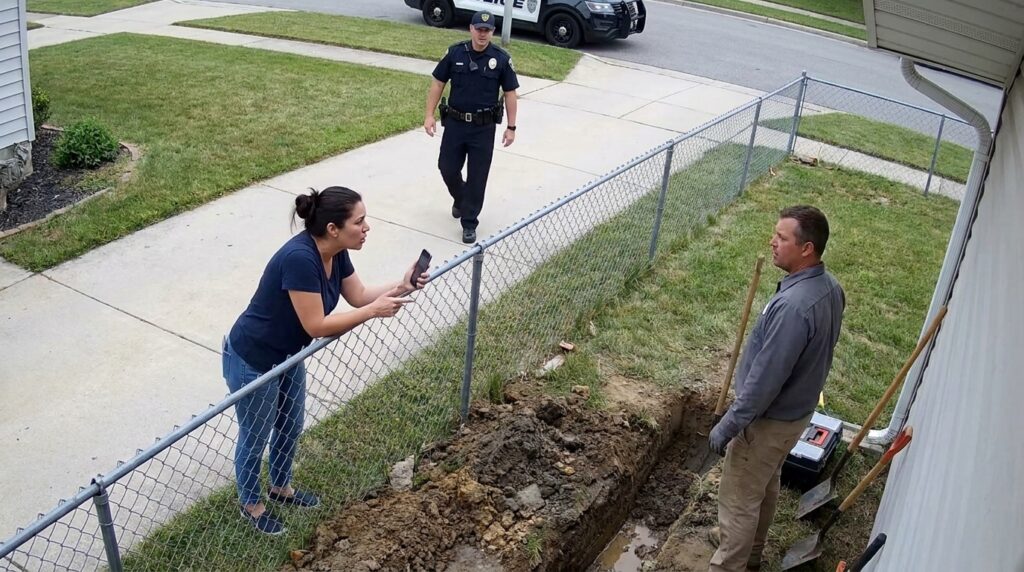
“This is an unconstitutional seizure of private lot assets,” she said, though she didn’t say it to the officer’s face anymore. She directed the words at the glass screen of her phone, her thumb jerking across the display to kill the live stream feed as her arm finally dropped to her side. The device looked impossibly small against the wide, sun-bleached expanse of her lawn, a clean sliver of plastic that had completely failed to hold the line.
She didn’t wait for the officer to reply. Her heels dug deep into the sod, leaving two small, torn plugs of green fescue in the turf as she turned her back to the fence. She marched up the gentle slope toward her front porch, her shoulders pinned back so hard her navy shirt bunched between her blades. The front screen door didn’t slam; the heavy hydraulic closer caught it at the last half-inch, shutting it with a dull, pressurized hiss that sounded like a long-held breath escaping an iron valve.
The technician didn’t watch her go. He remained down on the edge of the asphalt, his fingers tracing the rusted underside of the fence rail where the zinc coating had completely peeled away. The metal was pitted, the orange oxidation coming off on his skin in dry, chalky scales that smelled faintly of rotten sulphur and dead soil.
“The line’s still drawing,” he said, nodding toward the split polyethylene conduit down in the mud. The steam had thinned out, but the foul chemical heat still lingered in the bottom of the trench, a quiet, expensive hum that vibrated the loose stones around his boots. “If the backup generator inside her house is matching the frequency, her husband’s data hub is burning through its own infrastructure right now. It won’t hold twenty minutes before the primary switches melt.”
The officer stepped back from the trench, his black leather utility belt giving a long, creaking groan as he shifted his weight. He didn’t look up the hill toward the closed door. He turned his face down the street, where the crowd of neighbors had grown by three more households.
The old man from across the blacktop had reached the edge of the municipal truck’s bumper. He had set his coffee mug down on the metal tailgate, his thick, veiny hands hooked into the pockets of his gray trousers as he stared at the exposed brass marker.
“That’s the old line benchmark, isn’t it?” the old man asked. His voice was low, gravelly from a lifetime of foundry smoke, carrying no neighborly warmth—only the cold curiosity of someone who had watched this subdivision rise out of a bean field thirty years before. “The one the county crew put in when they widened the culvert back in seventy-four.”
“Yes, sir,” the technician said, clearing a handful of loose limestone from the edge of the disc. “The surveyor’s line tracks straight through that garage wall down at the corner of the bend. Every property stake on this side of the lane is shifted eight feet into the road allowance.”
The neighborhood woman in the grey sweatshirt let out a short, dry laugh. She didn’t look at the house at lot forty-two. She looked at the old man, her arms crossed tight against her ribs to ward off the rising morning heat. “My husband told the HOA board two years ago that our title insurance maps didn’t match the township tax grid. They threatened to fine us for parking our trailer on the easement strip. Said we were violating the aesthetic boundary.”
The silence that followed was heavy, the kind of stillness that settles over a street when people realize the rules they’ve been paying dues to enforce were written by the people who stole the ground underneath them. No one spoke up for lot forty-two. No one looked toward the house with the brick facade or the custom-painted shutters. They stood in the dust, their shadows shortening as the midday sun climbed into the center of the Ohio sky, watching the red clay slowly weep water back into the municipal ditch.
The technician reached down and retrieved his five-pound iron water wrench from the bottom of the pit. The tool was black now, the original gray enamel scorched off the jaw by the static arc from the illegal bypass. He used a piece of coarse burlap from his truck bed to wipe the grimy grease from the handle, the friction making a dry, rhythmic hiss that was the only sound left on the blacktop.
“We’re going to have to bring the line truck down from the yard,” the technician told the officer, his voice flat with the pragmatic exhaustion of a man who still had five more hours on his shift. “We can’t patch the iron with this bypass still pulsing. The weld won’t stick while there’s current in the pipe.”
The officer nodded, his fingers tapping the small leather case of his notebook against his thigh before slipping it back into his pocket. “The building inspector’s supervisor just called back on the secondary band. They’re pulling the original plat maps from the county seat right now. I’m staying here until the county truck drops its jacks.”
He looked down the line of the fence, where the galvanized rail stretched straight and true across three more lawns, its silver mesh glittering under the fierce, clean light. Every single post was set into the same concrete casing. Every single yard was an encroachment. The neighbor’s phone had gone dark, but the physical evidence was just beginning to surface, an entire neighborhood built over an unrecorded lie that was finally starting to rust from the inside out.








