
CHAPTER 6: THE ANCHORED LINE
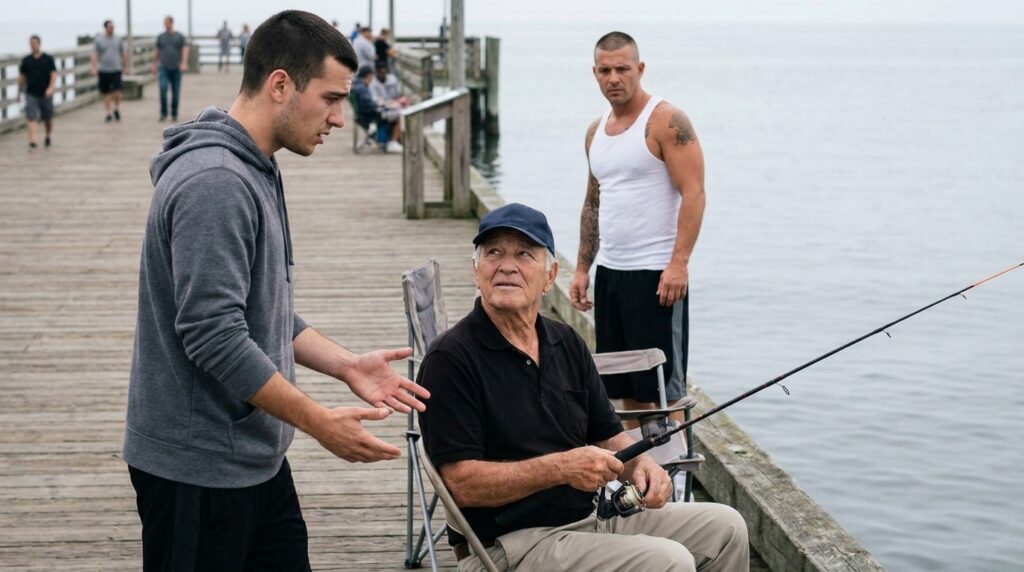
“My father didn’t talk,” Jesse said. The words came out thin, dried out by the glare that was now baking the top of the gray wooden rail. He didn’t lift his bait bucket. He just stood there, his sneakers slightly overhanging the gap where the creosote piling met the top decking, his fingers frozen into five small hooks against the plastic handle. “He died with his teeth shut, sir. But he kept the duplicate manifest in the cellar behind the water heater. I found it after the funeral. I found your name.”
Mac didn’t turn his head. He watched his line—the thin green thread of monofilament—as it cut the shifting brown water of the channel. The tide had fully turned now, running up-river with a heavy, silent power that pulled the dead marsh grass away from the bank and swirled it around the pilings in long, oily ropes.
Below his boots, the thrum was no longer a pulse. It was a single, unbroken tone—a high, mechanical frequency that resonated through the rusted iron drift-pins and into the aluminum legs of his chair. The array was locked on. Somewhere three miles out, past the sandbar where the gray rollers broke, a hull was moving through the deep trench, and the creosote logs beneath this public fishing dock were tracking its speed by the inch.
“A manifest is just paper, son,” Mac said. His voice was very quiet now, stripped of the command-deck rasp, matching the long, flat hiss of the river. “It doesn’t tell you what the water does to a man after forty years.”
He reached down, his movements slow and unhurried, and clicked the latch on the green steel tackle box. He didn’t slide the false bottom. He didn’t touch the paraffin-crusted oilcloth or the purple-inked courier log that carried the signatures of dead seamen. He simply took a single, two-ounce lead pyramid sinker from the top tray, his thumb testing the rough seam where the zinc had cooled in the mold.
The blue car at the edge of the lot had started its engine. The exhaust came out gray and heavy against the salt-cedars, the vehicle turning slowly on the gravel, its tires crunching the white clam shells with a dry, rhythmic crackle that sounded like teeth breaking. It didn’t drive toward the highway. It stopped at the throat of the wooden walkway, its nose pointed directly at the rail where Mac sat.
The man in the gray windbreaker was gone from the door, but the reflection on the windshield was blank, silvered by the midday light until the front seat was nothing but an empty slate.
“They’re going to take the box, aren’t they?” Jesse asked. He took a half-step closer, his gray shadow falling across the open tin trays of swivels and rusted hooks. He wasn’t looking at the car; he was looking at the way Mac’s hands didn’t shake as he tied the lead pyramid to the end of his line with a neat, five-turn clinch knot. “That man from the sedan. He’s been at the fuel dock three times this week asking about the old slips.”
Mac pulled the knot tight, using his teeth to nip the tag end of the nylon. The salt taste was sharp on his tongue—bitter, old, like the iron grease that used to coat the ladder-rungs of the DD-882.
“They can have the box,” Mac said, his fingers releasing the line. “The box is just where we keep the names so we don’t forget how to say them. The rest of it—the part your father didn’t put in the cellar—that stays under the wood.”
He stood up then, not with the sharp, defensive posture he had used to freeze Miller, but with a slow, heavy extension that seemed to take the entire weight of the pier up with him. He looked down into the water through the half-inch gap in the planks. The copper ground wire was vibrating so hard it had cleared a two-inch circle of green slime off the timber face, the bare metal shining like a new penny in the dark wash below.
The array wasn’t a secret he was guarding from the men in the car. It was the other way around. The car was there to make sure the array didn’t stop singing—to make sure the old man who sat on the aluminum chair every morning didn’t forget to keep his thumb on the wire-core cord that completed the circuit between the mud and the sky. They were all anchored to the same piling. Miller with his territorial greed, Jesse with his dead father’s pride, and the man in the sedan with his radio—all of them just foam on the surface while the machine did its work in the dark.
“Go home, Jesse,” Mac said, his hand coming down on the boy’s shoulder for the first time. The wool of the gray hoodie was rough under his palm, damp with the river mist, but the muscle beneath it was warm. “Tell your mother you found an old man who remembers the watch. That’s enough for a duplicate manifest.”
The boy looked at Mac’s hand, then up at the navy blue cap, his jaw moving once as if he wanted to pull the intercept back out of the history books, to make the destroyer reappear in the middle of this muddy coastal river. But the stillness in Mac’s face stopped him. It was the absolute, unblinking composure of a man who had already seen the end of the narrative long before the first line was cast.
Jesse nodded once, his eyes wet against the glare. He reached down, picked up his plastic bucket by the wire handle, and walked back down the center seam of the planks. He didn’t look at the blue sedan as he passed it; he kept his chin down inside his gray collar, his boots making a light, fading scuff against the pine until he hit the gravel and turned toward the town.
The blue sedan waited until the boy cleared the sedars, then its lights flickered once—a brief, amber flash of the parking lamps.
Mac sat back down in the aluminum chair. He didn’t open the tackle box again. He took the fiberglass rod in both hands, his thumb finding the deep split in the synthetic foam grip, his skin absorbing the steady, high-frequency hum that was traveling up from the silt forty feet below. The line was taut. The lead pyramid was anchored deep in the river mud, holding against the full weight of the Atlantic as it rushed into the mouth of the channel.
He pulled his cap low against the noon sun and kept his watch.








