
CHAPTER 5: THE UPRIGHT SHIFT
Jesse’s boots didn’t move backward, but his knees went rigid under the fleece pants, his weight locking into the wood like an unseasoned timber that was about to fracture under a crosswind. The second man—the one who had stepped away from the bait shack—closed the remaining gap with three flat, heavy strides. The nylon of his dark windbreaker gave a sharp, artificial hiss as his arm swung forward, the weight in his right pocket swaying like a pendulum against his thigh.
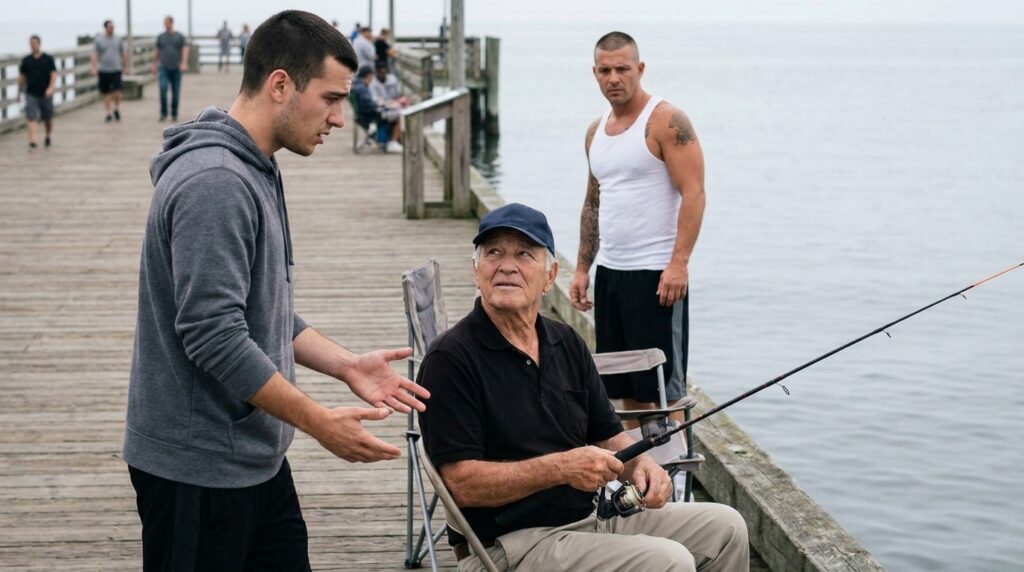
Mac stood up.
He didn’t pull against the iron rail to raise his frame, nor did his boots slide on the slime-filmed pine planks. He simply straightened his knees with a smooth, unhurried precision that belonged to an era when hundreds of tons of gray steel were balanced against a single centerline. The stoop left his spine in a single second. The change wasn’t an explosion; it was a realignment of gravity that made the aluminum chair behind him rattle once against its stays and then fall perfectly silent.
He let his right hand drop away from the fiberglass fishing rod. The line stayed cast in the gray water, but his fingers were empty now, the skin across his knuckles gray and tough as cured leather as he turned his chest directly into Miller’s shoulder.
“You’re on my deck, son,” Mac said. His voice didn’t rise to meet the wind, but it had the clear, low-frequency timber of an engine-room hatch being dropped into its rubber seating. It went straight down into the planks, cutting through the thin slap of the river against the wood.
Miller’s hand stayed frozen on the top rail of the folding chair. His fingers looked short and pink against the scuffed green zinc plate of Mac’s vintage tackle box, the tribal ink on his forearm twitching where the muscle met the tendon. He didn’t drop his jaw, but his eyes did a quick, mechanical calculation—tracking the width of Mac’s collarbones, the perfect vertical line of his spine, and the heavy, scuffed leather of the work boots planted at forty-five degrees near the center seam of the pier.
The second man stopped five paces back, his right hand still buried in the windbreaker pocket. The heavy, square outline inside the fabric didn’t shift, but his head tilted three degrees to the left, his gaze moving past Mac’s shoulder toward the gravel lot where the blue sedan sat under the salt-cedars.
The driver’s side door of the sedan had opened. A man in a plain gray windbreaker and dark trousers was standing behind the door frame, his hand resting on the roof of the vehicle while his eyes remained fixed on the far end of the pier. He wasn’t looking at Miller, and he wasn’t looking at the boy in the hoodie. He was looking at the green steel tackle box sitting by Mac’s heel.
“We’re just dropping lines, old man,” Miller muttered. The flat, local vowels were still there, but the weight behind them had dissolved into an uncomfortable, thin rattle. He didn’t release his grip on the chair, but his arm went soft, the muscle in his shoulder dropping into a defensive hunch as if he were trying to minimize his size against the gray sun.
“You’re dropping nothing here,” Mac said. He took a single half-step forward, his boot heel coming down on the very edge of the gap where the copper ground wire vanished into the green wash below. The vibration under his soles had stopped its triple pulse. It was a solid, continuous thrum now—the sound of a sub-surface array switching from its passive search cycle into a hard, directed sweep that was cooking the water ten feet beneath the walkway. “Take your gear and get behind the gate.”
Jesse looked between them, his face pale under the gray cotton hood. The romantic certainty that had brought him to the rail—the family stories of a legendary commander who had held a breaking destroyer together with nothing but discipline—was entirely gone now. He looked down at the green steel tackle box, then at the square shape in the second man’s pocket, his fingers trembling where they clutched the rim of his plastic bait bucket. He was beginning to smell the salt-tar and the old oilcloth, the real odor of a machine that didn’t have a place for a boy’s pride.
The second man in the windbreaker gave a short, single shake of his head toward Miller. He didn’t pull his hand out of his pocket, but he turned his heels back toward the bait shack, his boots making a light, whispering sound against the dry wood as he broke the perimeter.
“Come on,” the second man said to Miller, his voice entirely flat, stripped of any local color. “The current’s too fast here anyway. We’ll use the south wall.”
Miller didn’t answer immediately. He let his fingers slide off the aluminum frame of Mac’s chair, one by one, leaving five clear smears of grease on the clean metal. He took two slow steps backward, keeping his chest turned toward Mac until he cleared the five-pace line, then turned and followed his partner down the long, hollow walkway. Their shadows stretched out behind them, long and distorted against the weathered wood, until they vanished into the glare of the gravel lot.
The man by the blue sedan didn’t get back into his car. He watched the two dock-workers pass the salt-cedars without looking at them, then closed his door with a dull, heavy thud that carried across the marsh like a small pistol shot.
Mac didn’t sit back down. He reached down and took the fiberglass rod in his left hand, his thumb finding the split foam handle again, his skin absorbing the high, clear vibration of the taut line cutting the channel. The river was turning now, the gray face of it breaking into small, greasy ridges as the incoming tide met the flow from the upper basin.
“Sir,” Jesse said, his voice barely a whisper against the hum of the line. “The Vance… my father said the log was never logged. He said they left it in the box because the Navy didn’t want the signatures on the manifest.”
Mac looked at the boy, his gray eyes showing absolutely nothing but the flat reflection of the low-tide brine. “Your father talked too much to a boy who couldn’t keep his mouth shut on a public rail, Jesse. Pick up your bucket.”








