
CHAPTER 4: THE GAP IN THE DECKING
“He spent decades serving this country, let him enjoy some peace.”
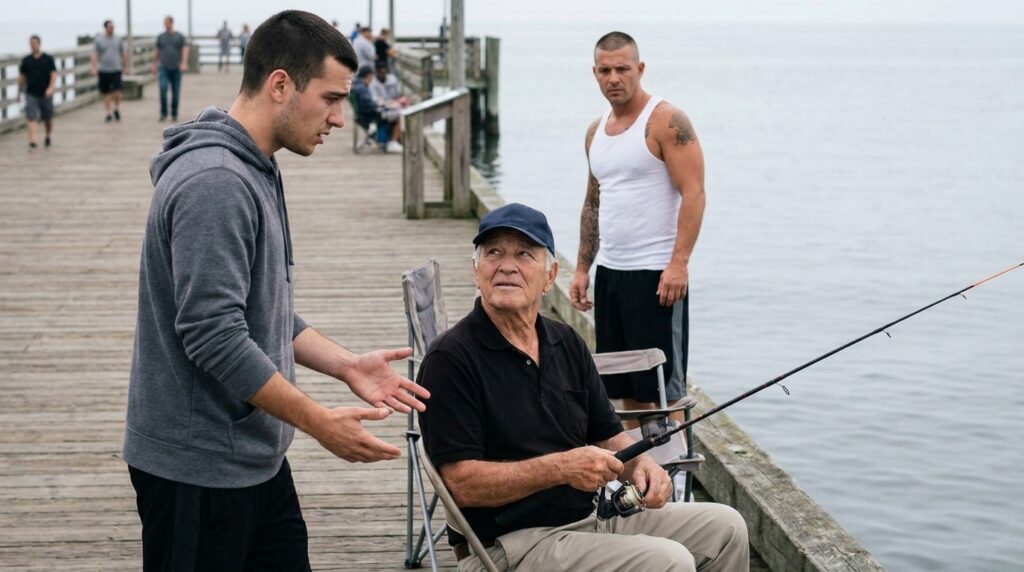
The words did not drop smoothly into the low-tide heat; they cracked across the open timber planks like a dry hemlock branch snapping under a boot. Jesse was already moving before the final syllable cleared his teeth, his gray fleece hoodie bunching around his collarbones as he swung his weight between Mac’s aluminum chair and the heavy, tattooed bulk of Miller. His hands were spread wide, fingers hooked over the empty air—not a fighter’s stance, but the clumsy, defensive blocking movement of an unguided boy trying to construct a wall out of pure posture.
Miller didn’t hit him. He didn’t even drop his hands into his pockets. He simply leaned his sternum forward until the white cotton of his tank top was three inches from Jesse’s nose, his thick jaw tightening into a pale ridge that smelled faintly of sour beer and fuel dock grease. Behind them, the second man—the one with the grease-darkened cap who had stayed near the bait shack—shifted his boots by two inches, his shoulder dropping into a slight, predictive lean that Mac recognized from forty years of close-quarter skirmishes.
Mac did not scream an order. He did not let the fiberglass rod rattle against the iron rail. He simply kept his fingers buried in the deep split of the foam handle, tracking the faint, rhythmic pulse beneath his soles—the three short clicks of the sub-surface array, regular as a dead man’s watch, vibrating through the creosote pilings.
“You don’t know who you’re talking for, kid,” Miller said, his voice dropping into a flat, level rasp that barely carried over the lapping of the water against the green timber. “The old man doesn’t need a shadow. He’s been clogging up this end of the rail since the spring thaw, and his bucket’s always empty. We got six lines to drop before the slack water ends. Move your skin.”
Jesse didn’t give an inch. His sneakers squeaked on the salt-damp pine, his eyes darting toward Mac for a split second—a quick, desperate appeal for verification, for the historic validation he had read into an old log or a piece of family kitchen-table gossip. He wanted the uniform to appear. He wanted the medals to rattle in the pocket of the old black polo shirt.
“I know exactly who he is,” Jesse said, his throat tight, his ribs expanding hard against the gray fleece. “My father was on the Vance. He told me what happened at the intercept. He told me who stayed on the deck when the lines parted.”
A cold, dead weight settled behind Mac’s ribs. The boy wasn’t just a stray. He was an inheritance.
The blue sedan at the foot of the gravel path didn’t start its engine, but the dark horizontal slit of the driver’s window slid down another inch, the black void within the glass framing the pale, featureless shape of a hand lifting an old-model brick radio to a mouth. The antenna caught the morning glare for a micro-second, a sharp silver needle cutting through the salt-cedars.
Mac let his breath out through his mouth, his tongue tracking the dry salt on his lips. The boy had just cracked the decoy wide open in front of the wrong ears. The whole pier was an ear. Every rusted bolt in the structural framing was tied to something that didn’t care about old sailors or the sons they left behind.
“Jesse,” Mac said. The name was small, but the gravel-scraped tone of it made the boy’s shoulders jump. “Step back from the rail.”
“But sir, he’s—”
“I said step back.” Mac didn’t look up at him. He kept his gaze locked on the small, lead sinker resting on the wood beside his boot—a three-ounce egg of oxidized zinc that had turned the color of an old tooth. “The fish aren’t under the wood today. They’re out in the channel. You’re wasting your bait on the pilings.”
Miller let out a short, wet grunt that was half-laugh, his heavy shoulders dropping as he read the old man’s compliance as simple fear. He reached down, his thick, scarred fingers gripping the top bar of Mac’s folding chair with a casual, crowding pressure that threatened to tilt the aluminum frame into the iron rail. “Listen to the grandfather, kid. He knows when the tide’s too heavy for him.”
The second man by the bait shack took three long, unhurried strides forward, his hand slipping into the loose pocket of his windbreaker where something heavy and square—too square for a knife, too flat for a standard reel—made the nylon sag.
Mac felt the bronze key in his own pocket press against his hip bone as his weight shifted. The notches were cold against his skin through the fraying canvas of his pocket lining. The false bottom of the green steel tackle box was only four inches from his heel, the purple-inked courier log sitting behind the lead weights, a direct trail that went straight back to the destroyer that had supposedly been scrapped in a Taiwan yard twenty years ago. If they touched the box, the whole line would unravel before the tide could clear the mouth of the river.
He didn’t move his hand toward his pocket. He didn’t look at Miller’s knuckles where they clamped the aluminum rail of his chair. Instead, he looked at the gap in the decking between his boots—a half-inch space where the wood had rotted away around a massive iron drift-pin. Down in the dark green wash, ten feet below the slime line, a heavy copper ground wire ran straight down the side of the piling, its insulation stripped away in neat, three-inch bands to let the salt water complete the circuit.
The triple pulse came again. Three short. A long void. Then the heavy, thrumming hum that made the monofilament line sing its high, clear note.
“Jesse,” Mac said, his voice dropping into that rhythmic, institutional cadence that had once cleared the lower decks of the DD-882 during a fire in the magazine. “Take your buckets and go back to the asphalt. Now.”
The boy looked down at him, the earnest certainty in his face fracturing into something small and confused, his mouth opening to subvocalize a protest that never came. He saw Mac’s eyes then—not the cloudy, fading gaze of an eighty-year-old pensioner, but the cold, slate-gray stare of a man who had spent forty years looking through the fog for things that were designed to kill him.








