
CHAPTER 2: THE TEXTURE OF SILENCE
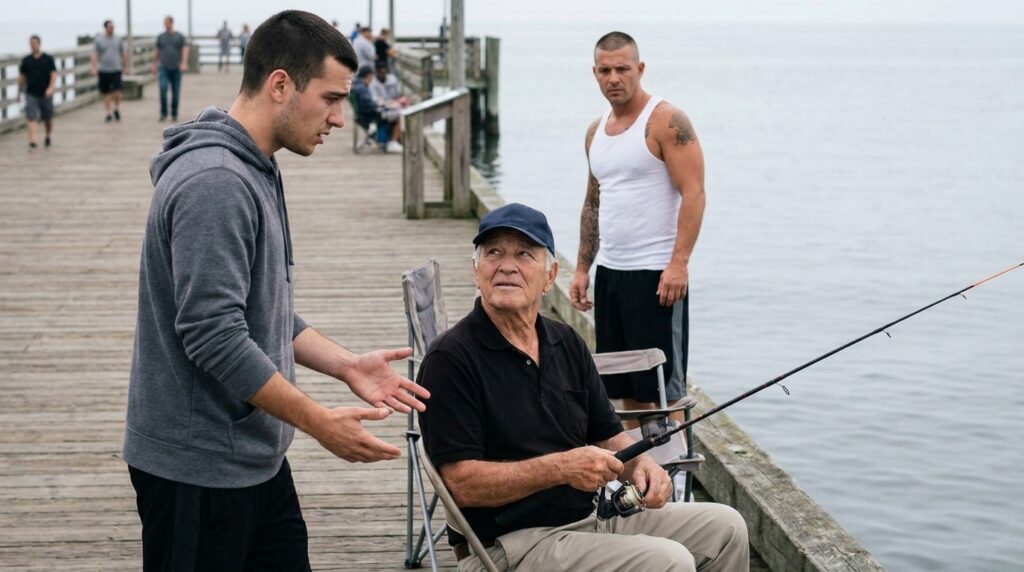
The silence that followed Mac’s voice didn’t rise from the river mouth; it seemed to drop from the iron girders of the bridge half a mile upstream, heavy and damp, pressing the heat back down into the river-mud. Miller didn’t speak. A man like that—built out of cheap gym weight and the easy authority of small-town docks—understood the physics of a threat long before he understood the words. He looked at Mac’s right hand. It wasn’t balled into a fist. It was simply wrapped around the vintage fiberglass fishing rod, his knuckles the color of salted tallow, the thumb anchored in the deep split of the foam grip with a stability that suggested thirty years of grey sea.
Miller’s shoulder dropped first. The movement was small, a single inch of deflating muscle beneath the thin cotton of his white tank top, but it was enough to change the air between them. He didn’t look at the younger boy in the hoodie either; he looked down at his own work boots, his tongue tracking the inside of his lip as if searching for a taste he had forgotten.
“Yeah,” Miller muttered, his voice flat, stripped of the heavy timber it had held thirty seconds ago. “Whatever. Fish are biting small anyway.”
He turned on his heel, his left boot heel catching the edge of a rusted iron cleat with a short, metallic chime that sounded like a small bell ringing underwater. His associate, the silent one who had stayed five paces back in the shadow of the bait shack, didn’t wait for him. They moved down the pier together, their strides long and uneven, their boots drumming a hollow, double-time rhythm against the loose pine planks until the sound lost its edge against the wider rumble of the highway behind the marsh.
The boy in the gray hoodie remained. He hadn’t dropped his hands yet; they stayed up, fingers slightly curved, like an actor who had forgotten his next position after the curtain had already started to fall. His breath came fast, the gray fleece of his chest rising and falling against the pale, low-slung sun.
“You didn’t have to do that, sir,” the boy said. He took a half-step back, his eyes tracking the sharp line of Mac’s jaw, then down to the faded navy blue cap pulled low over the old man’s brow. “I had him. Those guys from the fuel dock, they think they own the deep water. My name’s Jesse. My dad—he always said guys from your unit didn’t take grease from anyone.”
Mac didn’t answer. He didn’t offer his hand, nor did he look into the boy’s face long enough to let the connection stick. He let his weight sink back into the aluminum frame of the folding chair, the metal tubes giving a low, familiar groan as they took his lean bulk. The world was full of Jesses—earnest, soft-skinned boys with too much history in their heads and not enough salt in their blood, looking for old men to turn into stories they could carry around like pocketknives.
“Your line’s slack,” Mac said, his chin jerking toward the water.
Jesse looked down at the river, his mouth half-open as if he wanted to pull another sentence out of the air, but the cold weight of Mac’s stillness stopped him. He nodded once, a sharp, jerky movement of his neck, and retreated four paces to his own bucket, his movements quiet now, his fingers clumsy as he picked up his reel.
Mac waited until the boy’s back was turned before he reached down to the left side of his chair.
The tackle box was a heavy, three-tiered steel cabinet from the late sixties, its green enamel long since scrubbed away by sand and bilge water until only the dull gray primer remained. The brass hinges were thick with green verdigris, swollen by forty years of sea air until they required a specific, lateral pressure of the thumb to release.
Mac didn’t open the main lid. He slipped his fingers beneath the canvas skirt he had stitched around the base to keep the lead weights from rattling against the boat decks. His skin brushed against something that didn’t belong to the standard inventory of three-ounce sinkers and rusted swivels. It was a small square of heavy oilcloth, stiff with paraffin, wrapped tight around a hard, notched shape.
He didn’t look at it. His fingers knew the shape by heart: a short bronze key with three square teeth and a drilled eyelet that held a single strand of wire-core cord.
Beneath the oilcloth, where the canvas met the zinc bottom of the box, the structural lining felt thin. Too thin. For three weeks, the bottom layer had felt slightly higher than it should have been—less than a quarter of an inch, just enough to alter the center of gravity when he lifted the box by its leather handle. He pressed his thumb against the metal plate behind the lower tray. It didn’t give, but through the iron-pitted wood of the pier planks beneath his boots, he felt a vibration that had nothing to do with the incoming tide or the diesel trucks on the bridge.
It was a triple pulse—short, dry, regular as a clock—traveling up through the green pine pilings from the deep silt forty feet below the rail.
Mac closed his hand around the bronze key, his thumb tracing the notches until the metal bit into his skin. He looked over his shoulder at Jesse, who was leaning over his line, his eyes fixed on the gray water with the intense, vacant devotion of the young. Beyond him, at the foot of the pier where the asphalt met the gravel, a dark blue sedan with government plates and no dealer markings was idling under the salt-cedars, its exhaust rising in a thin, blue smudge against the marsh grass.
The car had been there since five. It would stay until the sun cleared the top of the bridge girders, and then it would move to the boat ramp three miles south.
Mac pulled his hand out from beneath the canvas skirt, his palm empty now, the key tucked back into the dark seam of his pocket. He took the fiberglass rod in both hands, checking the tension of the drag with a short, three-inch pull of the line. The monofilament hummed, a high, clear note that cut through the low hiss of the river.
“Jesse,” Mac said, his voice flat against the wind.
The boy turned instantly, his gray hood falling back from his ears. “Yes, sir?”
“Go up to the shack. Get two packs of salt-herring. The heavy brine.” Mac didn’t look back as he spoke, his eyes already returning to the gray line where his lead was anchored in the mud. “And don’t talk to the man in the blue car.”








