
CHAPTER 3: THE WEIGHT OF THE LINING
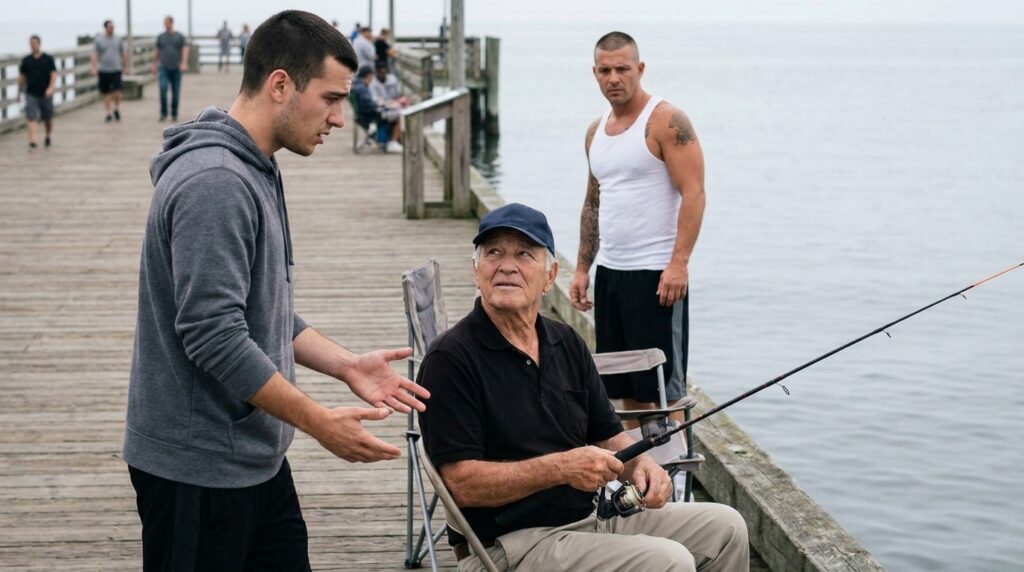
Jesse didn’t run, but he moved with a sudden, eager stiffness that made his gray hood flap against his shoulder blades as he retreated down the long walkway. His sneakers left small, dark wedges of dampness on the gray pine planks where the salt-spray had pooled. Mac didn’t watch him reach the dirt lot where the sedars grew, nor did he look back toward the blue sedan idling by the boat ramp. He simply leaned forward until his forehead almost touched the cold fiberglass of his rod, his eyes fixed on the slackening belly of his fishing line as it sagged with the shifting of the river current.
The tide was nearly flat now. The little slaps against the green timber below had slowed to a long, oily heave, the kind of quiet that usually brought the bottom-feeders out of the deeper mud.
Mac slipped his hand back down into the shadow of his folding chair, his fingers navigating the wet canvas skirt of the steel tackle box by touch alone. The cold brine had begun to stiffen the fabric, making the heavy canvas weave feel like coarse sandpaper against his knuckles. He pressed his thumb against the lower rim of the box where the zinc hull met the brass structural molding. With a small, practiced twist of his wrist, he didn’t lift the tray—he slid the entire secondary compartment sideways, a fraction of an inch at a time, until the internal latch gave a soft, oily click.
Inside the false bottom, beneath three layers of lead sinkers that smelled faintly of tallow and oxidized tin, lay a second layer of stiff oilcloth. This wrapper was older than the one holding the key. The paraffin had turned white and flaky along the creased edges, dusting his fingers like dried salt when he pulled the corner back.
It wasn’t paper inside. It was a bound log—thin, twenty pages at most, bound by three rusted copper staples that had left dark orange stains on the heavy watermarked linen.
Mac opened the first sheet with his thumb, his gaze remaining fixed on the water while his fingers mapped the raised lettering of the navy registry mark at the top of the page. He knew the sequence without looking: DD-882, Command Courier Log, September 1984. His mind didn’t drift back to the engine room or the grey rollers of the North Atlantic; it stayed right here on the wooden rail, tracking the physical vibration that continued to pulse through his boots—three short beats, a long pause, then three more.
The ink on the page was purple, the fading dye of an old spirit duplicator that had survived four decades in a dark drawer. His eyes dropped to the line items under the third watch column. A single name was scratched in the margin with a fine-point ballpoint pen, the letters small and hurried, as if written while the ship was pitching in heavy seas: V. Vance – Courier First Class.
Mac took a slow, deep breath of the low-tide air. Vance.
He looked down the length of the empty pier toward the small white shack where the salt-herring was kept. Jesse was standing by the screened door, his hand raised to shield his eyes from the glare of the water as he waited for the clerk to open the freezer locker. The boy had the same slight hitch in his left shoulder that the older Vance had carried when he came down the ladder into the command room with the leather dispatch bag chained to his wrist. A family shape, preserved across forty years of land-locked life, showing up on a dilapidated public dock three states away from the nearest naval shipyard.
The blue car by the cedars didn’t move, but the driver’s side window slid down three inches, a dark horizontal slit breaking the smooth reflection of the marsh grass on the glass.
Mac closed the log, his fingers sliding the oilcloth wrapper back into the zinc groove until the latch re-engaged with a dry, metallic snap. The weight of the box felt different now—not heavier, but off-center, the internal balance altered by the simple fact of his knowing what lay behind the lead weights. He didn’t feel the small, human satisfaction of a mystery solved; he felt only the familiar, cold tightening in his stomach that usually preceded a shift in the wind during a late-season gale.
The boy hadn’t just stumbled onto the pier to watch an old man fish. He had been brought here by an old ledger, or by a name dropped over a kitchen table in a house that smelled of old uniforms and damp wood.
A shadow broke the light on the water to his left. A common tern dropped from the telephone wires by the road, its wings folding into a clean gray V as it hit the surface without a splash, rising a second later with a three-inch silverside twisting in its beak. Mac watched the bird carry its meal toward the salt-cedars, its flight heavy and low against the rising heat of the morning.
He reached into his pocket and pulled out the notched bronze key, his thumb finding the three square teeth again. The wire-core cord was stiff, the metal strands inside the braided nylon starting to rust through where the salt had found a gap in the plastic coating. The key didn’t belong to any lock on his tackle box, nor did it fit the small padlock on the bait shack at the foot of the hill. It was an ordnance key, the kind used to clear the manual override switches on the old underwater tracking stations along the coastal shelf before the satellites took over the watch.
He looked down at the wooden planks beneath his feet, tracing the grain of the pine until it disappeared under the green scum of the water line. The pilings weren’t standard telephone poles; they were heavy timber balks, twelve inches square, treated with creosote that still smelled like coal tar when the sun hit them straight on. They went down deep into the mud, deep enough to anchor something more permanent than a public walkway for weekend fishermen.
Jesse was coming back now, carrying two white plastic tubs of brine-herring against his chest, his boots making a quicker, more rhythmic sound against the wood as he hurried to beat the incoming heat. Mac tucked the bronze key back into his pocket, his hand lingering on the frayed wool of his trousers until his fingers were completely still.
“Got the heavy brine, sir,” Jesse said, stopping two paces back, his face flushed under the gray hood. He set the tubs down with a wet splash that sent a circle of gray salt-water across the planks. “The guy in the car—he didn’t say anything. He just watched me walk past the grill.”
Mac didn’t look up from his line. “He’s paid to watch, son. Sit down and bait your hooks. The water’s about to turn.”








