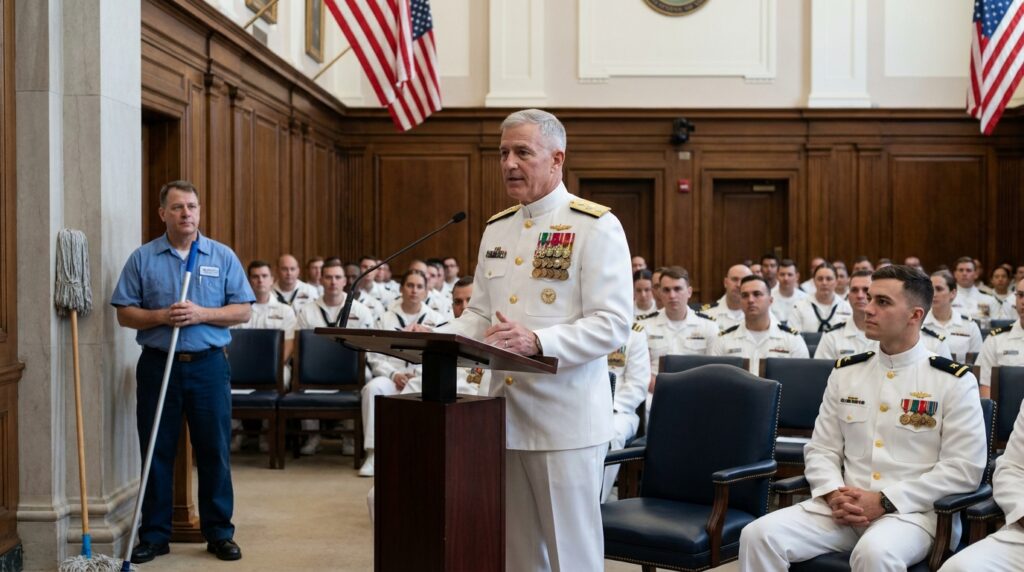
CHAPTER 5: The Red Ink of the Ledger
The station log didn’t arrive on a digital screen. Master Chief Halloway stepped across the stage with a thick, leather-bound binder, its corners reinforced with tarnished brass plates that had turned a dull, greenish-brown from years of exposure to salt fog. When he set it down on the speaker’s lectern, the heavy thud of the paper sounded like a hatch slamming shut in a flooded compartment.
“Open it, Ensign,” Captain Vance said. His hand remained at his side, his fingers brushed flat against the seam of his white trousers, completely motionless. His voice had lost its conversational edge; it was now a hard, mechanical command that left no room for hesitation.
Miller’s fingers felt stiff, almost wooden, as he reached toward the stage. The starch in his cuffs scraped against his wrists, a small, irritating friction that matched the burning heat climbing up his neck. He pulled the heavy cover back. The pages within were written by hand, a dense column of black ink records detailing every engine repair, every fuel transfer, and every midnight shift change across the lower sectors for the last fifteen years.
But halfway down the projected section of the log, the ink changed. A thick line of crimson water-resistant dye had been drawn across an entry dated twelve years ago. Beneath the red marker, the handwriting changed from the precise, geometric characters of a log clerk to a rough, sprawling script that Miller recognized instantly from the manual override file.
“Look at the entry for the third-alpha line recovery,” Vance said, his eyes drilling into the top of Miller’s cap. “Read the notation under the red line.”
Miller cleared his throat, but the sound was thin, swallowed instantly by the high, vaulted ceiling. “The system experienced a secondary pressure drop during the retrieval phase. Command authority re-routed to logistics wing to prevent structural failure of the main terminal block. The active commander accepted the administrative re-rating to clear the operational line.”
“To clear the operational line,” Vance repeated, his tone dropping into a dangerous whisper that reached the furthest rows of the auditorium. “Do you know what that line was carrying, Miller? It wasn’t oil. It wasn’t fuel. It was a fiber-optic telemetry loop from an experimental towed array three hundred feet below the shelf. A loop that had wrapped itself around a localized sea-valve because a junior officer on the bridge had miscalculated the drift vector by forty yards.”
Miller felt the breath catch in his throat. He looked up from the ledger, his gaze involuntarily tracking toward the deep shadow beneath the lower projection booth. John Garret hadn’t shifted his posture. He was still holding the mop handle vertical, his eyes fixed on the floorboards, his face caught in that same flat, unreadable calm that had broken Miller’s composure in the east corridor. The old man looked small in the massive hall, but the weight of the red ink on the page seemed to radiate from his position like a physical force.
“The junior officer on the bridge didn’t see his name in that log,” Vance continued, stepping back until his medals caught the direct glare of the morning light through the high windows. The silver campaign stars glinted like ice. “He didn’t see his career dismantled because the active master chief went down into the flooded pump room himself, manually decoupled the telemetry loop from the valve body, and took the administrative hit for the scheduling lag so the district office wouldn’t line-dry the entire unit. The master chief buried his own commendations under a civilian service contract so the station could keep its radar link active during the transition.”
The silence in the rows behind Miller was absolute. Nobody shifted their weight; nobody checked their terminal screens. The unearned entitlement that had carried Miller through the morning inspection—the crisp pride of his unblemished white uniform, the sharp polish of his shoes, the belief that authority was something bought with gold thread—was being systematically peeled away like wet paper.
“You thought he was an obstacle in your transit lane,” Vance said, his hand finally dropping to the leather spine of the ledger. “You thought he was an old man with a bucket who didn’t understand the speed of a modern command. But he was maintaining the foundations of this station while your father was still writing checks for your academy tuition.”
Miller’s hand dropped from the edge of the stage. He stood in the center aisle, his chest heaving slightly beneath the stiff wool of his jacket, his left shoe still caked in the white crust of the dried grease. The world had become very simple, and very cold. He was no longer an officer directing the velocity of a base; he was a boy who had used his newly polished heel to draw a line between himself and a giant.
“The auxiliary log remains open, Ensign,” Vance said, his voice returning to that flat, institutional register that signified the end of a formal review. “And you still have a line to sign before the inspection detail leaves the sector.”