CHAPTER 3: Under the High Rafters
The concrete maze of the logistics wing gave way to the vaulted silence of the ceremonial hall with a suddenness that made the ears ring. Pale morning sunlight cut through the high, salt-encrusted glass panels near the roof, casting long, dusty beams across the rows of dark wooden auditorium seating. The air here was different—less thick with the damp oil of the lower piers, but still carrying that sharp, underlying bite of industrial pine disinfectant that had been scrubbed into the terrazzo floors for forty years.
Ensign Miller slowed his pace, adjusting his cuffs with short, precise tugs as he stepped into the rear aisle. His left boot still left a faint, gray smudge where the grease had killed the polish, but under these high rafters, the small imperfection felt magnified, a dark blemish on an otherwise spotless sheet of paper. He could see the early arrivals from the mid-month inspection detail already scattered throughout the middle rows—mostly junior officers and logistics coordinators, their white dress uniforms gleaming like teeth in the dim, shadowed corners of the hall.
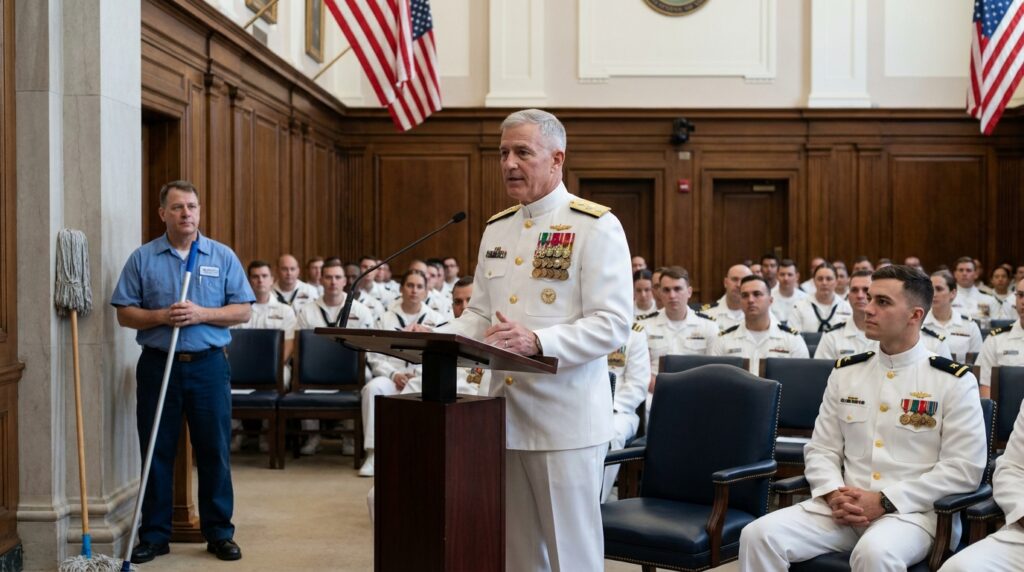
At the far end of the central aisle, the stage was framed by the crisp drapes of the national colors. Standing center stage was Captain Vance.
Even from fifty feet away, Vance’s posture possessed a density that seemed to pull the lines of the room toward him. His white uniform jacket was a heavy canvas of history, weighted down by rows of silver campaign ribbons and heavy medals that clinked softly whenever he shifted his gaze. His gray hair was cut into a regulation skin-fade that left his ears completely bare, emphasizing the hard, unyielding line of his jaw. He was looking down at a ruggedized command terminal mounted on the speaker’s lectern, his thumb tapping the bezel with a slow, deliberate rhythm that Master Chief Halloway copied perfectly from two paces behind.
Miller made his way down the side aisle, keeping his spine rigid, his fingers brushed flat against the seams of his trousers. Every row he passed seemed to bring a subtle decrease in temperature. The casual murmurs of the logistics staff drifted away as he drew closer to the stage, replaced by the heavy, dry rustle of starched wool as eyes began to track his approach. They weren’t looking at his face; they were looking at the left sleeve of his jacket. The faint, gray streak of industrial dust left by John Garret’s shoulder was broad and distinct against the immaculate white fabric.
“Ensign Miller,” Vance said without looking up from the terminal screen. The voice didn’t carry the raw volume of a drill instructor, but it had a deep, resonant friction that traveled through the wooden floorboards under Miller’s feet. “You’re late for the reconciliation assembly.”
“The pier inventory required an extended authorization check, sir,” Miller said, halting at the base of the stage steps and snapping his heels together. The impact made a hollow, flat thud against the terrazzo. “I had to ensure the terminal data was logged before the morning shift cleared the transit lines.”
Vance slowly raised his eyes. They were a pale, faded blue, matching the quality of the light coming through the salt-bitten glass above. His gaze traveled down Miller’s frame, pausing briefly on the ruined finish of his left heel before tracking up to the gray smudge on his sleeve. “The data is already logged, Ensign. In fact, it was logged twice. Once by your terminal at the lower pier, and once by a high-level manual override from the quartermaster’s central node.”
Miller felt the skin across his cheekbones tighten. “An override, sir?”
“A manual entry,” Vance continued, his tone remaining perfectly level, almost conversational. He stepped around the lectern, his heavy leather shoes making no sound against the thick rubber matting of the stage. He reached out, his thumb and forefinger catching the edge of Miller’s sleeve, turning the gray streak toward the light. “A clean, old-fashioned correction made by someone who didn’t need a terminal interface to know the pressure variances on the third-alpha line. Tell me, Miller, do you know what kind of fabric this jacket is made of?”
The shift in topic felt like a missing step on a dark staircase. Miller blinked, his gaze locked on the silver eagles on Vance’s shoulders. “Standard issue wool blend, Captain.”
“It’s twenty-ounce tropical serge,” Vance said softly, letting go of the sleeve. The fabric fell back into place with a faint rustle. “It holds a line beautifully. It resists moisture. But it takes grease like a sponge. It remembers every dirty surface it comes into contact with. Master Chief Halloway, did the custodian finish clearing the east corridor?”
Halloway stepped forward, his face a shadow behind the captain’s shoulder. “He’s standing by at the flank, sir. As ordered.”
Miller turned his head slightly, his eyes tracking Vance’s gaze toward the far left of the ceremonial hall. Standing in the deep shadow beneath the lower projection booth, completely removed from the rows of white uniforms, was John Garret. He was still wearing the faded blue denim utility shirt, his hands resting over the top knob of the vertical wooden mop handle. He stood as motionless as a piece of old timber, his face caught in the pale, dim light filtering through the side exit door. He looked entirely separate from the ceremony, a gray shadow against the white walls, yet his presence felt anchored to the floorboards with the same heavy permanence as the stage itself.
“He doesn’t belong in the assembly, sir,” Miller muttered, the words leaving his mouth before the calculation could stop them. “The civilian maintenance staff is restricted to the service wings during formal reviews.”
Vance let out a short, dry breath that might have been a chuckle if there had been any warmth in it. He turned back toward the lectern, his fingers tapping the glass screen of the terminal one last time. “The civilian staff goes where the command requires them to go, Ensign. And right now, this room requires a very specific kind of cleaning.”
The digital clock on the rear wall of the hall shifted to 0800 with a faint, electronic chirp. The heavy double doors at the back of the auditorium clicked shut, the sound locking the air inside the high rafters as the remaining seats were filled with the sudden, breathless silence of a formal correction in progress.