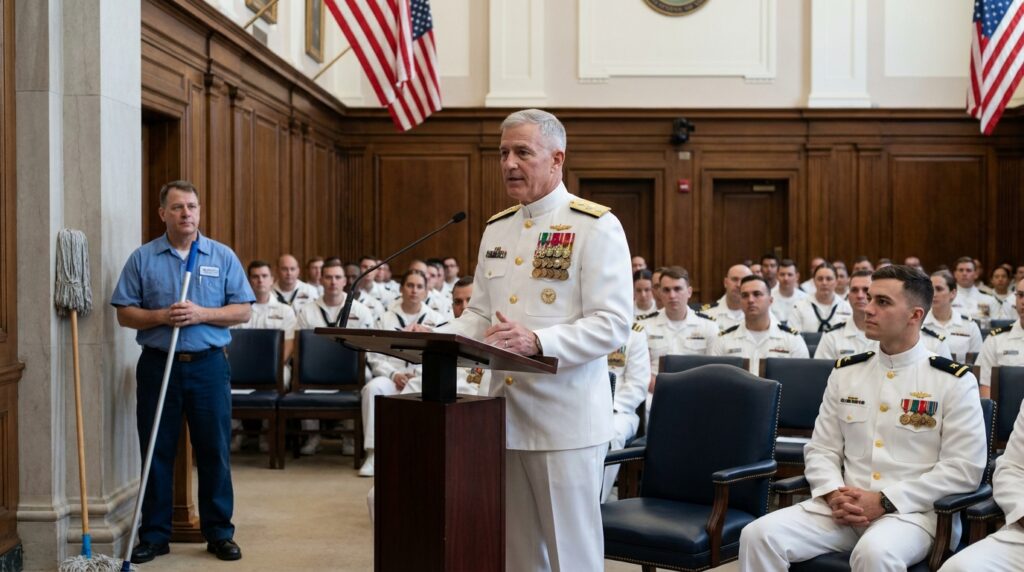
CHAPTER 4: The Anchor and the Line
Captain Vance did not move his feet from the center of the rubber stage matting, but his shoulders shifted, causing the dense clusters of silver ribbons on his chest to clink with a cold, metallic sharpness. The sound traveled across the polished terrazzo floor, slicing cleanly through the thick silence that had settled under the high rafters of the ceremonial hall. Every junior officer in the front rows sat completely rigid, their hands pressed flat against the crisp wool of their thighs, their breathing shallow.
“Ensign Miller,” Vance began, his voice dropping into the lower registers of the room like a sounding weight. “Read the inscription on the lintel behind you.”
Miller did not turn his back on the commander. His jaw remained locked, a faint muscle twitching beneath the pale skin of his cheek. He had walked past the bronze letters a hundred times since arriving at the station, their edges dulled by years of coastal humidity and layers of industrial cleaner. “Integrity is the bedrock of command, sir.”
“Integrity,” Vance repeated. The word left his mouth without force, yet it felt heavy, a brick dropped onto a glass table. He stepped closer to the lip of the stage, his pale blue eyes reflecting the cold sunlight cutting through the salt-encrusted overhead panels. “A clean word. Easy to print on a ledger. Very easy to memorize for a final exam at Annapolis. But a ledger is just paper, Ensign, and paper doesn’t have to carry the weight of a hull when the seams begin to weep.”
Vance reached down to the terminal screen on the lectern, his thumb sliding over the side casing. With a dry tap, he brought up a single document, projecting its data onto the broad white wall behind the stage. It wasn’t the logistics manifest Miller had filed an hour ago. It was an archival personnel log from twelve years past, its columns marked with high-level encryption stamps that had been stripped away by an administrative override. The name at the top of the file was Garret, J., but the title beside it was not civilian maintenance staff. It read: Master Chief Petty Officer, Subsurface Reconnaissance Division.
A low, collective rustle passed through the auditorium rows—the sound of forty starched white uniforms shifting against wooden seats. Miller’s gaze darted from the wall back to the captain’s face. The coldness at the base of his neck turned into a sharp, localized heat. He looked toward the flank of the room, where John Garret stood in the deep shadow of the projection booth. The old man hadn’t dropped his chin. He remained perfectly still, his calloused palms still resting over the wooden knob of his vertical mop handle, his faded blue utility shirt looking like an old ink stain against the pristine white of the hall.
“You told Master Chief Halloway that the civilian workforce was non-compliant with the standard clearing schedule,” Vance said, his voice dropping an octave, becoming a hard, flat glare. He didn’t look at the projected screen; his eyes were fixed entirely on the gray smudge of dust on Miller’s left sleeve. “You signed a micro-infraction log accusing a station worker of causing a logistics lag because he was wringing out a bucket in your transit lane.”
“He was obstructing the passage during a command shift change, Captain,” Miller said, his voice tightening as he fought to keep his posture from collapsing under the weight of forty pairs of eyes. “The regulations state that service lines must remain clear of debris to ensure operational velocity.”
“The regulations were written by men who expected you to have the intelligence to look at a deck and see the difference between grease and rust, Ensign,” Vance snapped. The sharpness in his tone was sudden, a clean fracture in his composed authority. He pointed a finger toward the projected file on the wall. “Look at the log, Miller. Look at the date of the line-drop on that subsurface reconnaissance unit. Twelve years ago, a master chief with twenty-four years of active-duty sea time was stripped of his command and re-rated because of an administrative failure during a deep-sea recovery operation. The record says he failed to maintain logistics velocity. It says he was non-compliant with the schedule.”
Miller’s tongue felt thick, dry against the roof of his mouth. He could feel the eyes of his peers burning into his profile. “Sir, I wasn’t aware of the custodian’s prior service record.”
“That is exactly your failure, Ensign,” Vance said, his voice returning to that low, terrifying calm. He stepped off the stage matting, descending the three wooden steps until he stood on the terrazzo, less than two feet from Miller’s rigid frame. The smell of high-grade wool and stale tobacco was overwhelming. “You looked at a man in blue denim and assumed his visibility was limited to the width of his bucket. You thought the uniform was what gave you the right to draw a line across the floor. You still have a responsibility to uphold the standards everyone expects from you, Miller. Character matters most, your next decision will define what happens now.”
Vance stopped, his gaze dropping to Miller’s left boot, where the gray grease from the east corridor had dried into a dull, white crust over the leather finish.
“Master Chief Garret didn’t break that hydraulic seal this morning,” Vance whispered, the words intended only for the space between them, yet carrying across the silent hall like an iron chain sliding through a hawsepipe. “He spent three hours in the crawlspace holding the backup bypass valve with his bare hands so the command terminal wouldn’t lose its link to the coastal radar grid. He did it while you were checking the inventory on the lower pier with a digital pencil.”
Miller felt the floorboards seem to tilt beneath him. The pristine, orderly structure of the base, the sharp hierarchy he had trusted to protect his authority, had suddenly turned into a mirror that showed every raw edge of his own entitlement. He looked back toward the shadow at the flank of the room, but the old man wasn’t watching him. Garret was looking down at the terrazzo, his expression completely blank, his fingers motionless on the worn wood of the handle.
“Halloway,” Vance called out, his eyes never leaving Miller’s face. “Bring the station log.”