CHAPTER 2: The Adjutants Mirror
The heavy door handle of the adjutant’s office didn’t just turn; it dropped with a heavy, institutional thud that seemed to suck the remaining air out of the long corridor. Ensign Miller didn’t move his boot from the dry boundary of the grease ring. His posture remained locked, a product of four years of parade-ground drilling that instructed him to treat every sudden noise as a test of structural composure.
Through the opening came the scent of stale tobacco and high-grade wool—the specific olfactory signature of Captain Vance’s immediate circle. It wasn’t the captain himself who stepped into the dim, flickering light of the transit lane, but Master Chief Halloway, a man whose skin looked like it had been cured in the salt flats of San Diego and whose uniform creases were sharp enough to cut paper. Halloway didn’t look at the wet crescent Garret was drawing across the floor. He didn’t look at the smudge of gray grease that had permanently dulled the mirror-finish on Miller’s left heel. He kept his eyes fixed entirely on the polished brass of Miller’s belt buckle.
“Ensign,” Halloway said. The word was flat, lacking the sharp bite of a typical disciplinary note, which made it infinitely worse. It had the dry, rhythmic cadence of a machine issuing a low-priority error log. “The administrative terminal in the secondary quartermaster’s office is experiencing a line-drop. You were assigned the morning reconciliation log for the station’s civilian service allocations.”
“I was processing the inventory on the lower pier, Master Chief,” Miller said, keeping his chin level, his eyes tracking a small water stain on the bulkhead just over Halloway’s left shoulder. “The civilian staff here has been… non-compliant with the standard clearing schedule. I was adjusting the transit boundaries to ensure the morning detail isn’t disrupted by logistics lag.”
“Is that what you call it?” Halloway shifted his feet slightly, the leather of his shoes making a low, dry rasp against the dry linoleum. He turned his head by a fraction of an inch, his gaze finally dropping down to the middle-aged man in blue denim who was currently wringing out his mop into the plastic bucket. The sound of dirty water hitting the strainer was loud—a wet, heavy crunch that filled the space between the three men like an uninvited witness. “Garret. You behind on the bulkhead seals again?”
John Garret didn’t look up from the bucket. He gripped the iron lever of the ringer, his forearm muscles knotting beneath the faded denim sleeve. A small, pale white scar ran across his wrist, disappearring under the cuff—a thin, puckered line that didn’t look like an industrial accident. “The pressure valve on three-alpha is weeping, Master Chief. It’s taking more time to pull the grease out of the seams than the log allowed.”
“The log is the log,” Miller interrupted, his voice hardening as he felt the subtle, unwritten shift in the room’s gravity. Halloway wasn’t correcting the janitor; he was listening to him. That wasn’t how the chain worked. Not according to the textbooks Miller had memorized until his eyes bled. “If the civilian workforce cannot maintain the timeline, the maintenance contract needs to be re-evaluated by the district office. I’ve already noted the delay in the auxiliary log.”
Halloway didn’t answer right away. He reached into his breast pocket and pulled out a small, lint-covered terminal, its glass screen scratched at the margins from years of desk friction. His thumb slid across the casing with a faint scritch. “The auxiliary log is locked, Ensign. Captain Vance pulled the primary terminal data fifteen minutes ago. He didn’t like the way the numbers were matching up against the port authority’s arrival manifest.”
Miller felt a cold, metallic prickle start at the base of his neck. “The Admiral?”
“The Captain,” Halloway corrected instantly, his tone dropping an octave. “And when the Captain overrides a logistics log, he usually wants to see the person who signed the bottom line. He’s in the ceremonial hall. They’re setting up for the mid-month inspection brief. He wants you there five minutes before the bell.”
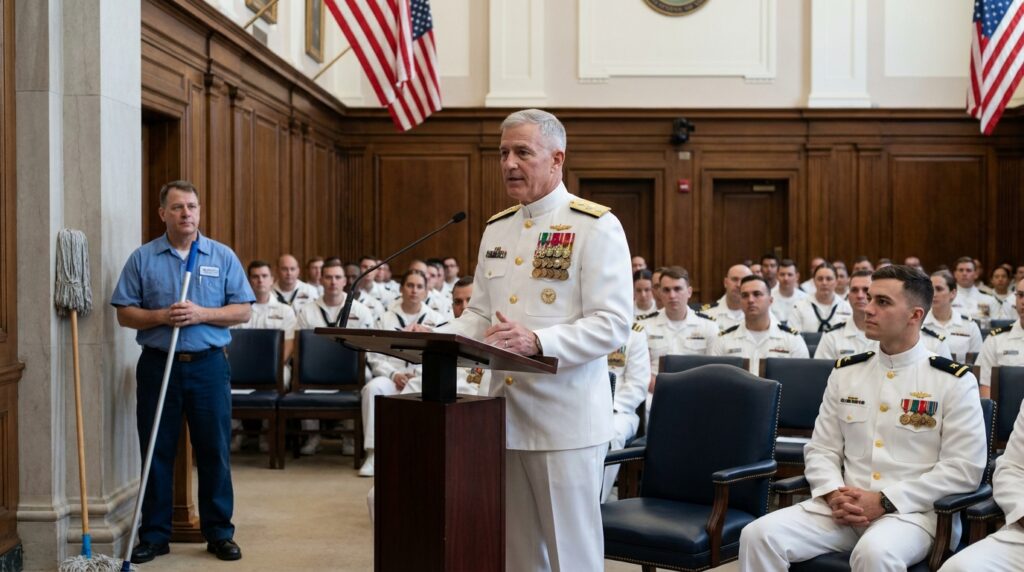
The old custodian let go of the ringer lever. It snapped back into place with a dull, echoing clack that sounded like a small firearm discharging in an empty cistern. Garret didn’t say a word, but as he moved his bucket back toward the wall, his shoulder brushed against Miller’s white sleeve. It wasn’t a hard impact—just the heavy, coarse friction of work-worn denim against premium military wool—but it left a faint, gray streak of industrial dust across the pristine white cloth of the Ensign’s arm.
Miller’s hand twitched toward his hip, his fingers curling into a tight, white-knuckled fist. “Watch your clearance,” he snapped, the words slipping out before he could check the rhythm of his breathing.
Garret stopped, the wooden handle of his mop tilted slightly backward. He looked at the gray streak on Miller’s arm, then up at the Ensign’s face. For the briefest second, the old man’s mouth twitched at the corner—not a smile, but a tiny, muscle-deep contraction of absolute, weary recognition. He didn’t apologize. He simply turned back to his bucket and continued down the corridor, his boots leaving a faint, damp trail of gray pine oil behind him.
“Ensign,” Halloway said, his voice cutting through the smell of the disinfectant like a dull knife. “The hall doesn’t wait for a brush-down. Move.”
Miller turned on his heel, his ruined left shoe catching the light as he moved away from the frosted glass of the office window. He could feel Halloway’s eyes on his back, a weight that felt remarkably like the pressure of a small, unseen lens tracking his every step through the concrete maze of the base.