CHAPTER 8: THE RECKONING OF THE LINEN
The heavy, white utility chassis of the county environmental vehicle didn’t make a sound as its tires stopped against the limestone curb. The engine died with a sharp pneumatic hiss that cut cleanly through the dense, desaturated heat of the afternoon. A technician wearing a lime-green safety vest and black nitrile gloves stepped out, carrying an empty glass sampling jar with a Teflon-lined cap. He didn’t look at Arthur, and he didn’t look at Vivian. He went straight to the base of the third privet hedge where the dark, oily puddle had ceased its bubbling and now lay stagnant—a black, iridescent eye staring out from the gray clay.
Arthur stayed entirely still. His bare shoulders were dry now, the salt lines from his labor crystallized into fine white tracks across his tanned skin. His left hand slowly reached to his waist, pulling the canvas-wrapped blueprint out from beneath his work shorts. The linen paper didn’t crackle this time; the humidity had made it soft, limp, like an old shop towel that had absorbed too many years of grease.
Officer Miller took the paper from Arthur’s palm. His stocky fingers were steady as he carried the slate-blue blueprint over to the hood of the cruiser, his silver mechanical pencil tracing the final, hand-drawn purple line that sliced straight through the center of the continuous concrete curb.
“The registry is clean, Miller,” Vivian said. Her voice didn’t rise above the low hum of the technician’s portable generator. She stood with her hands flat against the thighs of her trousers, her late husband’s oversized gray work shirt hanging off her frame like a shroud. The short blond hair that had spent months serving as her crown was plastered flat to her temple by sweat. “George filed the ninety-four update himself. He spent three weeks in the courthouse basement verifying the tract indexes before the development board closed the accounts.”
“He didn’t verify the tract indexes, Vivian,” Arthur said. He walked over to the front of the Ford Explorer, his bare feet sinking into the dead fescue. He pointed his thumb down toward the irregular, bulbous belly of the buried concrete wall. “He hid the discharge bypass. The old plating works didn’t just shut down; they left twelve hundred gallons of hazardous plating sludge in the main collector cistern under the ridge. When they graded the lot for your foundation in seventy-two, George intercepted the line. He built that continuous curb to keep the arsenic and trichloroethylene from seeping into your cellar walls, and he pushed the grade two feet onto this lot so the overflow would pool under my hedges instead of his.”
Vivian’s mouth opened, her fingers clawing at the blue embroidery of the G.B. initials on her pocket. Her clipboard—the old plastic tool she had used like a shield to intimidate every delivery driver and contractor who crossed her path—slid out from under her arm and hit the stone gravel with a dull, hollow clack. The yellow pages scattered across the property line, their neon ink fading instantly under the blinding glare of the noon sun.
She didn’t deny it. She didn’t invoke the HOA board, or the noise ordinance, or the county surveyor. She looked down at the black fluid welling up around the newly driven surveyor’s rod, her eyes wide behind her sunglasses as the truth of thirty years of deliberate, territorial theft lay bare on the dirt.
“The environmental citation is matching the sixty-one code, Miller,” the technician called out, his hand lifting the glass jar to the light. The fluid inside was stratified—a heavy, amber layer of industrial aromatic solvent sitting on top of a dark, zinc-tinted sludge. “This is a priority-one municipal violation under Code Four-Zero-One. The remediation mandate goes to the deed holder of the source alignment.”
Miller turned his head, his sunglasses tracking the line of yellow cones back to Vivian’s porch. “The alignment belongs to the estate, Vivian,” he said quietly, his voice carrying the absolute weight of twenty years of district enforcement. “George signed the maintenance covenant when he took the position with the county engineering department. The cleanup costs don’t hit the township fund. They track the original plat.”
The performance was over. The policing posture, the aggressive hand gestures, the phone recordings, and the collection of falsified notices had entirely dissolved into the heavy, chemical-scented silence of the block. The surrounding neighbors remained on their porches, their faces unreadable behind their screen doors, watching the woman who had spent decades dictating the height of their grass and the placement of their trash bins get forced to sign a formal county containment order at the boundary line.
Vivian took the silver mechanical pencil from Miller’s hand. Her white sneakers were ruined, covered in a thick, greasy crust of the very chemical soil she had spent thirty years hiding from her own basement floor. Her signature on the carbon pad was short, jagged, the pencil lead snapping on the final stroke before she handed the clipboard back to the officer.
She didn’t look at Arthur as she turned away. She walked back toward her house, her stocky frame looking smaller, more bent under the oversized work shirt. She climbed the porch steps with slow, mechanical movements, her sneakers dragging on the concrete before the heavy vinyl screen door clicked shut behind her, cutting off the expensive hum of her air conditioner from the yard.
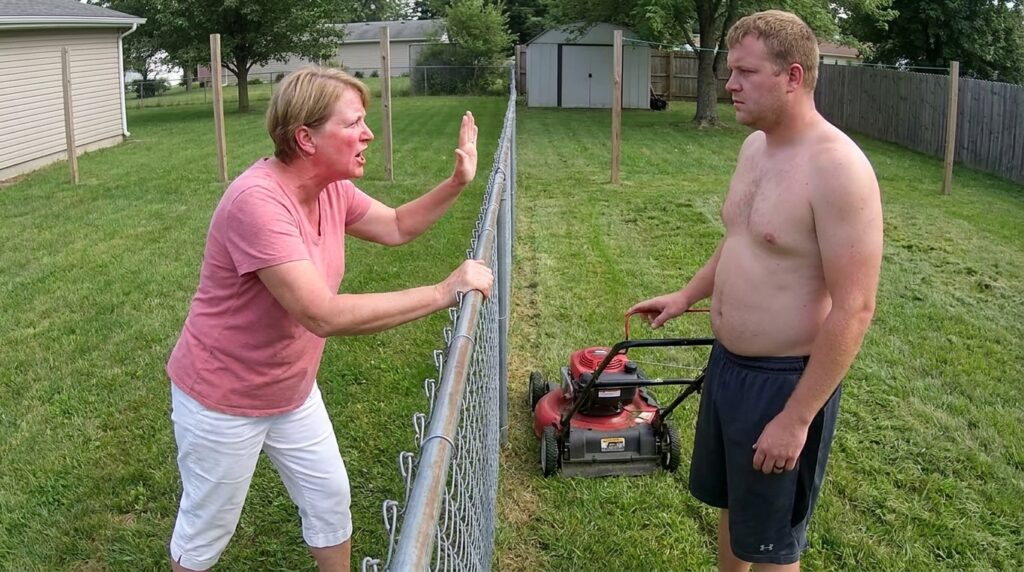
Arthur stood beside his mower. The sun had cleared the top rail of the chain-link fence now, casting no shadows at all on the yard. The land surveyor, Dale, spat another stream of tobacco juice into the gray clay, lifted his five-pound mallet, and drove the final iron marker stake home until its steel head was flush with the native turf.
Arthur reached down, his palm cupping the worn plastic handle of his starter rope. He gave it one short, disciplined pull. The Briggs & Stratton engine caught instantly, its heavy, unhurried roar filling the suburban quiet as he engaged the drive clutch and moved back to his lawn—cutting a clean, straight line across a yard that was now indisputably, legally his.