CHAPTER 5: THE AMBER CODE
The front tires of the Ford Explorer ground into the washed limestone gravel at the edge of the asphalt, sending a sharp spray of white pebbles against the lower panel of Arthur’s mailbox. The wail of the siren died with a wet, gurgling click from the roof-mounted speaker, replaced instantly by the synchronous, low-frequency click of the engine’s valve train. Amber strobe lights cut through the dense midday heat, painting the parched siding of Arthur’s garage in rhythmic, mechanical pulses.
Arthur stayed exactly where he was. His stocky arms remained down, his thumbs lightly hooked into the waistband of his dark work shorts, directly above the stiff edge of the canvas-wrapped linen map hidden against his stomach. He felt the cold sweat on his lower back turn to mud against the foundation dust still coating his skin.
The driver’s door swung open with a heavy, ungreased groan. An officer with graying hair and a faded county patch on his short-sleeved shirt stepped down into the dust, his heavy black utility boots creaking as his weight shifted onto the gravel. He didn’t unholster his sidearm, but his right forearm rested flat against the top of his leather gear belt, a silver mechanical pencil already gripped between his index and middle fingers.
“Arthur,” the officer said, his voice flat from twenty years of directing traffic around blown truck tires and listening to domestic disputes over unraked leaves. He didn’t look at Arthur’s bare chest; his eyes went straight to the fresh clod of turned gray dirt and the exposed iron pin by the privet hedge. “Vivian says you’re running an unpermitted excavation within thirty feet of a primary residential structure and threatening the shared boundary.”
“I was cutting the grass, Miller,” Arthur said. He didn’t raise his voice to match the low hum of the idling cruiser. He nodded toward the green push mower. “The deck hit the pin. I cleared the sod to see what the blade caught.”
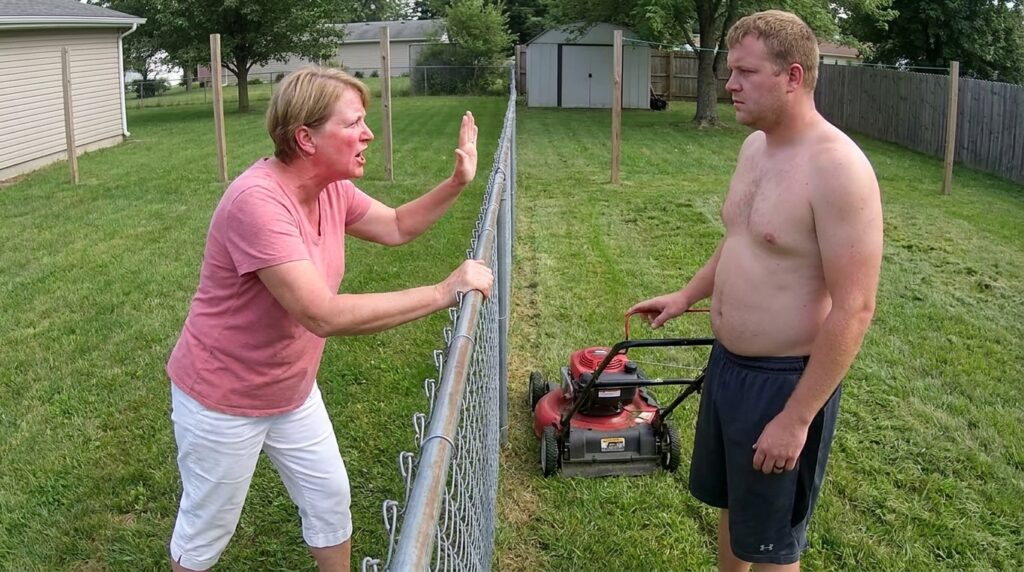
A side window on the neighboring house slid open three inches, the white vinyl frame catching the sun like a mirror. The pink sleeve of Vivian’s blouse was visible through the aluminum screen mesh, her hand holding her cell phone flush against the glass to capture the encounter.
Officer Miller walked down the center of the concrete driveway, his boots leaving faint, chalky tracking marks on the gray slabs. He stopped two feet short of the iron pin, his gaze dropping to the square-headed spike. He knelt with a slow, heavy sigh that smelled faintly of black coffee and engine grease, using the blunt tip of his silver pencil to clear a layer of parched clay from the side of the iron block.
“This is an old corner pin, Arthur,” Miller muttered, his brow furrowing as he noticed the deep, weathered pitting in the metal. He reached into his pocket and pulled a small, laminated district reference card out, comparing the visual layout to the houses. “But according to the township registry from the ninety-four update, the boundary for Tract 4B was adjusted to track the center line of the existing chain-link mesh. If you’re digging west of this line, you’re encroaching on her plat.”
“The ninety-four update didn’t wipe the county registry,” Arthur said calmly, his hand pressing slightly against the canvas bundle beneath his waistband. “It only updated the tax assessment blocks.”
Miller stood up, his knee joints clicking under the weight of his equipment belt. He looked from Arthur to the window where the pink sleeve remained frozen behind the screen. “Look, Arthur, I don’t run the recorder’s vault. I handle the peace. Right now, she’s got a filed complaint on the screen about neighborhood harassment and equipment noise during restricted hours. If that hole stays open and that mower stays on the line, I have to write a municipal citation for public nuisance.”
The failure was small, but it was absolute. Arthur’s reliance on the old iron spike had run squarely into the hard wall of current administrative routine. The system didn’t care about sixty-year-old iron driven into the dirt; it cared about the active database on the cruiser’s terminal screen.
“Check the terminal,” Arthur said, his voice dropping an octave as he stepped closer to the edge of the driver’s door, his stocky frame blocking the view from Vivian’s window. “Run the section under the old Valley Drainage Authority index. Not the HOA block. The infrastructure overlay from sixty-one.”
Miller paused, his silver pencil freezing against his notepad. His eyes narrowed, searching Arthur’s face for the usual signs of neighborly spite or erratic legal theories. Finding only the quiet, hard certainty of a man who worked with levels and transit lines, the officer turned back toward the cruiser, his heavy boots crunching against the loose stone as he reached through the open driver’s window to activate the ruggedized Mobile Data Terminal on the dashboard.
The blue glow of the screen washed over Miller’s lined face, the system humming as it accessed the older county mainframe. For forty seconds, the only sound in the yard was the rhythmic, amber flash of the roof strobes and the distant, dry rattle of a cicada in the oak trees. Then, the officer’s hand stopped moving across the rubberized keyboard.
“Arthur,” Miller said, his voice changing, losing its casual, small-town cadence as he stared at the red warning codes beginning to populate the bottom of his terminal screen. “Where did you get that index number?”
Before Arthur could answer, a loud, wet pop echoed from the base of the third privet hedge. A dark, oily bead of stagnant, black fluid began to well up from the loose earth around the exposed iron spike, its smell hitting the hot afternoon air with the unmistakable, sour stench of industrial solvent and old zinc-plating chemicals.