CHAPTER 6: THE UNROLLING OF THE PLAT
“Keep back from that edge, Miller,” Arthur said, his hand moving to his waistband. He didn’t pull the canvas bundle out with a flourish; he extracted it slowly, keeping his body positioned between the open police vehicle and the neighboring kitchen window where the pink fabric of Vivian’s shirt remained plastered to the mesh. “The fluid isn’t raw sewage. That’s industrial solvent. Smell the sulfur? It’s been sitting under the frost line for thirty years.”
Officer Miller took two steps back from the bubbling iron pin, his heavy leather duty boots crunching into the loose limestone gravel of the driveway. His face had lost its casual, small-town indifference. The blue glow of the dashboard terminal was still reflecting in his sunglasses, showing a column of flagged red municipal codes that hadn’t been accessed since the county drainage infrastructure was restructured back in the early seventies.
“What is that paper, Arthur?” Miller asked, his hand dropping back down to his utility belt, his fingers tapping nervously against his flashlight casing.
“The original Valley Drainage Authority map,” Arthur said, stepping toward the front of the Ford Explorer. The hood was baking under the direct July sun, the heat waves shimmering off the white enamel and smelling of hot radiator fluid. He unrolled the stiff, oil-hardened canvas package across the steel surface, using two rusted tire irons from his garage floor to pin the corners down against the wind. “The ninety-four update your computer is looking at only tracked surface easements for the residential plat. This blueprint shows what’s buried beneath the aggregate.”
The Prussian blue paper crinkled sharply as it smoothed out over the vehicle’s hood, the white line drawings mapping the subterranean reality of the block. Arthur pointed his thumb toward the irregular, hand-drawn purple notations that cut across the boundary line between Tract 4B and his own lot.
“Look at the serial numbers on the infrastructure block,” Arthur muttered, his voice dropping into the steady, transactional rhythm of a diesel mechanic tracing a cracked hydraulic line. “The easement isn’t municipal. It’s a private industrial bypass. Nineteen sixty-one. It ran straight from the old plating shop on the ridge down to the ditch behind our garages. When they built the subdivision in seventy-two, the builder didn’t remove the line; they just told the buyers it was an old drainage tile.”
Miller leaned over the hood, his uniform shirt stretching across his stocky shoulders as his eyes traced the crisp technical lines. His silver mechanical pencil clicked three times as he verified the boundary coordinates against the district index card in his pocket. “If this line is still active under the covenant, the fence line Vivian’s husband put down isn’t just an encroachment, Arthur. It’s an intentional blockage of an industrial right-of-way.”
“It’s not a blockage,” Arthur said, his gaze shifting toward the buried concrete curb beneath the chain-link mesh. “Look at the way the fluid is pooling. It’s coming from her side of the wire, under pressure. He didn’t block the line when he poured that continuous concrete barrier thirty years ago. He diverted it.”
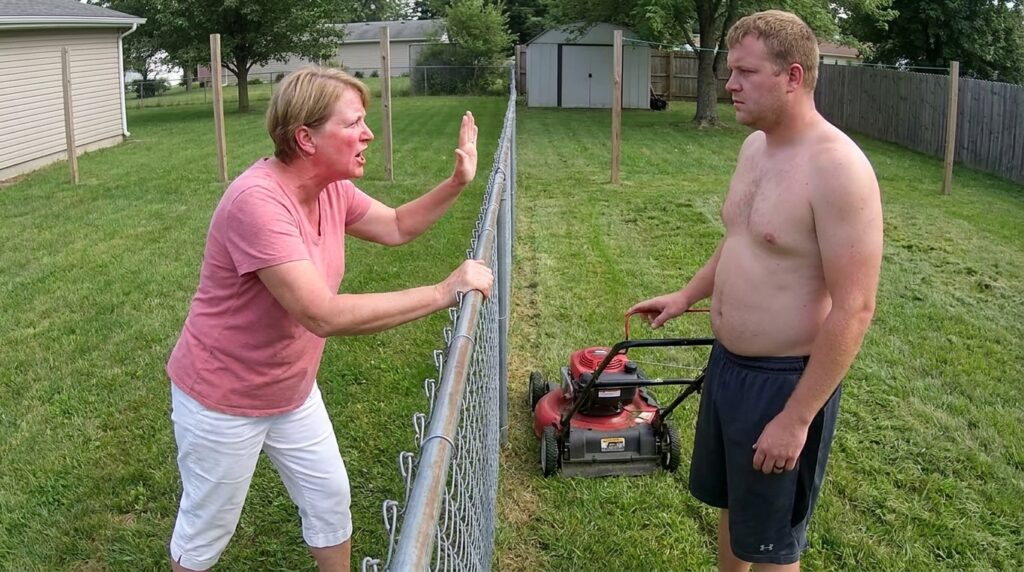
From the neighboring porch, the screen door slammed shut with a sharp, explosive whack that echoed off the aluminum siding of the garages. Vivian was descending the steps, her pristine white sneakers slicing through the black cedar mulch with frantic, short steps. The clipboard was clutched against her chest like a breastplate, her short blond hair catching the glare of the noon sun as she marched toward the front of the police cruiser.
“Officer Miller!” she called out, her voice splitting into a thin, breathless screech that failed to carry the authoritative performance she had used twenty minutes earlier. “That man is showing you fraudulent private documents. My husband worked for the county engineering department for twenty-four years. The boundary line is locked. This property is fully protected by the residential covenant!”
Miller didn’t turn his head to look at her until she reached the front fender of the Explorer. He kept his calloused hand flat on the slate-gray blueprint, his sunglasses hiding his expression as the oily, yellowing sheen of the fluid by the hedge continued to expand, its vinegar-sharp stench beginning to turn the air between the houses completely unbreathable.
“Vivian,” Miller said, his voice dropping into a professional, heavy cadence that signaled an immediate shift in status. “Step back from the vehicle. I need you to go inside and find your husband’s old workspace ledger from the ninety-four restructuring. Right now.”
She stopped dead on the gravel, her white trousers catching a dark splatter of mud from the tire track. Her mouth opened, her hand rising into her familiar, sharp stop gesture, but as her eyes fell on the faded Prussian blue paper unrolled across the hood of the police car, her posture cracked. The clipboard in her hands trembled against her pink blouse, its plastic edge clicking against the metal clip. She didn’t look at Arthur; her eyes were fixed entirely on the purple notary stamp on the blueprint—the exact same seal that marked the bottom of the yellow papers she had been using to threaten his yard.