CHAPTER 3: THE FOUNDATION LOCKBOX
The rhythmic thrum of the diesel engine at the curb vibrated through the spade’s handle, but Arthur didn’t step toward the driveway. He stayed low, dropping the chunk of chemically dead turf back over the exposed 1950s iron spike. A man who spent his life fixing hydraulic lines and setting concrete foundations knew that when a trap was snapping shut, you didn’t look at the sky; you looked at your anchors.
He left the spade leaning against the blistered siding of the garage and walked toward the side of his house, his boots sinking into the dry, uncooperative clay. Behind the row of dying privet hedges, the small, rusted lattice of a foundation crawlspace vent hung by a single sheet-metal screw. He reached down, his fingers catching the rough, oxidized iron scale of the frame, and pulled. The mesh tore away with a dry, fibrous screech, revealing an unlit, cavernous square that smelled of cold silt, dead wood-boring beetles, and ancient lime mortar.
The strobe lights from the curb flashed against the gray concrete of his neighbor’s porch, casting long, fractured shadows across his yard. Arthur dropped to his knees, his stocky frame protesting as he slid his chest through the narrow opening, his bare shoulders scraping against the rough sills of the mudsill. The dark beneath the joists swallowed him whole.
The ground down here was different. It hadn’t seen the sun since the framing crews hammered the subfloor down in the winter of 1956. He crawled on his forearms, the dust rising into his nose with a thick, chalky bite that tasted of zinc and decayed horsehair insulation. His right hand swung blindly through the cobwebs until his knuckles barked against something solid—something that didn’t give like the surrounding dirt or the rotting formwork left behind by the original builders.
It was an old, industrial-grade steel ammunition can, repurposed and half-buried beside the main sewer stack. The original olive-drab paint had long since surrendered to a thick, blistered crust of white mineral salts and orange rust that flaked off under his touch like dried scab tissue. The heavy steel latch was frozen solid by decades of damp earth.
Arthur shifted his weight, his knee driving into the cold silt as he slipped a small, hardened line-wrench from his pocket and jammed the flat end beneath the lid’s seal. He pried upward, his muscles bunching in the tight space. The steel groaned, a sharp, high-pitched fracture of rust echoing between the floor joists as the vacuum broke, releasing a stale, trapped pocket of fifty-year-old air that smelled intensely of graphite, damp laundry, and old lard.
Inside, wrapped in oil-soaked canvas that had hardened into a stiff, greasy shell, sat a small bundle of documents.
He unrolled the stiff fabric with care, his fingers tracing the edges of the thick, fibrous linen paper. This wasn’t standard modern copy sheet; it was heavy blueprint stock from the mid-century, the deep Prussian blue dye faded to a pale, watery slate gray along the crease lines. At the top, printed in blocky, hand-drawn draftsman letters, were the words: Valuation Section Property Maps – Ohio River & Valley Drainage Authority, 1961.
Arthur leaned back until his spine pressed against the rough-sawn bottom of a floor joist, his eyes adjusting to the dim gray light filtering through the open vent. His thumb smeared a trace of black carbon across the bottom corner of the plat map, right where a circular, purple-inked notary stamp had bled through the fiber.
It was an exact duplicate of the stamp he’d spotted on the neighbor’s clipboard twenty minutes ago. But the ink lines on this sheet hadn’t been drawn with a pink grease pencil. These were clean, crisp technical lines drawn with an indelible purple draftsman’s pen, marking an irregular, ten-foot-wide swath that bypassed the official road frontage and sliced directly through the center of both his backyard and hers.
The text beneath the schematic was clear, written in the cramped, precise hand of a long-dead county surveyor: Unregistered Private Easement for Industrial Discharge Diverting to Tract 4B. Subject to perpetual maintenance and non-obstruction by adjacent property owners under Deed Covenant 401-A.
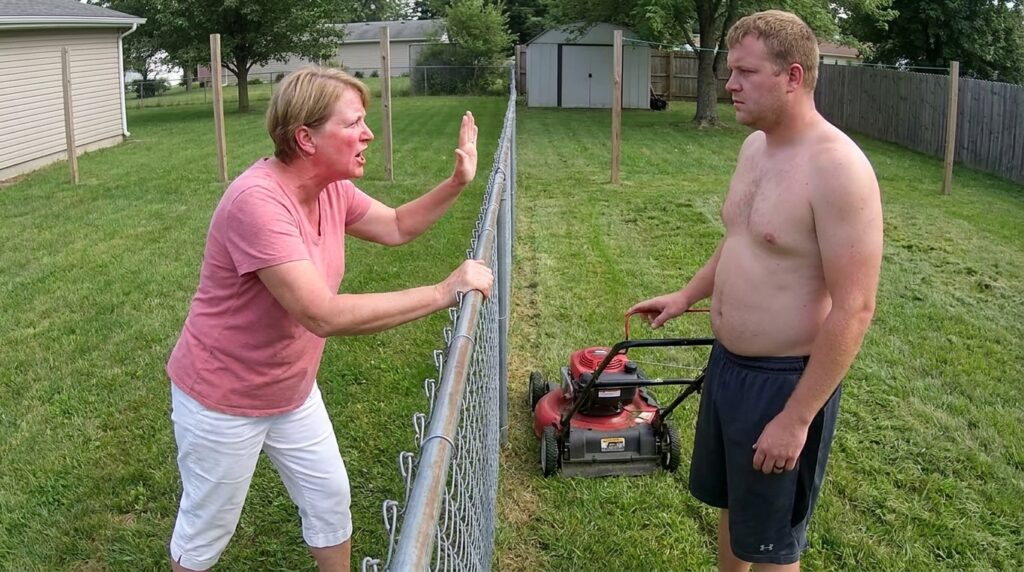
The document didn’t clear his name. It did something far worse. It suggested that neither he nor the woman in the pink blouse actually owned the ground where the chain-link fence stood. The entire two-foot strip of land he had spent months watering, mowing, and defending was technically a legal dead zone—a municipal pipeline reserve that had been erased from the public neighborhood directory but preserved in this buried metal box.
From the world above the floorboards, three heavy, rhythmic knocks vibrated through the front door sill. The wood groaned under the weight of a solid, government-issued fist.
Arthur slowly refolded the blue linen paper, the stiff creases clicking like dry leaves between his calloused fingers. He didn’t put it back in the rusted ammunition box. He tucked the canvas bundle flat against his stomach, under the waistband of his dark work shorts, and turned his stocky body around in the dirt, dragging himself back toward the small, blinding square of afternoon light where the orange strobe lights continued to sweep through the dust.