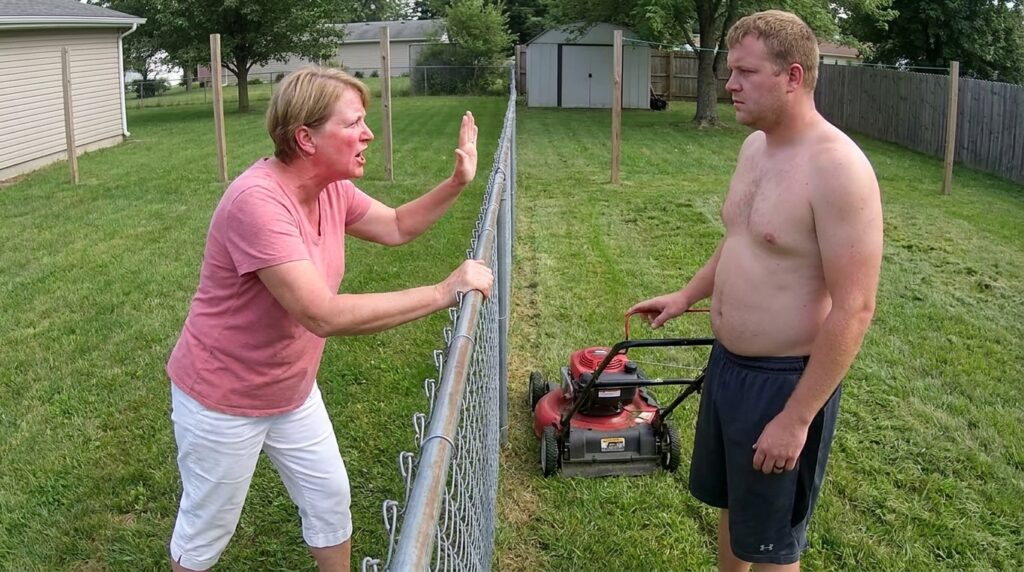
CHAPTER 7: THE METALLIC STRIKES
The first blow of the five-pound steel sledge mallet sent a short, sharp ring vibrating through the chain-link mesh, the high-frequency sound causing three birds to scatter from the low limbs of the neighbor’s walnut tree. The surveyor Arthur had requested by phone two hours earlier didn’t look up to check the windows. He was an old man with a face like dry leather, his neon-orange field vest covered in gray clay smudges as he leaned his full weight over a long, three-quarter-inch iron rod.
Clang.
The iron rod descended another four inches into the dry, unyielding sod, throwing up a tiny ring of white, sulfurous limestone dust that settled instantly onto the toes of Arthur’s work boots. Arthur stayed planted three feet back, his muscular arms folded across his bare chest, his thumb pressing firmly against the stiff edge of the canvas map bundle hidden flat under his waistband.
Officer Miller stood beside the trunk of his Explorer, his leather gear belt creaking as he shifted his weight. He had already set a cordon of small, yellow plastic cones along the asphalt curb, keeping the small group of porch watchers from stepping off their respective concrete walkways. The air between the houses was growing thicker by the second, the pungent, vinegar-sharp odor of old industrial plating chemicals now pooling visibly in the shallow ditch where the sod had been turned.
“That’s twenty-four inches west of the fence-line post, Dale,” Miller said, his voice dropping into a low, professional register as he watched the surveyor unroll a yellow fiberglass tape measure across the lawn.
“The fence isn’t on the deed, Miller,” the surveyor muttered, his breath coming in short, raspy grunts as he lifted the sledge for a third strike. He spat a dark stream of tobacco juice into the dead fescue. “The original baseline pin from fifty-six is locked here under the roots. The alignment Vivian’s husband poured isn’t a property marker. It’s an obstruction.”
Clang.
The iron rod struck something hard and hollow six inches below the turf—a deep, booming resonance that didn’t sound like a typical glacial boulder or an old limestone shelf. The sound traveled horizontally across the yard, causing the metal framework of the neighbor’s back porch to give a small, sympathetic rattle.
Arthur’s eyes narrowed. He looked past the surveyor’s shoulder toward the base of the chain-link fence. The continuous concrete curb Vivian’s husband had poured back in the early nineties didn’t just run straight; it had an intentional, bulbous belly that extended precisely eighteen inches into Arthur’s lot before snapping back to the iron line. It was a structural reinforcement, but it wasn’t holding up the posts. It was shielding a junction.
A screen door clicked open from the side of the neighboring house, but it wasn’t the frantic, explosive slam from twenty minutes ago. The movement was slow, deliberate, almost silent.
Vivian stepped out onto the concrete pad. She had removed the pink blouse, replacing it with an old, oversized gray work shirt that belonged to her late husband, the initials G.B. still visible in faded blue embroidery over the pocket. She wasn’t carrying her clipboard. Her hands were tucked deep into the pockets of her trousers, her short blond hair slightly unraveled from its rigid styling by the hot valley wind.
She didn’t shout. She didn’t wave her phone or invoke the zoning board. She walked to the absolute edge of her cedar mulch, her white sneakers stopping precisely where the dark wood chips met the gray, dying grass of Arthur’s lot.
“You don’t know what’s down there, Arthur,” she said, her voice dropping into a flat, level cadence that lacked any of her previous theatrical performance. It was a tired voice—the sound of an old clerk realizing the ledger was short at the end of a thirty-year shift.
Arthur looked at her across the wire mesh, his stocky frame unmoving. “I know the authority map from sixty-one has a purple stamp, Vivian. The same stamp your husband used to clear the ninety-four tax updates.”
“The ninety-four updates kept this block from being condemned,” she whispered, her fingers remaining deep in her pockets, her gaze fixed entirely on the iron rod the surveyor was currently leveling with a brass plumb bob. “The plating works went bankrupt before the EPA could issue the cleanup order. If George hadn’t poured that continuous curb, the runoff from the old acid vats would have hit my basement floor before the winter thaw.”
The revelation didn’t bring a sense of victory. The air between them grew heavier, the sour, metallic tang of the fluid welling up around the surveyor’s iron stake proving that the decoy secret—the unregistered municipal utility easement—was merely a legal skin. The ultimate final reality was still buried beneath that continuous gray concrete wall, a dark structural truth that had been leaking into Arthur’s soil for three decades while he simply tried to keep his lawn cut straight.
Officer Miller stepped forward, his silver mechanical pencil scratching against his notepad with a dry, rhythmic hiss. “Vivian,” he said, his voice quiet but authoritative through the noon glare. “I need you to step away from the stake line. Dale’s got to set the third indicator, and the county environmental truck just cleared the bypass on Route Four.”