CHAPTER 4: THE FENCE LINE STANDOFF
Arthur stepped out of the crawlspace hole, his palms slapping against the sun-baked clay as his stocky frame cleared the foundation sill. The thick canvas bundle hidden against his gut felt stiff and dense, a hard block of historical record wedged between his skin and the heavy cotton of his work shorts. He didn’t have time to brush the gray lime dust from his bare shoulders.
The rumble of the diesel at the curb wasn’t a city surveyor’s truck. It was an old, rusted iron-bed international flatbed belonging to a local tree salvage crew, its hydraulic lift whining as it tilted toward the gutter. But before the driver could even cut the ignition, a sharp, metallic rattle cut through the diesel exhaust.
It was the chain-link fence.
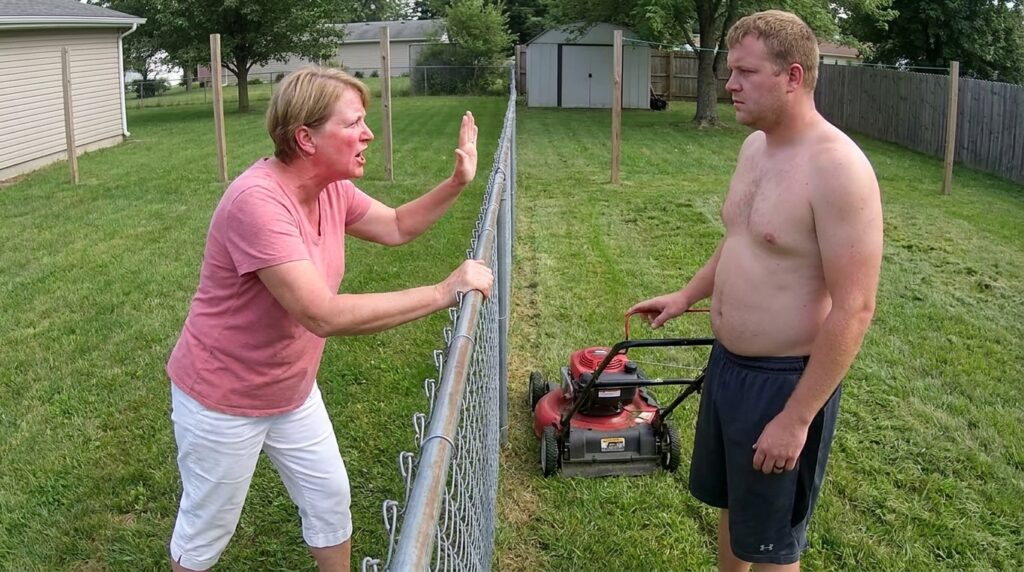
She was back at the boundary, her white-knuckled fingers knotted into the zinc-coated diamonds of the wire mesh, shaking the vertical posts until the concrete anchors beneath the turf groaned. The bright pink of her blouse was fully saturated under the high noon sun, casting a neon shadow across the gray, dying grass of Arthur’s yard. In her other hand, she held her phone high, the camera lens pointed directly at the exposed iron pin Arthur had unearthed minutes earlier.
“You are tampering with a municipal boundary indicator, Arthur!” her voice pitched high, designed to carry past the oak trees toward the four neighboring porches where screen doors were already clicking open. “I have the zoning clerk on the line. This is a class-four misdemeanor, and I am documenting the structural disruption to the common easement!”
Arthur didn’t run. He walked with a heavy, unhurried stride toward the green push mower where it sat cooling in the shadow of the garage eaves. His chest was mapped with black grease marks from the foundation stacks, his breath steady, his eyes locked on the specific spot where her sneakers pressed into the turf.
She didn’t move back as he approached. Her jaw was set, her styled blond hair rigid despite the gusting hot wind off the blacktop. “Don’t you turn that machine back on,” she snapped, dropping her phone into her shirt pocket and flattening her palm into a rigid, vertical stop sign across the top rail of the fence. “You can’t put yourself in my place and decide for me. The deed restrictions on Track 4B are explicit. This entire alignment belongs to the estate.”
Arthur stopped precisely three feet from the fence line. He didn’t touch the starter cord of the mower. He didn’t lift his hands to his hips or mirror her aggressive, policing posture. He stood solidly in his dark work shorts, his bare feet planted in the scorched fescue, his chest rising and falling against the humid heat.
“I’m handling my side,” he said. His voice was flat, dry, devoid of the defensive volume she was fishing for. “And that’s all.”
“Your side?” Her laugh was a short, sharp bark that didn’t have any humor in it. She jammed her index finger down toward the freshly turned clod of gray, sulfur-scented dirt where the square-headed iron spike was visible. “This alignment has been locked since nineteen seventy-two. My husband set these posts himself with three yards of poured transit-mix. You think you can dig up fifty years of neighborhood history with an old spade because your grass is rotting?”
Arthur looked down at the iron spike, then back up at the plastic clipboard she had wedged under her arm. Through the translucent polymer, he could see the hand-drawn pink grease line she had added to her copy of the plat map. It was an intentional overlay, a desperate attempt to cover the real, purple technical lines hidden inside the canvas roll against his belly.
He noticed a detail he had missed from the nighttime security feed: the base of her chain-link fence posts didn’t have standard circular concrete footings. They were poured into a long, continuous subterranean curb of rough, gray aggregate that ran parallel to his privet hedges—a concrete wall buried six inches deep, designed not to hold a fence up, but to keep something underneath from shifting toward her basement.
“The fence line doesn’t move just because you scream at it, Vivian,” Arthur said, using her proper name for the first time in three seasons.
Her face didn’t go pale; it went dark, a deep, blotchy crimson spreading under her sunglasses as her fingers tightened on the wire mesh until the metal links bit into her skin. “Fine,” she whispered, her voice dropping into a clipped, venomous delivery that was far tighter than her public shouting. “Do whatever you want. But the county cruiser I called forty minutes ago just turned the corner on Elm.”
She let go of the fence. The wire rattled behind her as she turned on her heel, her white trousers catching the dust from her fresh cedar mulch as she retreated toward her back porch. She didn’t look back, but her retreat was too fast, her shoulder checking the screen door frame as she vanished into the air-conditioned dark of her kitchen.
Arthur didn’t move. He stood beside the green mower as the rhythmic, low-frequency wail of a local municipal siren began to rise from the end of the block, its sound echoing off the parched aluminum siding of the garages.