Chapter 9: The Home They Had Fought to Protect
The following spring, sunlight poured through the clubhouse windows at Lake Haven Estates.
Outside, the lake reflected the blue Florida sky.
The southern walking path had been repaired.
New drainage improvements were underway.
The landscaping looked healthier than it had in years.
Inside, nearly sixty residents gathered for the annual HOA meeting.
It was the largest attendance anyone could remember.
Robert sat beside Susan near the middle of the room.
He recognized familiar faces.
Evelyn Brooks had brought her daughter.
Margaret Ellis sat with several neighbors from the southern section.
Frank Delaney occupied his usual chair near the back.
Thomas Reed had prepared a short financial presentation.
Linda stood at the front, reviewing the agenda.
She had been elected to a regular board term after serving as interim president.
Her leadership style was very different from Karen’s.
She rarely raised her voice.
She invited questions.
She made sure residents understood which decisions required board approval and which belonged to the membership.
When someone disagreed with her, she listened.
Not every meeting was easy.
Residents still argued about landscaping costs, pool hours, and parking rules.
Some homeowners believed the board was moving too slowly.
Others worried about spending too much.
But disagreement no longer meant disloyalty.
People could challenge a proposal without fearing retaliation.
That change was visible in the way residents spoke.
The meeting began with an update on the community’s finances.
Thomas explained the restitution received, the legal and accounting expenses incurred, and the remaining reserve shortfall.
The numbers were not perfect.
But they were understandable.
Residents could see where their money had gone and what still needed to be done.
The board then reviewed the infrastructure plan.
The drainage system had undergone further inspection.
Necessary repairs were scheduled according to documented priorities.
Future projects would require competitive proposals when appropriate and independent verification of completed work.
The association had also revised its enforcement procedures.
Violation notices now identified the applicable rule and provided clear information about the review process.
Fines required proper authorization.
Appeals were heard through established procedures.
Homeowners could request relevant records without being treated as troublemakers.
Near the end of the meeting, Linda invited Robert to speak.
He had not prepared a long address.
He walked slowly to the front of the room carrying a single sheet of paper.
For a moment, he looked out at his neighbors.
He saw people who had spent decades working, raising families, serving their communities, and saving for retirement.
They had come to Lake Haven Estates because they wanted a place to enjoy the years they had earned.
He thought about how easily that peace had been disturbed.
Then he spoke.
He reminded everyone that an HOA was not supposed to be a private kingdom.
It was a community organization entrusted with responsibilities.
Its authority came from governing documents, applicable law, and the homeowners it served.
Board members were not owners of their neighbors’ lives.
They were stewards of shared obligations.
Robert paused.
He looked toward Susan.
Then he thanked the residents who had spoken up when doing so was uncomfortable.
He thanked Linda for protecting the election records.
He thanked Frank for preserving evidence.
He thanked the neighbors who had provided statements, attended meetings, and helped rebuild the association.
Finally, he asked everyone to remember that good governance required participation.
No community could protect itself if its members stopped paying attention.
He returned to his seat.
The applause was warm but restrained.
Robert preferred it that way.
He had never wanted to become a local hero.
He wanted to be a retired husband who could enjoy his home.
After the meeting, several residents stayed for coffee.
People talked about grandchildren, fishing, upcoming birthdays, and summer travel plans.
For the first time in years, the clubhouse felt ordinary again.
That evening, Robert and Susan walked along the lake.
The air was warm.
A gentle breeze moved through the palm trees.
They passed the repaired drainage area and continued toward a bench overlooking the water.
Susan sat beside him.
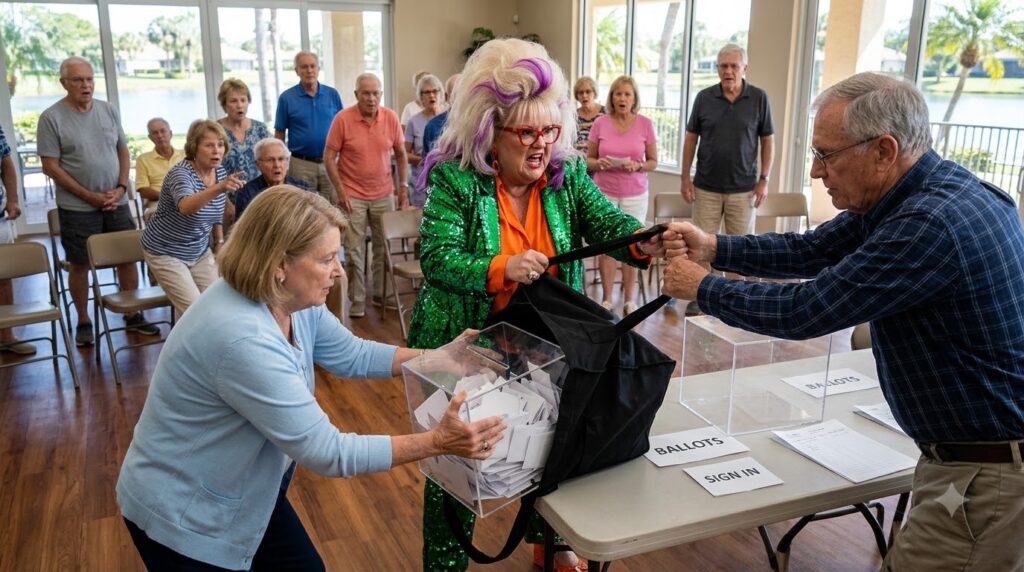
She remembered the afternoon Karen had tried to take the ballot box.
At the time, the struggle had seemed almost unbelievable.
A woman entrusted with leading the community had attempted to hide the votes that might remove her.
But Susan no longer thought of that day only as a moment of anger and humiliation.
She thought of it as the moment the neighborhood stopped surrendering its voice.
Robert watched a pair of herons standing in the shallow water.
He knew Lake Haven Estates would never be perfect.
There would always be disagreements.
There would always be bills to pay and repairs to make.
There would always be people who wanted stricter rules and others who preferred fewer restrictions.
That was part of living in a community.
The important difference was that no one person could simply declare an argument finished and expect everyone else to obey.
When they returned home, the porch light was glowing.
Susan’s ceramic bluebird stood beside the walkway.
Robert stopped for a moment to look at it.
Such a small object.
Such an ordinary thing.
Yet it reminded him of everything they had nearly lost.
Not the house itself, although the threats against it had been frightening.
Not the money, although the legal expenses and financial uncertainty had been painful.
What they had nearly lost was the simple dignity of living in their own home without being intimidated by someone who confused authority with ownership.
Robert opened the front door.
Susan stepped inside.
Behind them, Lake Haven Estates settled into a peaceful Florida evening.
The community had survived a stolen ballot box, a disputed election, financial misconduct, and months of uncertainty.
Its residents had learned that protecting a neighborhood required more than attractive landscaping and strict rules.
It required honest records, fair procedures, responsible leadership, and the courage to question authority when necessary.
Karen Whitmore had believed that controlling the ballot box meant controlling the community.
She had been wrong.
The votes belonged to the homeowners.
The association belonged to its members.
And the homes they had worked a lifetime to afford deserved to be places of dignity, security, and peace.
For Robert and Susan Mitchell, that was worth standing up for.
The End.