Chapter 5: The Money Behind the Rules
The caller’s name was Michael Torres.
He was fifty-eight years old and had worked as an operations supervisor for Gulf Coast Property Services, the company responsible for much of Lake Haven Estates’ landscaping and common-area maintenance.
Michael had left the company eight months earlier.
He told Linda that certain invoices submitted to the HOA did not accurately reflect the work performed.
At first, Linda hesitated to involve him.
She knew accusations about money could destroy reputations if handled carelessly.
But Michael offered to provide documents.
He had retained copies of work schedules, job summaries, and correspondence relating to projects he personally supervised.
Linda arranged for him to speak with Daniel Mercer.
Robert attended the meeting with permission.
Michael arrived carrying a thick folder.
He looked nervous.
He explained that Gulf Coast Property Services had originally provided ordinary landscaping work at reasonable prices.
Over time, the company began receiving additional projects through the HOA.
Some involved irrigation repairs.
Others concerned decorative stonework, tree trimming, and shoreline maintenance.
The unusual part was not the existence of those projects.
It was the paperwork.
Michael identified several invoices listing work that his crews had not performed.
One charged the association for replacing irrigation equipment at a location where no replacement had occurred.
Another described extensive shoreline landscaping that had consisted of a routine cleanup.
A third billed for emergency tree removal on a date when the crew had been assigned elsewhere.
The documents did not prove who had authorized every discrepancy.
But they gave the attorney specific transactions to investigate.
Daniel asked Michael whether he had reported his concerns internally.
Michael said he had.
His supervisor told him the invoices had been approved by HOA leadership and instructed him to stop asking questions.
A few months later, Michael resigned.
He had not wanted to become involved in a dispute between homeowners and their association.
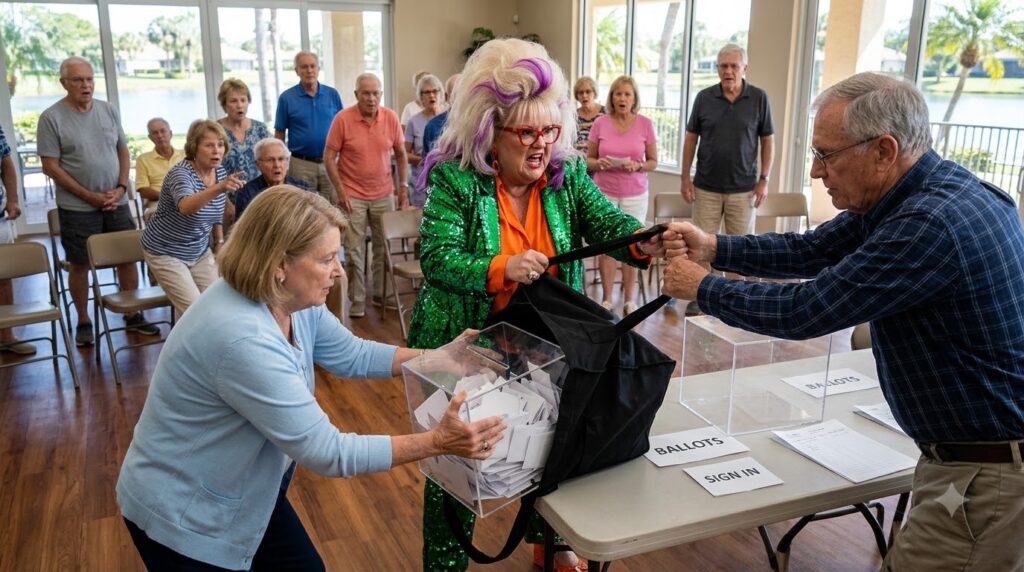
But the ballot-box video changed his mind.
He recognized Karen from meetings with the company’s management.
He also recognized Harold Bennett.
According to Michael, both had attended private discussions concerning maintenance contracts.
Robert felt a knot forming in his stomach.
For months, he had believed Karen’s aggressive enforcement policies were mainly about personal control.
Now he wondered whether the association’s finances provided another reason to remain in office.
Daniel cautioned against jumping to conclusions.
Inflated invoices could result from poor administration, contractor misconduct, unauthorized payments, or deliberate fraud.
The evidence needed independent examination.
Linda agreed.
She contacted the other board members and requested a special meeting to authorize an outside financial review.
Karen rejected the proposal.
She called Michael a disgruntled former employee.
She accused Robert of manufacturing allegations to overturn the election.
Then she demanded that Linda surrender her secretary’s records.
Linda refused to hand over personal notes or copies of documents without an appropriate process.
She offered to make official association records available to authorized reviewers.
Karen threatened to remove her from the secretary position.
That threat produced an unexpected result.
Harold Bennett requested a private meeting with Daniel.
He arrived looking exhausted.
He admitted that he had approved invoices without verifying all the supporting documentation.
Karen had assured him the work was necessary and that the contractor’s prices were competitive.
Harold said he had trusted her.
He also acknowledged signing several checks after Karen told him the board had already approved the expenses.
When Daniel showed him the meeting minutes, Harold recognized votes he did not remember attending.
He grew pale.
He asked for time to review his records.
Daniel advised him to obtain independent legal counsel because his own conduct might be examined.
Harold agreed.
The following day, he resigned as treasurer.
His resignation letter did not accuse Karen of theft.
Instead, it stated that he could no longer certify the reliability of the association’s financial records.
For Lake Haven Estates, that statement was devastating.
Residents had spent years paying assessments under the assumption that the money was properly managed.
Now they faced the possibility that thousands of dollars had been spent without adequate oversight.
Robert went home and found Susan sitting on the patio.
The ceramic bluebird rested on the table beside her.
She listened as he described the developments.
Then she asked a question he had been avoiding.
What would happen if the association’s accounts were worse than anyone expected?
Robert had no answer.
And within a week, the preliminary review revealed a problem that threatened more than the community’s finances.
It threatened the lake itself.