Chapter 3: The Woman Who Kept the Records
Linda Parker had never considered herself particularly brave.
She had worked for thirty-eight years as an administrative assistant at a regional hospital, where she learned that accurate records could protect both institutions and individuals.
After retirement, she joined the HOA board because she wanted to help her community.
She liked organizing meetings.
She liked making sure bills were paid.
She liked seeing the clubhouse filled with neighbors enjoying themselves.
She did not like arguments.
Karen had understood that weakness almost immediately.
During Linda’s first year as secretary, Karen frequently asked her to make small adjustments to meeting minutes.
Sometimes a sentence was reworded.
Sometimes an objection was omitted.
Sometimes a decision made informally was presented as though the full board had approved it.
Linda initially assumed Karen was correcting administrative mistakes.
But the changes grew more serious.
One afternoon, Karen instructed Linda to record approval of a landscaping contract that had never been discussed at a formal meeting.
Linda refused.
Karen stared at her across the office desk.
She reminded Linda that the president controlled committee assignments and that board members were expected to support association decisions.
Linda went home deeply unsettled.
That evening, she opened a drawer containing her old notebooks.
She compared her handwritten records against the official minutes stored in the HOA’s electronic files.
The differences were not occasional.
They formed a pattern.
Over several months, Linda quietly assembled copies of documents she was authorized to access.
She kept dated notes identifying discrepancies without altering the originals.
Then Robert’s recall petition arrived.
Linda hoped the vote would settle the conflict peacefully.
She helped establish a ballot procedure that included a verified voter list, sealed ballots, and a transparent container monitored by designated volunteers.
The association’s governing documents required a specific voting threshold and a documented count.
Linda wanted every step to be defensible.
Karen appeared cooperative in public.
Privately, she repeatedly demanded access to the ballots before the meeting.
Linda refused.
Two days before the vote, Karen arrived at the clubhouse carrying a large black tote.
Linda was organizing chairs near the storage room.
Through the partially open door, she saw Karen examining a transparent ballot box.
There were two identical containers on a shelf.
One had been purchased as a spare.
Karen asked whether the boxes were interchangeable.
Linda explained that the official voting box would be marked and monitored.
Karen said nothing.
She simply looked at the spare container for several seconds before leaving.
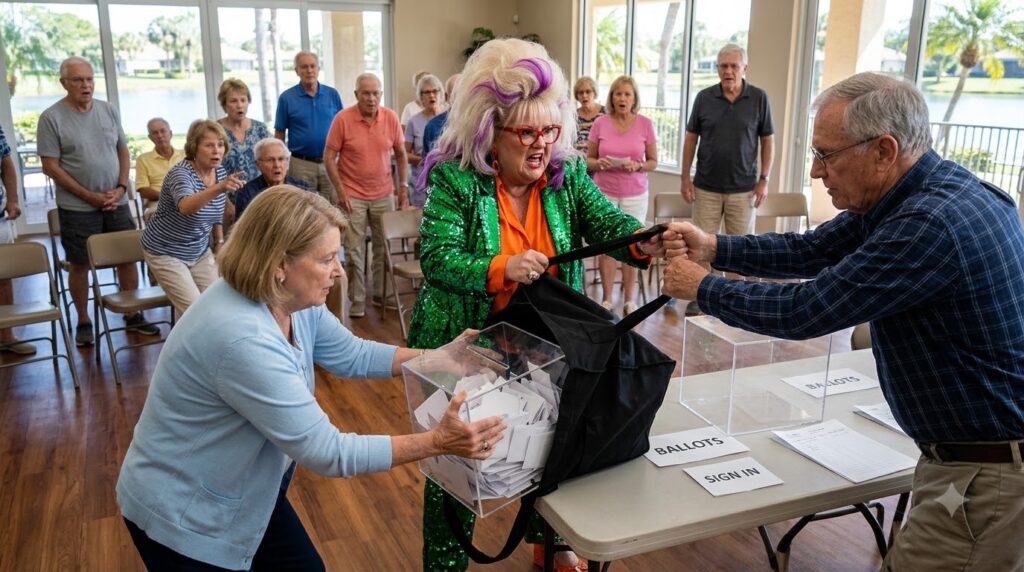
Linda remembered that moment when Karen slammed the empty box onto the table during the meeting.
Now, standing beside the recovered ballots, she understood why the question had mattered.
The residents began demanding an explanation.
Karen insisted the second box had been part of an administrative demonstration.
She claimed she had intended to verify the ballots privately before counting them.
Robert pointed out that the vote had never authorized her to remove the ballots.
Linda stated that the official container had been under election supervision and that Karen had no authority to replace it.
Karen demanded that Linda stop speaking.
For once, Linda did not.
She explained that the vote would remain suspended until the ballots could be secured and the chain of custody documented.
Robert suggested contacting an independent attorney to determine whether the compromised election could be completed or would need to be repeated.
The residents agreed that no one should open or count the recovered ballots until the situation was reviewed.
Karen protested.
She claimed the board could not act without her approval.
But Linda reminded everyone that the membership’s voting rights did not disappear because the president objected.
The room settled into uneasy silence.
Several homeowners began photographing the two boxes.
Others wrote down what they had witnessed.
A retired accountant named Thomas Reed volunteered to help prepare a written incident record.
Margaret Ellis offered to collect witness statements.
Evelyn Brooks, who had lived in the neighborhood since its development, insisted that every resident be informed of what had happened.
Karen eventually left the clubhouse through a side door.
She walked past the lake without looking back.
Robert watched her go.
He expected an angry letter from the HOA’s attorney.
He expected accusations, threats, and perhaps another round of violation notices.
What arrived the next morning was something far more serious.
A certified letter informed Robert that the association intended to place a lien against his home.