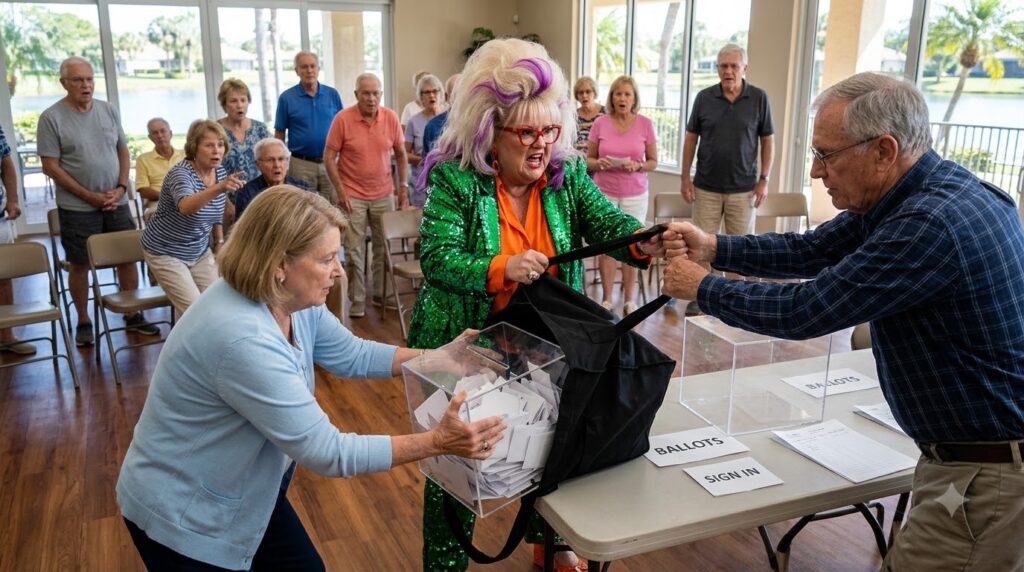
Chapter 7: A Vote Nobody Could Hide
The second election took place three weeks after the ballot-box incident.
By then, Lake Haven Estates felt different.
Neighbors who had avoided HOA meetings for years began attending informational sessions.
Residents compared governing documents, asked questions about budgets, and volunteered to help with community projects.
The clubhouse no longer belonged to the loudest person in the room.
It belonged to everyone who had a right to be there.
The new vote was organized with independent election supervision and legal guidance.
Eligibility was verified.
Ballots were issued according to the governing documents.
Observers were allowed to monitor the process without interfering.
The ballot container remained secured.
Every stage of the count was documented.
Karen challenged the arrangements.
She objected to the independent supervisor.
She questioned the voter list.
She claimed the recall petition had been improperly circulated.
Her attorney submitted written objections, which were reviewed through the appropriate procedures.
The election went forward after the organizers addressed the procedural questions.
Robert arrived with Susan shortly before voting began.
He wore a pale blue button-down shirt and the same comfortable walking shoes he used every morning.
Susan carried a small handbag and a folded copy of the association’s governing documents.
They were not celebrating.
Robert understood that removing one president would not automatically repair the neighborhood’s finances or restore trust.
The association would still need responsible leadership.
Its records would need examination.
Its maintenance obligations would remain.
And the homeowners would have to participate rather than surrender responsibility to whoever volunteered to take charge.
Inside the clubhouse, Linda greeted residents at the registration table.
She looked tired but composed.
Margaret Ellis helped direct voters.
Thomas Reed assisted with the written attendance records.
Frank Delaney sat quietly near the back, his phone tucked away.
He had already done what was necessary.
There was no need for another confrontation.
Karen entered fifteen minutes after voting began.
Her appearance was as striking as ever.
She wore a bright coral jacket over a patterned black-and-white dress, oversized sunglasses, and sparkling jewelry.
But she seemed less certain of herself.
She walked past Robert without speaking.
She cast her ballot.
Then she took a seat near the windows overlooking the lake.
For the first time in years, she waited like every other homeowner.
The voting process lasted most of the afternoon.
When the polls closed, the independent supervisor verified the ballot count in the presence of authorized observers.
The results were recorded and checked against the applicable voting threshold.
A substantial majority of the eligible votes cast supported removing Karen from her position under the association’s governing procedures.
The required threshold was met.
The result was announced calmly.
There was no shouting.
No one rushed toward Karen.
A few residents applauded, but the sound faded quickly.
Many simply sat in silence.
For them, the result represented something more personal than a change in leadership.
It meant their voices had been counted.
Robert looked toward Susan.
She reached for his hand.
Across the room, Linda lowered her eyes and exhaled.
Karen remained seated.
Her face was rigid.
When the supervisor finished announcing the result, she stood and walked toward the exit.
At the doorway, she turned briefly.
She said the community would regret its decision.
Then she left.
Robert watched her disappear into the afternoon sunlight.
He expected to feel triumphant.
Instead, he felt tired.
The election had been necessary, but it had exposed deep divisions among neighbors who once trusted one another.
Some residents had supported Karen because they believed she kept the community orderly.
Others had feared challenging her.
A few had benefited from her decisions.
Now everyone would have to live together after the dispute.
The newly constituted board held its first organizational meeting the following week.
Linda agreed to serve temporarily as president until the next regular election.
She insisted on clear meeting procedures, published minutes, and documented financial approvals.
Robert declined an invitation to join the board.
He believed the community needed fresh participation, not another personality around whom every dispute revolved.
Instead, he volunteered for a limited advisory role concerning infrastructure maintenance.
His first recommendation was simple.
No major project should be considered complete without adequate documentation.
The board adopted a financial transparency policy and commissioned a more comprehensive independent review.
The accountant began tracing payments across several years.
The results would take time.
Meanwhile, Karen’s attorney continued challenging aspects of the removal process.
Daniel prepared the association’s response.
The election dispute was moving toward resolution.
But one final discovery would determine how far the consequences reached.