Chapter 4: The Threat Against Robert’s Home
Robert read the letter twice before handing it to Susan.
The notice claimed he owed the HOA $4,850 in unpaid fines, administrative charges, and legal expenses.
According to the document, the balance had accumulated over several months.
Robert recognized only one item.
The seventy-five-dollar bluebird fine.
The remaining charges were unfamiliar.
Some supposedly concerned landscaping violations.
Others referred to unauthorized exterior modifications.
One alleged that Robert had interfered with association operations.
The letter warned that continued nonpayment could lead to additional collection action, including a lien if legally permitted.
Susan sat at the kitchen table, staring at the amount.
Their house was paid for.
They had planned to leave it to their children someday.
Now an association they helped fund was threatening their property.
Robert immediately requested an itemized accounting and copies of every underlying violation notice.
He also contacted a Florida attorney experienced in condominium and homeowners association disputes.
The attorney, Daniel Mercer, was a quiet man in his late fifties who had represented homeowners and associations for more than twenty years.
He listened carefully before offering an opinion.
A demand letter did not automatically make every charge valid, he explained.
The HOA would need to establish the legal and contractual basis for the amounts claimed and follow the applicable notice and collection procedures.
Robert should preserve every document and avoid ignoring any formal deadline.
The attorney also advised him not to assume that the failed ballot swap alone would resolve the dispute.
The election process and the financial claims required separate attention.
Robert understood.
He had spent his professional life insisting that buildings be evaluated using evidence rather than assumptions.
Now he would have to apply the same discipline to his own home.
Meanwhile, the story of the ballot-box incident spread throughout Lake Haven Estates.
A resident named Frank Delaney had recorded much of the confrontation on his smartphone.
Frank was seventy-four, a retired television repair technician who rarely attended HOA meetings.
He had come that afternoon because his wife wanted him to vote.
When Karen began shouting, he instinctively raised his phone.
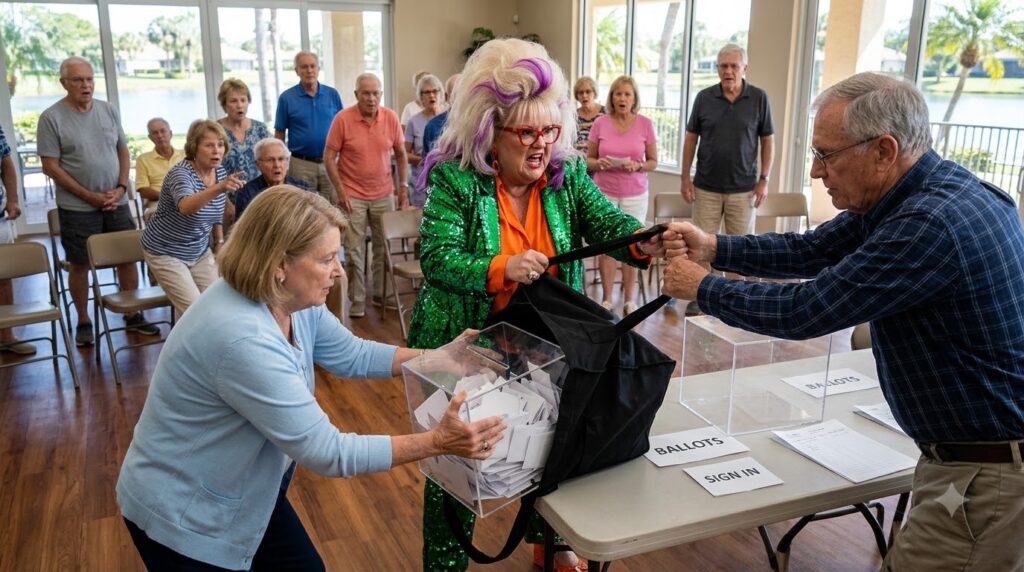
His recording captured the empty box hitting the table, Robert questioning the bag, the struggle over the strap, and Linda recovering the original container.
Frank had not filmed every second of the meeting.
But the important sequence was clear.
He provided the original file to the attorney handling the election dispute and preserved a backup.
Robert urged him not to circulate edited clips.
The residents needed reliable evidence, not an internet spectacle.
Still, the video made Karen’s explanation difficult to accept.
She had claimed the ballot boxes were switched for administrative reasons.
The recording showed her trying to conceal the full container inside her personal bag.
More troubling developments followed.
Three homeowners received unexpected violation notices within forty-eight hours of signing witness statements.
Margaret Ellis was cited for an allegedly unauthorized garden border.
Thomas Reed received a warning about his mailbox.
Frank was told that his driveway contained prohibited stains.
Each resident believed the timing was retaliatory.
Karen denied that accusation.
She insisted the association was simply enforcing existing rules.
Daniel advised the residents to document the notices, preserve envelopes and electronic timestamps, and use the formal dispute procedures.
He also recommended requesting a temporary pause on discretionary enforcement while the board reviewed the election controversy.
Two board members supported the pause.
Karen refused.
The fourth board member, a retired insurance executive named Harold Bennett, remained silent.
Harold had served as treasurer for three years.
He was polite, well-dressed, and known for avoiding public disagreements.
Robert had never considered him an ally of Karen.
But Linda had recently discovered that Harold approved most of the invoices she had questioned.
When Robert asked him about the association’s finances, Harold appeared visibly uncomfortable.
He said the records were complicated.
He promised to review them.
Then he ended the conversation.
That evening, Linda received an unexpected telephone call.
The caller was a former employee of the landscaping company that maintained Lake Haven Estates.
He had heard about the attempted ballot swap.
And he believed the residents needed to know why Karen was so determined to remain president.