Chapter 5: What the Camera Actually Showed
The police department’s review was completed the following week.
The footage was clear enough to establish the essential sequence.
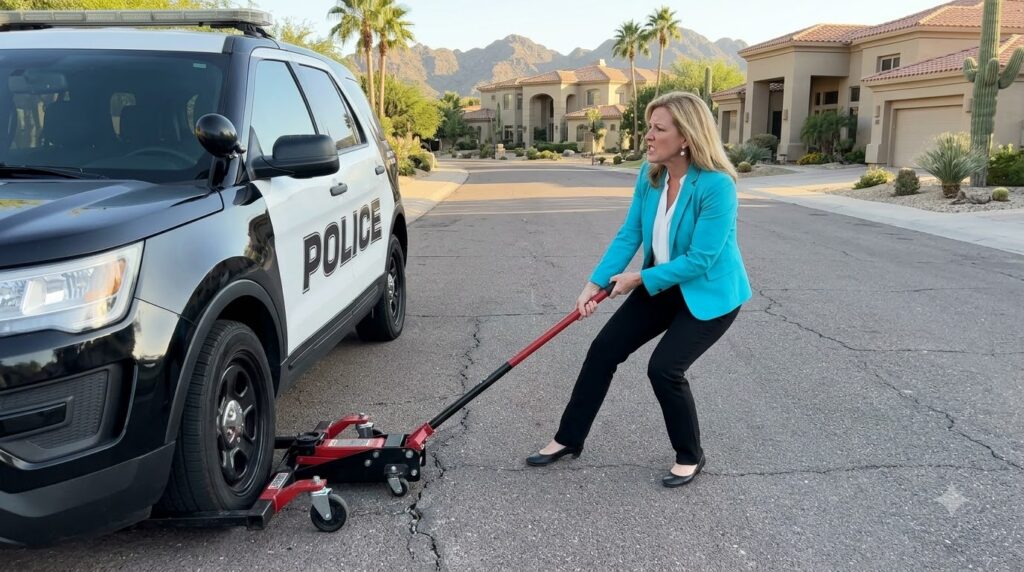
Marilyn approached the patrol SUV carrying the oversized violation decal.
She pressed it across the driver’s door, covering much of the POLICE lettering.
She smoothed it into place.
Then she pulled it loose, accidentally folding the adhesive onto itself.
The camera also captured her reaction when she noticed the recording indicator.
The video did not show damage to the vehicle’s paint.
A subsequent inspection found no lasting damage beyond removable adhesive residue.
That distinction mattered.
The department documented the incident and referred the available evidence for appropriate review. The final response would depend on the applicable law, the evidence, and the decisions of the responsible authorities.
There was no dramatic arrest.
No squad cars surrounding Marilyn’s house.
No public confrontation on her front lawn.
Instead, the consequences arrived through formal channels.
Marilyn received notice that the incident had been documented and that she could be contacted for further information.
The HOA board also received a written communication concerning the attempted application of an unauthorized adhesive notice to a department vehicle.
The letter did not tell the association how to govern itself.
It simply made clear that HOA rules did not grant permission to interfere with legally parked public vehicles.
Robert Hale called another board meeting.
This time, Marilyn did not chair it.
She had been asked to recuse herself from discussions directly involving her conduct.
Susan presented the department’s communication, along with the association’s own parking policy.
The board voted to formally prohibit adhesive enforcement notices on public-street vehicles and to require documented approval for any future enforcement materials.
Marilyn was furious.
But the more significant development came from the independent records review.
The examiner, a certified public accountant named Claire Donovan, had begun comparing fine assessments, homeowner payments, appeal records, and management-company invoices.
Claire had worked with community associations for more than fifteen years.
She knew that poor recordkeeping could look suspicious without involving fraud.
She also knew that sloppy procedures could cause serious harm even when nobody intended to steal anything.
Her preliminary findings revealed several troubling patterns.
Some homeowners had been charged additional administrative fees that were not clearly supported by the association’s adopted fine schedule.
Several appeals had been recorded as closed without documentation showing that the homeowners received a decision.
A number of fines continued accumulating after residents submitted proof that the underlying violations had been corrected.
And enforcement appeared inconsistent.
Comparable landscaping violations at different properties had resulted in sharply different penalties.
Claire could not yet determine why.
She requested additional records.
Among them were emails from Marilyn’s personal account to the property management company.
The emails showed that Marilyn had repeatedly instructed staff to prioritize enforcement against certain addresses.
Thomas Mercer’s home appeared several times.
So did Evelyn Brooks’s.
The correspondence did not establish that Marilyn had personally profited from the fines.
But it raised a serious question about whether she had used enforcement authority to punish homeowners who challenged her decisions.
Claire reported the issue to the board.
Robert read the findings twice.
He had known Marilyn for years.
They had attended neighborhood cookouts together. Their families exchanged holiday cards. He had once considered her a friend.
He wanted to believe she had simply become too aggressive in enforcing rules.
But the records suggested something more troubling.
Not a single impulsive mistake.
A pattern.
Meanwhile, Thomas received an envelope from the HOA.
He expected another violation notice.
Instead, it informed him that disputed enforcement charges would be placed on hold pending review.
He read the letter three times.
Then he called Evelyn.
For the first time in months, his voice sounded hopeful.
But Evelyn had news of her own.
She had found a copy of an old board resolution that might explain how Marilyn gained so much control over enforcement decisions.
And if Evelyn was reading it correctly, that authority had expired years earlier.