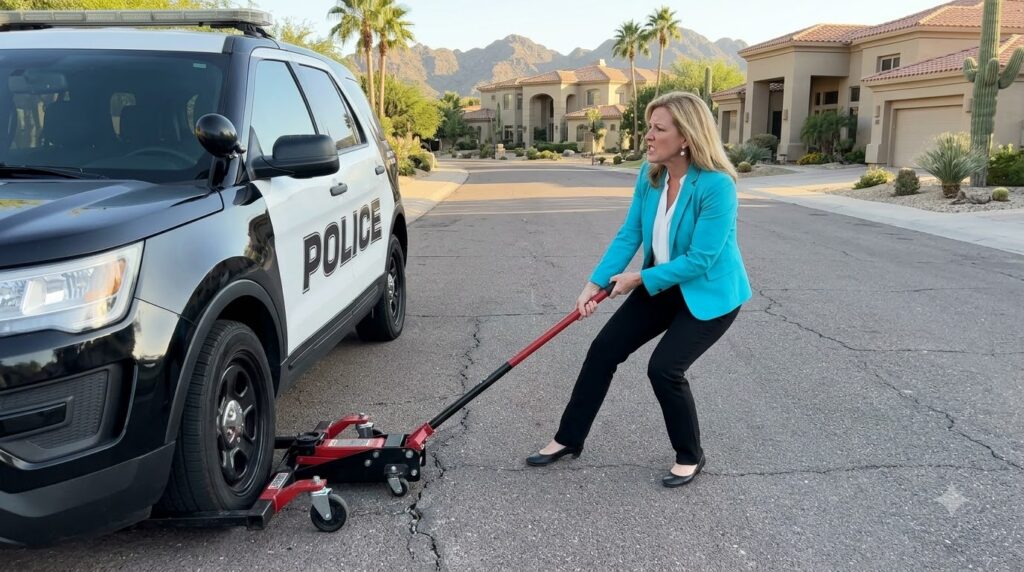
Chapter 3: The Letters Nobody Wanted to Open
By the following morning, Marilyn Whitcomb had convinced herself that the confrontation was a minor misunderstanding.
She had not damaged the SUV, she reasoned.
The sticker had come off.
The officer had not arrested her.
And surely a police department had more important matters to handle than a dispute over neighborhood parking.
Still, she couldn’t stop thinking about the blinking red light.
At breakfast, her husband, Richard, noticed that she barely touched her coffee.
Richard was sixty, a regional insurance executive who had learned over thirty-three years of marriage that Marilyn disliked being questioned.
He also knew the difference between her ordinary irritation and genuine anxiety.
When he asked what had happened, she described the officer as disrespectful and claimed she had been unfairly challenged while performing HOA duties.
She omitted the sticker.
Richard listened.
Then he asked whether the vehicle had been parked illegally.
Marilyn set down her cup.
“That’s not the point.”
Richard knew that answer.
He had heard it before.
Across the neighborhood, Thomas Mercer was sitting at his kitchen table with a stack of HOA letters.
Daniel had stopped by before work.
The two men had agreed not to discuss the incident with neighbors until the department had reviewed it. Daniel wanted the facts documented properly, and Thomas had no interest in turning his street into a public spectacle.
But the encounter had stirred something in Thomas.
For years, he had accepted the HOA’s increasingly harsh treatment because he didn’t want conflict.
Ellen had always been the more outspoken one.
She could challenge an unfair decision with a smile, a well-chosen question, and a patience Thomas admired.
After she died, he found confrontation exhausting.
It was easier to pay a small fine than argue.
Easier to repaint a mailbox than demand an explanation.
Easier to remain quiet.
But the letters had accumulated.
Thomas spread them across the table.
There were fourteen notices from the previous eighteen months.
Some concerned legitimate maintenance issues. He had never denied that.
Others seemed unreasonable.
One fined him for leaving a garden hose visible beside the garage.
Another cited a decorative wooden bench Ellen had purchased for their twenty-fifth anniversary.
The bench had stood beneath the same oak tree for sixteen years without complaint.
Then Marilyn’s enforcement committee declared it an unauthorized exterior furnishing.
Thomas had refused to remove it.
The fine had grown.
Daniel studied the paperwork.
“Why didn’t you tell me it had gotten this bad?”
Thomas gave a tired smile.
“Because you’re my son, not my lawyer.”
Daniel didn’t smile back.
One notice troubled him in particular.
It threatened additional collection action over unpaid fines and warned of possible legal remedies against the property, subject to applicable law.
Thomas had underlined the paragraph twice.
He admitted that he had begun wondering whether he could afford to stay.
That confession hurt Daniel more than he expected.
His father had taught generations of students about fairness, citizenship, and the importance of questioning authority.
Now he was afraid of losing the home where his wife had spent her final years.
Daniel asked permission to organize the notices.
Thomas agreed.
But he insisted that any challenge be handled properly.
He didn’t want his son using a police badge to settle a private dispute.
Daniel understood.
The incident involving the patrol SUV would remain separate from his father’s HOA concerns.
That distinction mattered.
Later that afternoon, Thomas called his neighbor, Evelyn Brooks.
Evelyn was seventy-two, a retired accountant who lived alone after her husband passed away.
She had received several similar fines.
So had Harold Jenkins, a Vietnam veteran who lived two streets over.
And so had Linda Alvarez, a widowed grandmother whose grandchildren occasionally helped maintain her yard.
The stories sounded familiar.
Small violations.
Large penalties.
Confusing explanations.
Appeals that seemed to disappear.
Evelyn had kept copies of everything.
Unlike Thomas, she had also maintained a spreadsheet.
When she brought it over that evening, Thomas stared at the numbers.
The association’s fine revenue had increased dramatically over the previous three years.
But the neighborhood’s maintenance budget had not increased proportionately.
Evelyn was careful not to accuse anyone of stealing money.
The records she had were incomplete, and increased fines did not necessarily mean wrongdoing.
Still, she believed the board owed homeowners a clear explanation.
Thomas looked at the spreadsheet, then at the old photograph of Ellen on his mantel.
For years, he had thought his struggle was personal.
Now he realized it might be shared.
And if enough neighbors had been treated the same way, Marilyn Whitcomb’s greatest problem might not be the police camera.
It might be the people who had finally decided to speak.