Chapter 2: The Officer Who Had Every Right to Be There
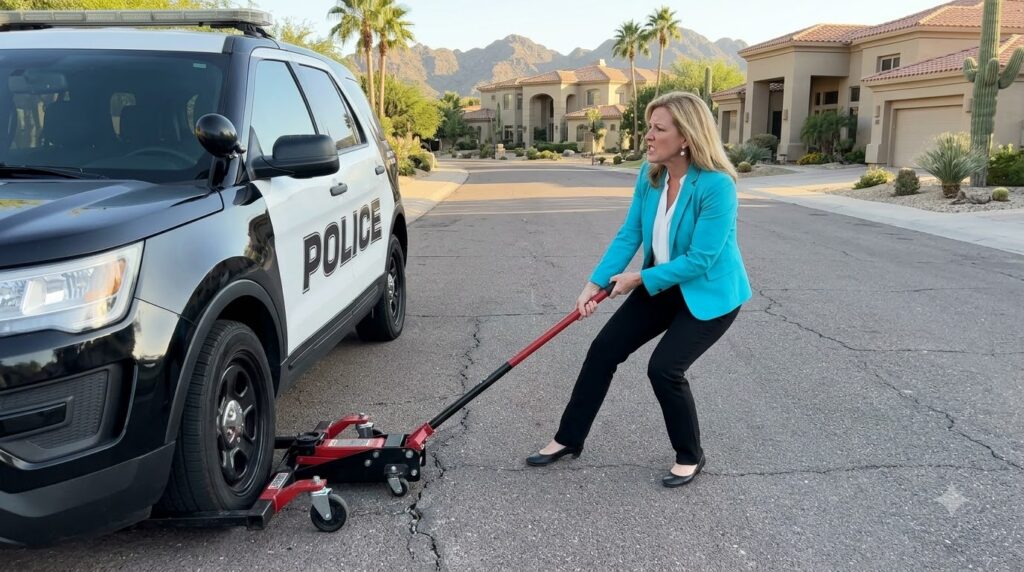
Officer Daniel Mercer had parked his patrol SUV on Willow Crest Drive for a reason that had nothing to do with Marilyn Whitcomb.
He was visiting his father.
At sixty-eight, Thomas Mercer had recently returned home after a difficult hospital stay. A retired high school history teacher and widower, Thomas had lived in Willow Crest Estates for nearly twenty years.
His wife, Ellen, had loved the neighborhood.
They had purchased their modest brick home long before property values climbed and oversized houses began replacing the original ranch-style residences.
For Thomas, the house represented forty-one years of marriage, two children raised, and countless ordinary evenings spent sitting beside Ellen on their front porch.
After her death, leaving it had never seemed possible.
But maintaining it had become increasingly difficult.
His arthritis made yard work painful. His medical expenses had consumed much of his savings. And since Marilyn Whitcomb became HOA president, the association’s enforcement notices had arrived with exhausting regularity.
A faded mailbox.
Grass half an inch too tall.
A trash container returned from the curb several hours late.
Each notice carried the possibility of another fine.
Daniel knew his father worried about those letters more than he admitted.
That afternoon, he had stopped by during a break in his shift to deliver groceries, replace a faulty smoke detector, and check whether Thomas had taken his medication.
Thomas’s house stood several doors down from Marilyn’s property.
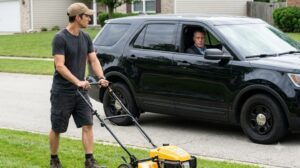
The curb directly in front of his father’s driveway was occupied by a landscaping truck, so Daniel had parked farther along the public street.
The space happened to be in front of Marilyn’s home.
There were no parking restrictions.
He had left his patrol SUV properly secured and walked to his father’s house.
When Daniel returned about twenty minutes later, he found Marilyn standing beside the driver’s door, struggling with a crumpled red-and-white sheet of vinyl.
She froze when she saw him.
Daniel’s first thought was that she had been involved in some kind of accident.
Then he noticed the lettering on the sticker.
HOA PARKING VIOLATION.
He looked at the exposed police identification on his door.
Then at the adhesive residue clinging to Marilyn’s fingers.
He understood enough to become concerned, but not enough to know exactly what had happened.
“Ma’am, is there a problem with my vehicle?”
Marilyn straightened her shoulders.
The familiar expression of authority returned to her face, although her hands remained awkwardly joined.
“This vehicle is parked in front of my residence. I’m the HOA president.”
Daniel glanced at the curb.
He checked the distance to her driveway.
Then he looked back at her.
“You’re standing on a public street, ma’am.”
Marilyn’s cheeks reddened.
She explained that police vehicles created an undesirable impression in an upscale community. She claimed residents might assume criminal activity was taking place nearby.
Daniel listened without interrupting.
He had encountered angry citizens before. Most disagreements could be resolved by explaining the law and giving people a moment to reconsider.
But Marilyn wasn’t interested in reconsidering.
She insisted that HOA regulations prohibited commercial and government vehicles from parking in residential areas.
Daniel explained that whatever restrictions might apply to privately owned HOA property, the association could not simply override applicable public-street parking laws.
He also pointed out that he had parked legally while visiting a family member.
That detail caught Marilyn’s attention.
“A family member?”
“My father lives down the street.”
Something shifted behind her eyes.
“Thomas Mercer?”
Daniel’s expression hardened slightly.
“Yes.”
Marilyn looked toward the older brick homes at the end of the block.
Thomas Mercer was familiar to her.
Too familiar.
He had questioned several HOA spending decisions at the previous annual meeting. He had also challenged the association’s increasingly aggressive fine structure, asking why elderly homeowners were being penalized for minor maintenance issues while larger violations at expensive properties received informal warnings.
Marilyn had not appreciated the questions.
Now she realized the police officer standing in front of her was Thomas’s son.
For a moment, neither spoke.
Daniel noticed the way she tightened her grip on the sticker.
“Did you put that on my vehicle?”
Marilyn glanced toward the small camera near the mirror.
She didn’t answer directly.
Instead, she insisted that she had merely been documenting a parking violation.
Daniel took out his department-issued phone and photographed the decal, the vehicle, and the surrounding curb.
He then checked the vehicle’s camera system.
The exterior recording indicator was active.
He couldn’t yet confirm what footage had been saved, but the system had been operating while the vehicle was parked.
Marilyn watched him carefully.
For the first time, she seemed to understand that her title might not carry much weight in this conversation.
Daniel asked her to preserve the sticker and not touch the vehicle again.
He explained that the incident would be documented and reviewed according to department procedures.
Marilyn attempted one final appeal to her position.
“I have a responsibility to protect this neighborhood.”
Daniel looked toward his father’s small brick house.
“So do the people who live here.”
He didn’t raise his voice.
He didn’t need to.
As he began completing his report, Thomas Mercer appeared on the sidewalk, leaning slightly on his cane.
He had seen his son speaking with Marilyn.
And from the expression on her face, he suspected the afternoon had taken an unexpected turn.
What Thomas didn’t know was that the incident would soon expose a problem far larger than a sticker on a police SUV.