Chapter 9: The Neighborhood That Chose Each Other
Six months after Hurricane Caroline, Pelican Shores looked different.
Not completely restored.
Some roofs still needed repairs.
Several homes remained unoccupied while insurance claims were resolved.
A few families had decided to move inland.
But the streets were clean.
The drainage system had been inspected and repaired.
New palms stood beside the community entrance.
And the clubhouse had reopened.
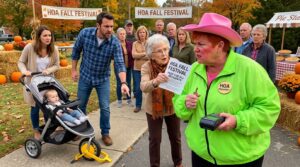
On a warm Saturday morning, residents gathered beneath a large white canopy for the neighborhood’s first annual emergency preparedness day.
There were tables with hurricane checklists, battery-powered radios, first-aid supplies, and information about evacuation routes.
County emergency management volunteers demonstrated how to store drinking water safely.
A local pharmacist answered questions about keeping medications available during power outages.
Children helped assemble small emergency kits for elderly neighbors.
The event was organized by Helen Brooks.
Robert Gaines handled the budget.
Thomas helped prepare the informational materials.
Evelyn Carter was responsible for refreshments.
She had insisted on the assignment.
At seventy-seven, Evelyn moved a little more slowly than she once had.
But she was determined to remain useful.
She arranged lemonade, sandwiches, and homemade cookies on a folding table.
Walter sat nearby, checking names on the volunteer sign-up sheet.
The two had become close friends after the hurricane.
They checked on one another most mornings.
Sometimes they shared dinner.
Sometimes they simply sat outside and watched the evening light settle over the canal.
Their friendship had grown from a terrible experience into something neither had expected.
The neighborhood had changed in other ways.
Board meetings were better attended.
Financial reports were easier to understand.
Residents volunteered for committees.
Disagreements still happened.
People argued about landscaping costs, parking spaces, and whether the clubhouse needed new furniture.
But the arguments were different now.
Questions were answered.
Records were available.
Nobody was threatened for asking how money had been spent.
The association had also established a written emergency access policy.
It made clear that authorized emergency responders and disaster relief personnel would not be subjected to HOA access fees or obstruction.
The policy had been reviewed with the county.
Copies were posted in the clubhouse and distributed to homeowners.
Near the main entrance, the old AUTHORIZED ENTRY BY HOA APPROVAL ONLY sign had been removed.
In its place stood a new sign.
PELICAN SHORES
NEIGHBORS HELPING NEIGHBORS
Thomas had suggested the wording.
The board approved it unanimously.
Margaret Voss still owned her home in the community.
She had largely withdrawn from neighborhood activities.
Some residents remained angry with her.
Others preferred not to discuss the past.
A few occasionally saw her walking along the canal in the early morning.
She no longer wore her HOA badge.
Her expensive jewelry and flamboyant jackets had become less common.
She kept mostly to herself.
One afternoon, several weeks before the preparedness event, Margaret had approached Evelyn near the community mailbox.
Evelyn wasn’t sure what to expect.
For years, their conversations had involved warnings, fines, or complaints.
This time, Margaret seemed uncomfortable.
She asked whether Evelyn had recovered from the hurricane.
Evelyn said she had.
Margaret looked down at the letters in her hand.
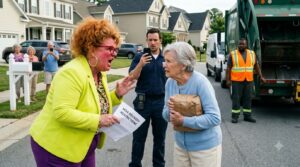
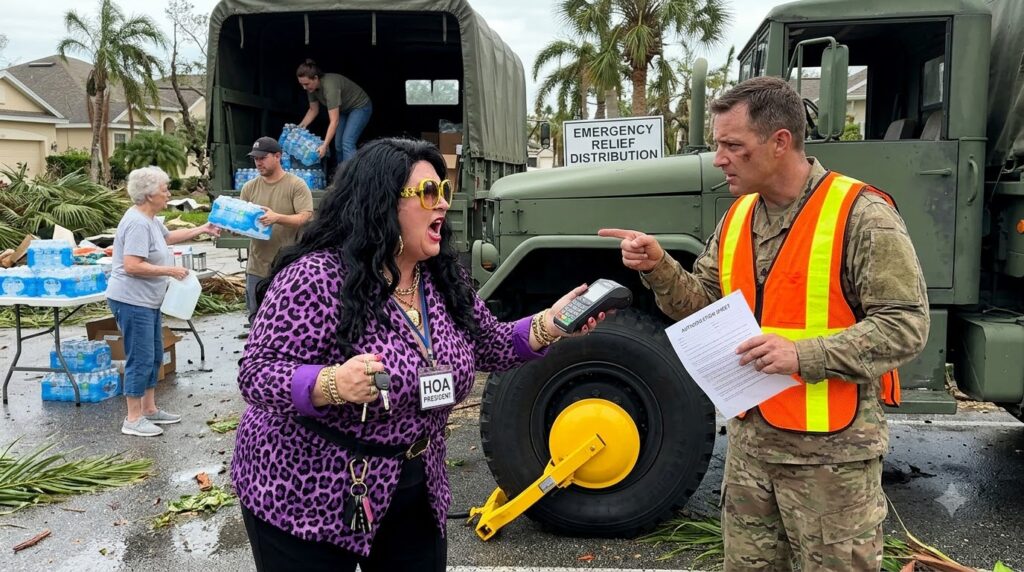
Then she apologized for what happened at the relief truck.
It was brief.
Awkward.
And far too late to undo the harm.
Evelyn accepted the apology without pretending everything was forgotten.
She told Margaret that the neighborhood had needed help, not control.
Margaret nodded.
They parted without another word.
Evelyn later told Helen about the conversation.
Helen asked whether she believed Margaret had changed.
Evelyn considered the question.
She didn’t know.
People could regret consequences without fully understanding the damage they caused.
Real change required more than a few words.
But Evelyn was willing to leave room for the possibility.
She had lived long enough to know that bitterness could become its own kind of prison.
On the morning of the preparedness event, Daniel Mercer returned as an invited guest.
He arrived in a county emergency management vehicle rather than the olive-drab cargo truck.
Several residents recognized him immediately.
Walter shook his hand.
Helen thanked him for his team’s work.
Evelyn approached carrying a small framed photograph.
It was the same image Thomas had received months earlier.
The photograph of her holding the first bottle of water.
Evelyn had placed it in a simple wooden frame.
She wanted Daniel to have it.
Daniel looked at the picture and smiled.
He said he was glad the team had been able to help.
Evelyn shook her head gently.
The photograph wasn’t only about the water.
It was about the moment the neighborhood remembered what mattered.
People had been frightened.
They had been tired.
Some had lost nearly everything.
But they had still found ways to care for one another.
Daniel accepted the frame.
He promised to place it in the emergency operations office.
Later that afternoon, the residents gathered for a short dedication ceremony.
Robert thanked the volunteers who had helped during and after the hurricane.
He recognized the county relief team, local emergency workers, and the residents who had checked on vulnerable neighbors.
Then he invited Evelyn to speak.
She stood beneath the canopy, looking out at familiar faces.
Some belonged to people she had known for decades.
Others belonged to newer residents who had moved in only recently.
She thought about Frank.
She thought about the blue house they had bought when the streets were still unfinished.
She remembered their children riding bicycles around the retention pond.
She remembered neighborhood cookouts, holiday decorations, and quiet evenings on the porch.
And she remembered the morning she stood beside a military truck with an empty water jug.
Evelyn didn’t speak for long.
She said that homes were important.
Property values mattered.
Rules had their place.
But a community was measured by what its people did when someone needed help.
She looked toward Thomas, Helen, Walter, and Robert.
Then toward Daniel.
The people who had shown up.
The people who had refused to look away.
When Evelyn finished, the applause lasted longer than she expected.
She returned to her chair, embarrassed by the attention.
Walter handed her a glass of lemonade.
Across the lawn, children laughed as they practiced packing emergency bags.
Volunteers carried supplies into the newly organized storage room.
A county worker explained how residents could request assistance during future storms.
Everything was ordinary.
And that was what made it beautiful.
Thomas stood near the entrance, watching the activity.
His phone buzzed.
It was a message from his daughter, who lived in North Carolina.
She had seen photographs of the event.
She asked whether he was finally ready to stop worrying about the HOA.
Thomas smiled.
He looked at the new community sign.
Then he typed a reply.
He told her he wasn’t worried anymore.
He was involved.
There was a difference.
As the afternoon ended, Evelyn walked home along the repaired sidewalk.
The sky was clear.
A warm breeze moved through the palms.
Her porch railing had been repainted, and a neighbor had helped replace the damaged steps.
The house looked much as it had before the storm.
But Evelyn knew something had changed.
For years, she had thought of home as the place where she and Frank built their life.
Now she understood that home was also the people who came when the lights went out.
The neighbor who shared a generator.
The volunteer who carried a heavy box.
The man who refused to stop delivering water.
The retired editor who kept recording when everyone else was too shocked to move.
And the residents who finally stood together and demanded fairness.
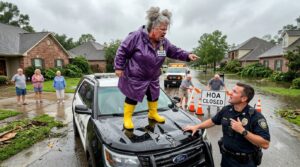
Margaret had tried to stop a relief truck with a yellow wheel clamp and a stolen set of keys.
She believed control meant power.
But the truck’s cargo doors had remained open.
The water had kept moving.
And in the end, so had the neighborhood.
Evelyn reached her porch and looked back toward the clubhouse.
She could still hear laughter in the distance.
For the first time in a long while, she felt certain about the future of Pelican Shores.
Not because the community had found a perfect leader.
Not because every problem had been solved.
But because its residents had learned a lesson they would not easily forget.
A neighborhood is not protected by the person who holds the keys. It is protected by the people who open their doors when someone needs help.
And this time, no one would be allowed to lock kindness away.