Chapter 3: The Water That Almost Never Arrived
Daniel Mercer had dealt with difficult people before.
During his twelve years in emergency logistics, he had encountered frightened homeowners, angry business owners, exhausted local officials, and volunteers who wanted to help but didn’t understand the danger.
He knew disasters brought out powerful emotions.
Fear could make reasonable people behave irrationally.
But Margaret Voss was different.
She wasn’t frightened.
She was calculating.
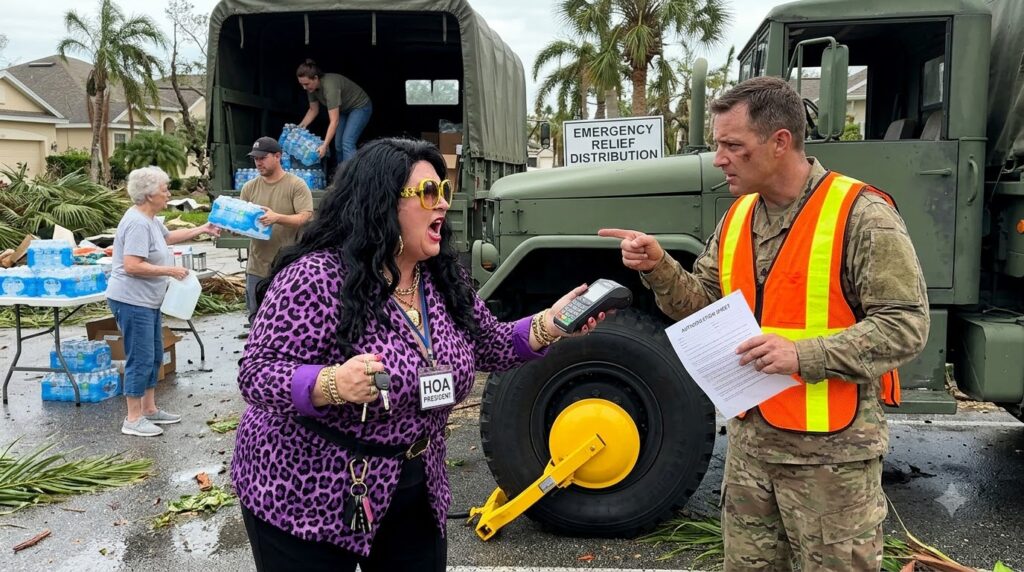
Even after the first cases of water reached the residents, she continued demanding payment.
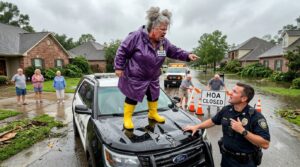
She insisted that the HOA controlled the streets and that the emergency team had violated community access rules.
Daniel understood that arguing with her would accomplish little.
His priority was the people waiting in line.
He instructed his volunteers to continue unloading the truck while he contacted the county emergency operations center.
The dispatcher confirmed that Pelican Shores was an approved relief location.
The authorization had been issued that morning.
No HOA payment was required.
Daniel reported the stolen keys and wheel clamp.
He also explained that the truck remained operationally accessible because its cargo compartment was open.
The dispatcher advised him that a deputy was being sent.
Until then, Daniel kept the distribution moving.
The first supplies went to residents with urgent medical needs.
Walter received drinking water and shelf-stable meals.
A woman recovering from surgery received bottled water and assistance carrying it home.
Several residents took supplies to neighbors who couldn’t leave their houses.
Evelyn remained near the table after receiving her water.
She watched a young volunteer struggle with a heavy carton and stepped forward to help.
The volunteer gently declined.
Evelyn insisted on carrying a smaller package.
At seventy-six, she knew her limitations.
She also knew she was tired of feeling helpless.
Meanwhile, Margaret moved from one end of the truck to the other, looking for some way to reassert control.
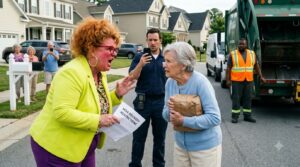
She threatened to report the volunteers for trespassing.
She photographed their identification badges.
She wrote down the truck’s registration number.
Then she began demanding the names and addresses of everyone receiving water.
Helen Brooks stepped between Margaret and the distribution list.
Helen was sixty-eight, a retired elementary school principal with silver hair and a manner that rarely invited argument.
She had spent thirty years managing classrooms full of children.
Margaret’s performance did not impress her.
The residents needed water, Helen explained, not another layer of paperwork.
Margaret claimed she needed the information to assess emergency service charges.
That was when Evelyn finally spoke.
She had been quiet through most of the confrontation.
Now she looked directly at Margaret.
“My husband paid dues here for thirty-eight years. We didn’t pay them so someone could charge us for a bottle of water after a hurricane.”
The words weren’t loud.
They didn’t need to be.
Several neighbors nodded.
Margaret turned away, but her expression had changed.
She had expected the residents to remain passive.
Instead, they were beginning to stand together.
Thomas noticed something else.
Margaret repeatedly glanced toward the clubhouse.
The building had suffered extensive damage, but a small storage shed behind it remained intact.
Earlier that morning, Thomas had seen two workers carrying unopened cartons into the shed.
He assumed they were moving HOA records away from the water.
Now he wasn’t so certain.
He asked Helen whether the HOA had purchased emergency supplies before the hurricane.
Helen remembered an announcement about a preparedness fund.
The board had approved money for bottled water, batteries, flashlights, and temporary shelter equipment.
Margaret had personally overseen the purchases.
But none of those supplies had been distributed.
Thomas felt a cold uneasiness settle in his stomach.
If the HOA had already purchased emergency supplies with residents’ money, why were people waiting desperately for a county truck?
He approached the shed.
A heavy padlock secured the door.
Through a narrow gap beneath the roof, he could see stacked cardboard boxes.
Some carried the printed logo of a regional wholesale distributor.
Others were labeled with the HOA’s name.
Thomas photographed the boxes through the gap.
Then he returned to the distribution area.
He found Daniel helping a resident load water into a wheelbarrow.
Thomas showed him the photographs.
Daniel studied them carefully.
The markings suggested the cartons contained bottled water and emergency food.
He couldn’t confirm what was inside without opening them.
But the quantity appeared substantial.
Thomas explained that the HOA had purchased emergency supplies before the storm.
Daniel looked toward the shed.
Then toward the line of residents.
If those boxes contained what Thomas suspected, the neighborhood might have had enough water to begin distribution the previous day.
Instead, elderly residents had spent two nights rationing their last bottles.
Daniel asked Thomas not to force the lock.
The arriving deputy would need to document the situation properly.
Thomas agreed.
He had spent his career believing that facts mattered most when emotions were running high.
But as he walked back toward Evelyn, he couldn’t help thinking about the unopened boxes sitting behind a locked door.
The water had been there.
Possibly all along.
And Margaret had known exactly where it was.