Chapter 4: The Locked Shed
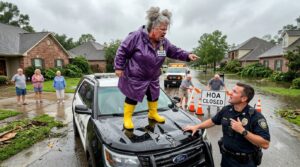
Deputy Rebecca Alvarez arrived shortly after noon in a county sheriff’s SUV marked with dried mud and saltwater stains.
She was forty-six, experienced, and visibly exhausted.
Her department had spent the previous two days responding to flooded homes, missing-person reports, blocked roads, and medical emergencies.
A dispute involving an HOA president and a military relief truck was not what she expected.
But the situation became clear almost immediately.
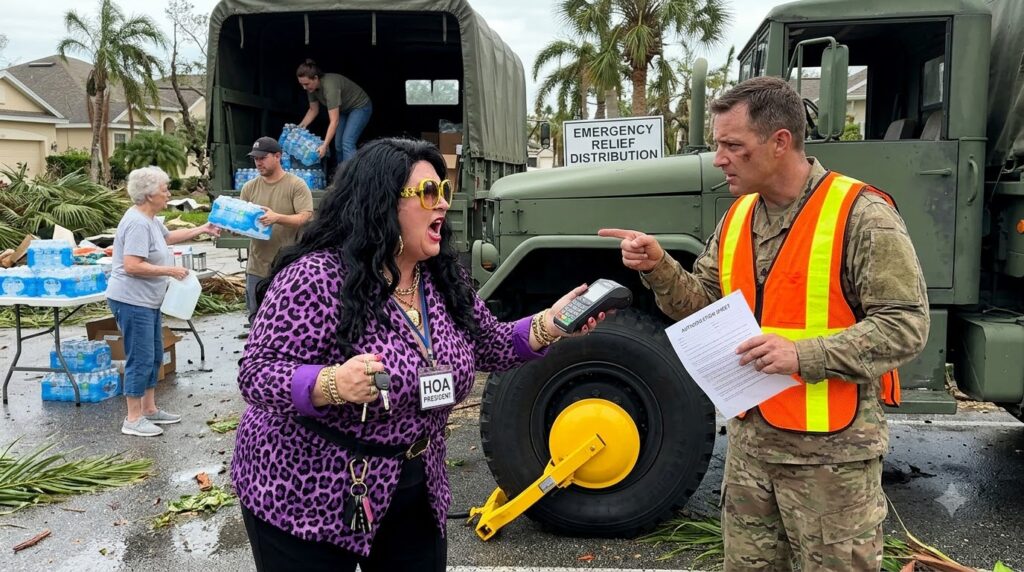
The yellow wheel clamp remained attached to the truck.
Margaret still held the ignition keys.
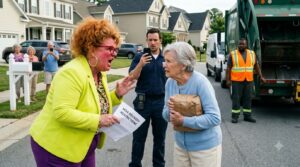
Daniel presented the emergency authorization.
Thomas offered his video.
Rebecca separated the parties and began establishing the facts.
Margaret claimed the truck had entered private property without permission.
She insisted that the $750 charge was authorized under emergency access rules.
Rebecca asked to see the written policy.
Margaret produced a laminated sheet bearing the HOA logo.
The document listed various charges for unauthorized commercial vehicles, temporary equipment, and outside contractors.
There was no specific provision for county-authorized disaster relief.
Rebecca also noticed that the document lacked an adoption date and board approval reference.
Margaret insisted that she had executive authority during emergencies.
Rebecca explained that an HOA badge did not grant her the right to take someone else’s vehicle keys.
Margaret’s expression hardened.
For the first time that morning, she appeared uncertain.
Rebecca instructed her to return the keys.
Margaret hesitated.
Then she placed them in the deputy’s outstretched hand.
The moment was small but significant.
For years, Margaret had issued demands and expected obedience.
Now someone with actual law-enforcement authority was telling her what to do.
The deputy returned the keys to Daniel.
A relief mechanic removed the wheel clamp after Margaret surrendered its key.
Daniel checked the tire and confirmed that the truck had not been damaged.
The vehicle could move again.
But the deputy wasn’t finished.
Thomas showed her the footage of Margaret positioning the barrier before the truck arrived.
He also showed her the photographs of the locked storage shed.
Rebecca asked Margaret about the emergency supplies.
Margaret claimed they were HOA property and could not be distributed without formal authorization.
Thomas explained that the supplies had been purchased with a community emergency preparedness fund.
Margaret disputed that characterization.
She said the inventory was reserved for a later stage of the disaster.
Helen joined them with a copy of the HOA’s emergency preparedness notice.
The notice promised that water and essential supplies would be made available to residents when normal services were interrupted.
The hurricane had interrupted normal services two days earlier.
Rebecca examined the notice.
Then she asked Margaret for the storage inventory and purchase records.
Margaret said those documents were unavailable because the clubhouse office had flooded.
Thomas quietly pointed out that he had seen Margaret’s maintenance workers entering the shed that morning.
Rebecca requested permission to inspect it.
Margaret refused.
The deputy did not force entry.
Instead, she documented the refusal and contacted the county emergency management office and her supervisor.
The shed was private HOA property, and she needed a proper legal basis before taking further action.
While they waited, Thomas called the wholesale distributor whose logo appeared on the cartons.
He didn’t ask for private customer records.
He simply confirmed that the company sold emergency bottled water and food kits.
Then he contacted two HOA board members.
One was out of town.
The other, a retired accountant named Robert Gaines, answered immediately.
Robert had been vice president of the association for three years.
He had approved the emergency preparedness budget but believed the supplies were being stored for distribution through the clubhouse.
He was stunned to learn that residents had received nothing.
Robert drove to the community from his daughter’s home in a neighboring town.
When he arrived, Thomas showed him the locked shed.
Robert examined the HOA inventory labels visible through the gap.
He recognized the purchase order numbers.
He also recognized the padlock.
It was one Margaret had installed after removing the previous board’s shared access system.
Robert took out his phone and opened the HOA’s digital financial records.
The emergency preparedness purchases appeared in the ledger.
So did several additional payments he didn’t remember approving.
One payment was especially troubling.
It had been made to Coastal Community Compliance.
The same company Thomas had questioned months earlier.
Robert stared at the amount.
$18,400.
The description read:
Emergency access management and security equipment.
He had never approved an $18,400 emergency security contract.
Neither had the board, as far as he knew.
Robert looked toward Margaret, who was arguing with the deputy beside the relief truck.
For the first time, he began to understand why Thomas had been so persistent about the financial records.
The locked shed was only one part of the problem.
The money trail was another.
And it appeared to lead straight back to Margaret.