Chapter 7: The Meeting Margaret Couldn’t Control
Three weeks after the hurricane, the Pelican Shores clubhouse remained closed.
The roof needed repairs, and several rooms were unsafe.
So the association held its special membership meeting in the auditorium of a nearby community church.
More than 150 homeowners attended in person or through valid proxy arrangements.
It was the largest HOA gathering anyone could remember.
Some residents arrived using walkers.
Others came with adult children who helped them navigate the crowded parking lot.
A few wore work clothes because they were still repairing storm damage.
Thomas sat near the front with a folder of documents.
Helen helped check attendance.
Robert stood beside the HOA attorney, reviewing the meeting agenda.
The process had been carefully prepared.
Notices had been delivered.
The applicable bylaws and state requirements had been reviewed.
The voting procedures were explained.
Independent volunteers helped verify the count.
Margaret arrived fifteen minutes before the meeting began.
She wore a bright red jacket, gold earrings, and her familiar HOA PRESIDENT badge.
Her expression suggested she expected the room to become silent when she entered.
It didn’t.
Residents continued speaking quietly among themselves.
Margaret walked to the front and demanded the microphone.
Robert explained that the meeting would follow the announced agenda.
The attorney confirmed the procedure.
Margaret protested.
Then she sat down.
The first portion of the meeting addressed the board’s decision to remove her from the office of president.
Under the association’s bylaws, the directors had authority to select and replace officers.
A properly convened board vote had already removed Margaret as president and appointed Robert to serve temporarily.
The membership meeting would address her separate position as a director.
The attorney explained the distinction carefully.
Margaret was given an opportunity to speak.
She claimed she had acted in the community’s best interests.
She said the hurricane created extraordinary circumstances.
She accused Thomas of conducting a personal campaign against her.
She insisted that strict leadership had protected Pelican Shores for years.
Some residents listened sympathetically.
Margaret had supporters.
A few remembered her organizing repairs after earlier storms.
Others believed she had once been effective, even if her methods had become harsh.
Thomas understood their perspective.
He didn’t want the meeting to become an exercise in humiliation.
He wanted accountability.
When his turn came, he spoke briefly.
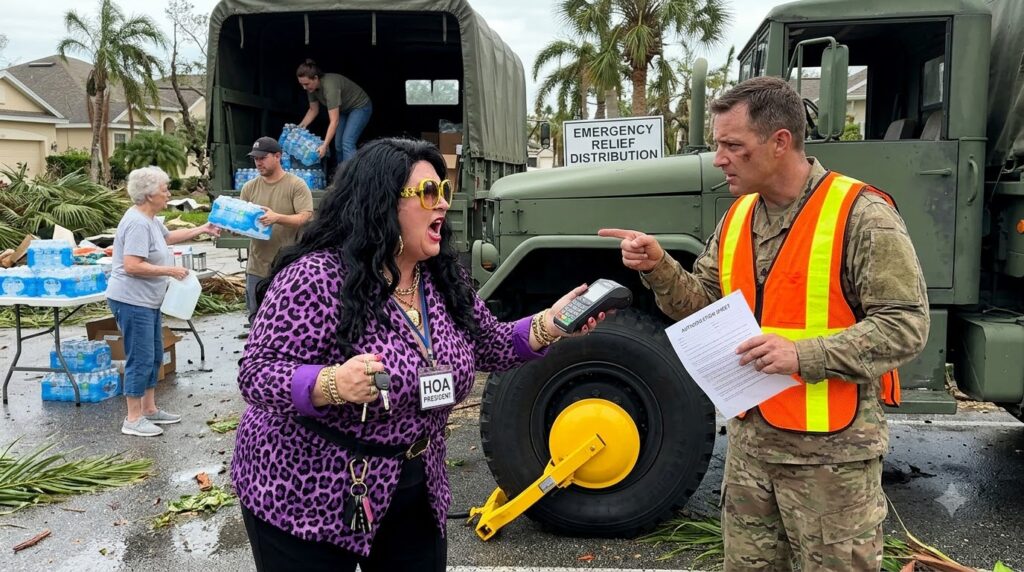
He described the relief truck incident, the locked supplies, and the financial questions.
He emphasized that the independent review and law-enforcement investigation were still ongoing.
He did not claim that every allegation had been proven.
He simply asked the residents to consider whether Margaret had demonstrated the judgment and trustworthiness required to remain on the board.
Then Evelyn Carter stood.
She hadn’t planned to speak.
Her daughter had driven her to the meeting, and Evelyn intended to listen quietly.
But when she looked across the auditorium, she saw neighbors who had shared water, food, and generators during the worst days of the storm.
She remembered standing beside the relief truck with her empty jug.
She remembered Margaret demanding money while people waited.
Evelyn walked slowly to the microphone.
She spoke about her late husband, Frank.
He had served in the Navy, worked as an electrician, and believed that a neighborhood was more than a collection of houses.
Frank used to say that a good community was one where people noticed when someone else’s porch light stayed dark.
Evelyn told the room that she had loved Pelican Shores for nearly four decades.
She wanted to love it for whatever years she had left.
But she could not trust a leader who placed control ahead of human need.
When she finished, the auditorium remained quiet.
Then people began applauding.
Not wildly.
Not triumphantly.
It was the sound of neighbors recognizing something they had almost forgotten.
They belonged to one another.
The vote followed.
The ballots were collected and counted according to the established procedures.
Margaret sat rigidly near the front.
Thomas watched the volunteers verify the results.
The recall passed by a substantial margin.
Margaret was removed from her director position.
Robert announced the result.
There were no cheers.
Only a long, collective release of tension.
Margaret stood, removed the HOA PRESIDENT badge from her jacket, and placed it on the table.
For a moment, she looked older than her sixty years.
Then she walked out.
Outside, the evening air smelled of wet pavement and freshly cut branches.
Margaret paused beside her car.
Across the parking lot, she could see Evelyn talking with Helen.
Thomas was helping Walter into his vehicle.
Robert was answering questions from homeowners.
Nobody appeared to be celebrating her defeat.
They were already discussing repairs, budgets, and the next steps toward rebuilding.
Margaret realized that the neighborhood had moved on without her.
But the consequences of her actions were not finished.
The HOA vote had ended her leadership.
The legal investigation was still underway.
And the financial records were beginning to tell their own story.