Chapter 5: The Company Nobody Was Supposed to Question
By the following morning, the story had spread beyond Pelican Shores.
Thomas’s video had been shared among residents, their adult children, and several neighborhood groups.
The footage was difficult to misunderstand.
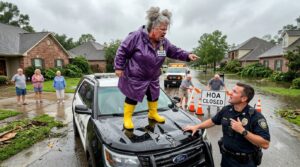
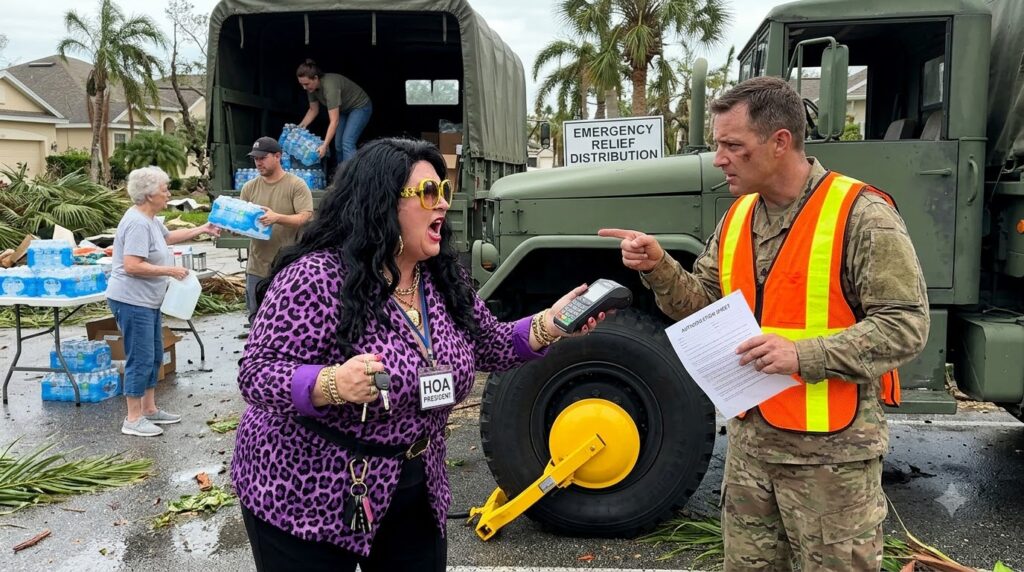
A woman wearing an HOA PRESIDENT badge had clamped a relief truck, taken its keys, and demanded $750 while hurricane survivors waited for water.
A local television station contacted Thomas.
He agreed to speak with a reporter but insisted that the coverage focus on the residents and the relief operation.
He had no interest in turning the neighborhood’s suffering into entertainment.
What concerned him was the possibility that money intended for emergencies had been diverted.
Robert Gaines shared that concern.
As vice president, he called an emergency board meeting using the association’s established procedures.
Three directors participated by telephone.
Margaret refused to attend.
She sent an email accusing Thomas and Robert of conspiring to remove her from office.
The board proceeded with the business it was authorized to conduct.
Robert presented the financial records.
The emergency preparedness fund had originally contained $42,000.
According to the ledger, the HOA spent approximately $16,000 on bottled water, food kits, batteries, and emergency equipment.
Another $18,400 went to Coastal Community Compliance.
Additional charges included consulting fees, administrative assessments, and equipment rentals.
The fund’s remaining balance was far lower than the board expected.
Thomas had brought copies of the invoices he retained from his time as treasurer.
The company name appeared repeatedly.
Robert searched the Florida business registration records.
Coastal Community Compliance had been organized several years earlier.
Its registered manager was a man named Curtis Voss.
Margaret’s nephew.
Robert recognized the name immediately.
Curtis had attended several HOA meetings and occasionally helped Margaret with computer problems.
He was thirty-four and operated a small property maintenance business in another county.
No board minutes showed that Margaret had disclosed the family relationship when recommending the company.
That did not automatically prove a crime.
But it raised serious questions about conflicts of interest, contract approval, and whether the services had actually been performed.
The directors voted to obtain an independent review of the payments.
They also voted to suspend any further discretionary payments to Coastal Community Compliance pending that review.
Robert contacted the HOA’s attorney.
The attorney advised the board to preserve all financial records, communications, invoices, and meeting minutes.
He also cautioned against making public accusations before the facts were established.
Thomas agreed.
He had no desire to replace Margaret’s arrogance with a different kind of recklessness.
Meanwhile, the county sheriff’s office continued investigating the truck incident.
Daniel had filed a formal report.
The deputy’s body-camera footage, Thomas’s recording, and witness statements provided a consistent account.
The keys had been taken without permission.
The wheel clamp had been installed without the relief coordinator’s consent.
The demand for payment had been explicit.
The truck had been delayed, though its supplies were ultimately distributed.
The sheriff’s office referred the matter for prosecutorial review.
Margaret responded by hiring an attorney.
She released a written statement claiming that her actions had been misunderstood and that she had acted to protect residents from unauthorized vehicles.
The statement did not explain why she had taken the keys.
It also did not explain the $750 demand.
Then something unexpected happened.
Curtis Voss contacted Robert.
He said he wanted to correct the record.
Robert arranged a meeting with the HOA attorney present.
Curtis arrived carrying a laptop and a folder of printed invoices.
He looked nervous.
His company, he explained, had originally been hired to provide parking enforcement and access-control services.
Margaret had expanded the arrangement over time.
Some invoices were legitimate.
Others described services Curtis said his company had never performed.
He claimed Margaret had instructed him to submit certain charges using descriptions she supplied.
He also claimed she had directed him to purchase wheel clamps shortly before the hurricane.
Curtis showed the attorney an email.
In it, Margaret described a plan to charge outside contractors and emergency service providers for access to Pelican Shores.
The email referred to disaster conditions as an opportunity to recover lost HOA revenue.
Robert read it twice.
Thomas remained silent.
He had suspected financial misconduct.
But seeing the words in writing made the situation feel worse.
Margaret hadn’t merely lost her temper when the relief truck arrived.
According to the records Curtis provided, she had been preparing an access-fee scheme before the storm struck.
The attorney instructed everyone to preserve the documents and avoid discussing the allegations publicly until they could be verified.
Curtis agreed to cooperate with the independent review.
When the meeting ended, Robert sat alone in his car for several minutes.
He thought about the residents standing in line with empty water containers.
He thought about Evelyn and Walter.
He thought about the years he had served on the board without questioning Margaret more closely.
Then he called Thomas.
There was something they needed to do immediately.
The residents had to regain control of their emergency supplies.
And this time, they would not wait for Margaret’s permission.