
CHAPTER 7: THE PERMANENT LOCK DOWN
The screaming red glare from the tactical server rack turned the damp concrete walls into a pulsing, open artery. Commander Vance had completely retreated from the interface, his hands scraping uselessly against his starched trousers as the mechanical key matrix began to click on its own—a phantom input sequence triggered by someone else on the flight line. The sheer speed of the cascading code was melting the legacy safety algorithms, filling the small bunker with the sharp, rancid odor of scorched resin.
The Senior Serviceman didn’t waste motion on the commander. He stepped into the core lane of the server floor, his heavy boots crushing the fine layer of abrasive metal shavings that had settled over the deck plates. His aluminum clipboard slammed down onto the auxiliary terminal frame with a violent metallic ring, the metal buckling under his hand.
Through the narrow viewing slit of the bunker, the loud, dual-turbine whine of the fourteen hundred transport plane reached its peak escalation, the aircraft shifting its heavy weight onto its primary wheels to begin taxiing toward the active line. The silver solid-state arrays in the split crate were already broadcasting. Miller hadn’t been an idiot trainee running a private hustle, nor was he an institutional stress test. He was the local bridge, an unthinking conduit whose modified simulation flight paths had provided the precise topographical blind spot needed to bypass the base’s internal security parameters.
“The secondary interface is on the back panel,” Vance shouted, his voice cracking against the scream of the high-voltage override alarm. “But the breaker box has an administrative lock, counselor. If you force the manual drop, the entire server cluster blows its logic. There’s no retrieval after that. It erases thirty years of operational memory.”
The veteran didn’t look back. He shoved his thick hands behind the main iron frame of the monolith, his fingers finding the coarse, rusted edge of the emergency isolation housing. The sheet-metal casing was hot to the touch, its flaking gray paint blistering against his skin as he dug his knuckles into the narrow gap. He didn’t have twenty minutes to trace the code path; he didn’t even have twenty seconds. The plane was turning into the wind.
He pulled the silver mechanical stopwatch from his chest pocket. The internal mechanism was still ticking with its dry, unyielding regularity, completely unconcerned with the digital collapse around it. He laid the small steel disc directly onto the copper bus-bar of the manual override circuit.
The metal shorted instantly.
A sharp, brilliant arc of blue electrical fire erupted from the panel, hissing as it oxidized the grease on the terminals and casting violent shadows across the unpainted concrete walls. The heavy smell of ozone filled his throat like swallowed dust. The internal gears of the stopwatch seized, the mainspring snapping with a tiny, clean click against his ribs. The time had officially run out.
He threw his entire mass against the primary lever. The iron bar was rusted into its housing from decades of dry desert air, stubborn and unyielding under his initial pull. The veteran locked his boots into the deck, his chest expanding beneath the green flight suit as his muscles committed to the absolute limit of their structural capacity. The tendons in his throat stood out like steel cables, his knuckles scraping raw against the sharp galvanized edges of the chassis as he forced the dead mechanical linkage down.
The lever broke its rust with a loud, echoic thud that sounded like a rifle shot inside the vault.
The crimson light died. The wailing of the diagnostic override alarm dropped into a low, descending moan before the entire room plunged into absolute blackness. The cooling fans spun down, their dry bearings squealing into silence until the only remaining sound was the distant, muffled roar of the transport aircraft outside suddenly losing its telemetry guidance loop. The plane’s engines coughed, their thrust dropping back down to a clean baseline idle as the cockpit navigation systems went black on the tarmac.
The vault became a tomb of cooling metal and stagnant grease.
Vance was a silent shadow in the corner, his shallow, terrified breathing the only proof he hadn’t left the room. The veteran remained standing over the dead terminal, his hands resting on the iron housing, his fingers wet with his own blood and the dark oil of the lever. The silence was heavier than the heat outside. It was the absolute silence of a dead system.
He reached down in the dark, his hand finding the edge of his buckled aluminum clipboard and the small, sheared iron rivet that had rolled into the gutter of the counter. He took both items, his stride unhurried and precise as he walked back toward the sheet-metal door, pushing it open into the blinding glare of the afternoon sun.
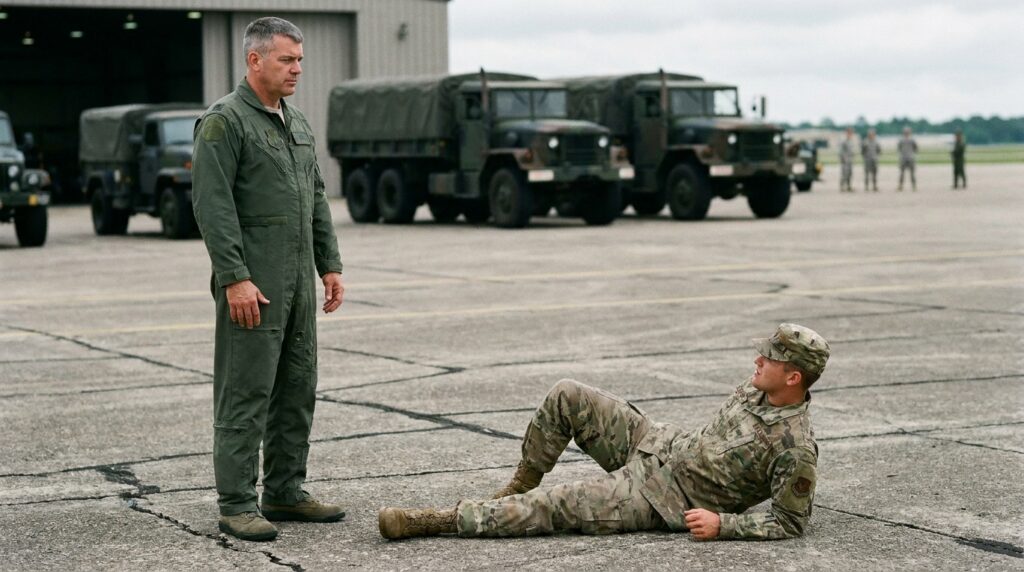
The flight line was entirely frozen. The transport plane sat dead on the secondary taxiway, its nose wheel turned slightly toward the dirt shoulder, surrounded by three-ton trucks that had finally cut their diesel engines. Trainee Miller was sitting on the back of an ambulance fifty yards away, his shoulder wrapped in rough white gauze, his low-slung cap gone. He looked across the concrete at the Senior Serviceman walking down the lane. There was no defiance left in his eyes; there was only the quiet, empty reverence of a soldier who had realized the manual wasn’t written to limit him—it was written to keep him alive.
The veteran didn’t stop to look at him, nor did he look back at the administrative shack. He walked past the silent base personnel, his green flight suit stained with grease and iron scales, his face an unreadable monument of weathered stone. He had permanently locked the command structure. The replacement algorithms would have no data to digest today, and the legacy would remain exactly where it had been earned—deep inside the pavement.








