
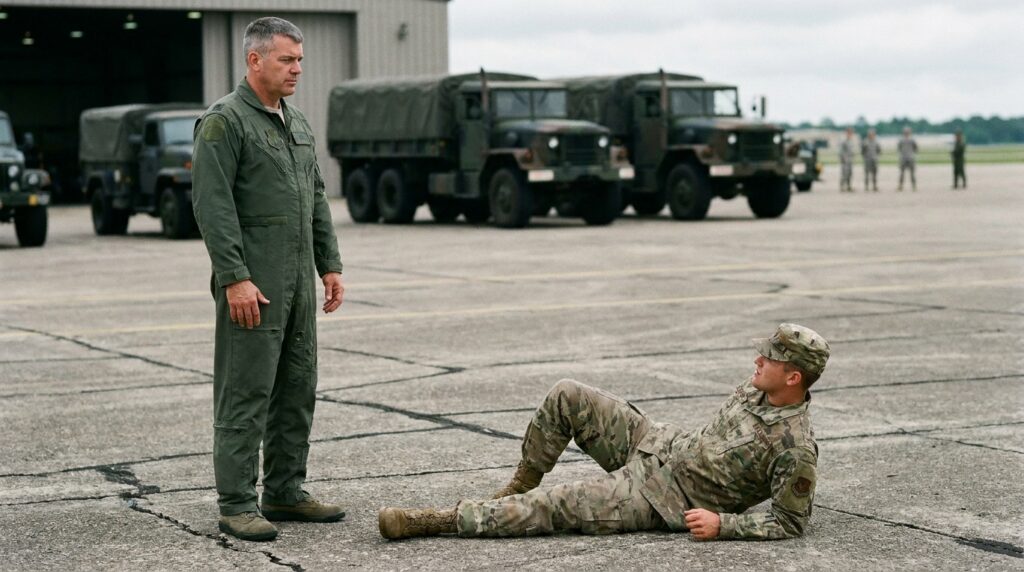
CHAPTER 2: THE CORROSION OF ALIGNMENT
“A six-degree drift isn’t an option on a low-observable approach, Trainee Miller. It’s a localized suicide vector.”
The air inside the simulation bay was thick with the scent of ozone and the stale, chemical humidity of hard-running cooling fans. Unlike the blinding glare of the flight line outside, the bay was a cavern of desaturated shadows, lit only by the sickly green phosphor glow of the tactical display grids. The Senior Serviceman did not lower the clipboard. His eyes, narrowed and flat as chipped flint, tracked the lime-green vectors cutting across the glass terminal screen.
Trainee Miller didn’t step back from the console. His fingers, stained with dry hydraulic fluid that had dried into the creases of his knuckles like rust, remained planted on the edge of the input deck. The metallic casing of the simulator was cold, its paint flaking off in tiny, gray scales wherever boots had kicked the base frame over the years. Miller leaned his weight forward, his shoulder joint locking with a stiff, defiant click.
“The new atmospheric data from the ridge line accounts for the drift, advisor,” Miller said, spitting the title out like a bit of loose tobacco. He pointed a grease-blackened finger at the flight path modification he’d scribbled directly onto the simulator’s plexiglass overlay. “We aren’t flying the old iron anymore. The airframes we’re running can pull through the sheer before the guidance computer even registers the drop. Your manual is out of spec by twelve thousand hours.”
The veteran didn’t answer immediately. He let the silence settle, a heavy, dead weight that filled the small space between them until the hum of the transformer sub-station beneath the floorboards seemed to vibrate in their teeth. From the perimeter of the dark bay, near the racks of decaying flight gear and salt-crusted oxygen masks, two base mechanics stopped sorting their copper washers. The light scratching of brass brushes against steel pins ceased entirely. The witness layer was thickening again, their eyes reflecting the pale green phosphor.
The Senior Serviceman reached out, his thick thumb tracing the edge of the plexiglass overlay. He felt the rough, jagged scoring where Miller’s stylus had gouged the plastic. It wasn’t just a modification; it was an erasure of standard safety margins. He pulled his silver mechanical stopwatch from his chest pocket, the turn-screw rough against his palm, its internal spring ticking with the dry, metronomic heartbeat of an era Miller considered dead.
“The guidance computer relies on the static ports along the belly,” the veteran said, his gravelly tone cutting through the cooling fans’ drone. “At four hundred knots in a thermal inversion over the valley floor, those ports don’t see air. They see vacuum. Your airframe won’t pull through the sheer, Miller. It will pitch until the tail-planes shear off at the root. I wrote that manual because I buried three men who thought the computer was smarter than the mountain.”
“That was thirty years ago,” Miller shot back, his jaw tightening until the tendons in his throat stood out like taut cables against his stiff collar. He didn’t check his position; he doubled down, his hand sliding closer to the primary control yoke as if to claim ownership of the simulated sky. “The tech has caught up. We don’t need the old guard holding the brakes when the tactical pace has doubled. Some of us are trying to prep for a real fight, not a memorial service.”
The insult hung in the damp air, sharp and unwashed. The veteran’s face remained a mask of weathered stone, but his internal calculations shifted three gears. He wasn’t looking at Miller’s arrogant glare; he was looking at the precise layout of the modified flight path coordinates. There was something wrong with the numbers. They didn’t just bypass the ridge line—they aligned perfectly with an unmonitored commercial corridor three hundred miles to the west, a sector completely outside this unit’s training mandate.
He reached down, his fingers brushing past Miller’s hand with the slow, deliberate friction of a heavy piston moving in its sleeve. He tapped the specific coordinate marker for the simulation’s turning point—a remote, dry lake bed marked on the glass as Sector Seven.
“Who gave you this atmospheric update, Trainee?” the veteran asked, his voice dropping into a deeper, cooler register that made the mechanics by the tool racks shift their boots.
Miller’s eyes flickered, a micro-second of hesitation breaking the symmetry of his confidence. He pulled his hand back from the yoke, his palm scraping against the oxidized aluminum edge of the console with a dry hiss. “It came through the standard data drop. Morning shift logistics report.”
“The morning logistics report was restricted to maintenance turn-arounds today,” the Senior Serviceman countered flatly, his thumb pressing down on the plexiglass until the plastic flexed under his weight. “This file has a high-altitude routing signature. It didn’t come from the ground crew.”
He picked up the loose simulator logbook resting on the top deck. As his thumb flicked through the yellowed pages, his eyes caught a fresh, crisp entry at the very bottom of the ledger—a sequence of numbers written in a sharp, blue ink that hadn’t completely cured against the greasy paper. The handwriting didn’t belong to any instructor on this base. It was a precise, block-letter script, identical to the notation style used on the logistics manifests he’d been analyzing on the hot flight line an hour before.
A cold draft passed through the bay as the heavy steel fire door at the back of the hangar groaned open. A figure stood in the bright, blinding slit of daylight, their shadow stretching long and distorted across the concrete floor toward the simulation console. The veteran didn’t turn his head to look, but his fingers tightened on the edge of the clipboard until the aluminum groaned. He knew the silhouette without seeing the face. The game wasn’t just happening on the tarmac anymore; the sand was already inside the turbines.








