
CHAPTER 4: THE GEOMETRY OF FALLING
The transition from the shadowed maintenance bay to the active flight line was like stepping into an open blast furnace. The noon sun hammered against the concrete, baking the oxidized iron of the hangars and turning the air into a wavering, toxic mirage of diesel exhaust and hot tar. The Senior Serviceman didn’t squint. He let his pupils contract naturally, his boots grinding against the loose grit of the tarmac as he walked the fifty yards to the staging lane.
The four remaining logistics cases sat stacked on a wooden pallet near the idling transport trucks. They were standard olive-drab composite crates, stenciled with faded yellow alphanumeric codes indicating routine hydraulic spares. But as the veteran closed the distance, the structural logic of the scene began to fray.
The trucks were still running, their heavy chassis vibrating, but the load-masters were nowhere near the tailgate. The mechanics who had been watching the earlier exchange had multiplied; a dozen ground crew personnel now stood near the perimeter fences, their wrenches and rags hanging limp in their hands. They were waiting for a performance.
The veteran reached the pallet. He ran a thumb over the locking latch of the top crate. It wasn’t a standard steel-pin hasp. It was a dense, rectangular block of matte-black tungsten—a biometric magnetic seal used exclusively for compartmentalized telemetry hardware. You didn’t put magnetic seals on hydraulic spares. You didn’t load them on a daylight training manifest.
The silver stopwatch ticked against his ribs. Vance’s test, he thought, the pieces locking into a grim, pragmatic framework. Vance ordered the boy to run these specific crates. Push the old man until he breaks protocol, disqualify his advisory status, and push the new training doctrine through without oversight. It was a dirty, administrative ambush, written in the language of logistics.
“I told you to clear the lane.”
The voice came from over his right shoulder. Trainee Miller stepped out from behind the heavy steel bumper of the transport truck, his camouflage uniform already stained with dark patches of sweat. He had walked fast to beat the veteran here. The younger man’s chest heaved slightly, the arrogance in his jaw now fueled by the adrenaline of Vance’s implicit backing. He believed he held all the cards. He believed the base commander had given him a hunting license.
“These four crates require a biometric clearance code to log, Miller,” the veteran said. He didn’t turn around. He kept his eyes on the matte-black lock, feeling the intense ambient heat radiating off the composite casing. “They contain restricted telemetry hardware. They don’t belong on this manifest.”
“They go on the truck,” Miller snapped, stepping closer. The gravel crunched under his chevron-tread boots. “The manifest is whatever I say it is. You’re an antique with a clipboard. You don’t have the clearance to authorize a fuel top-off, let alone challenge my cargo.”
The veteran finally turned. He rotated on the ball of his foot, a slow, deliberate movement that grounded his center of gravity perfectly over the hot asphalt. He let the clipboard drop to his side.
Miller stepped directly into his personal space, breaching the invisible boundary of physical safety. The younger man was three inches taller, his shoulders broad and corded with fresh muscle. He angled his chin down, trying to cast his shadow over the veteran’s face, exhaling a breath that smelled of stale coffee and copper. The air between them grew suffocatingly tight.
“Don’t mistake restraint for weakness,” the Senior Serviceman said. His voice was a low, gravelly vibration, completely devoid of anger. It was the tone of a mechanic warning a novice not to touch a live wire. “You’ve pushed this far enough.”
Miller’s lips curled into a sneer. The audience of mechanics was watching. Vance’s protection was absolute. He thought he saw hesitation in the older man’s stillness.
“Make me,” Miller whispered, and drove his right hand forward, hooking his thick fingers aggressively into the collar of the veteran’s green flight suit, aiming to physically shove the older man back against the pallet.
The veteran didn’t block the hand. He didn’t throw a punch. He relied on the brutal, unforgiving physics of momentum.
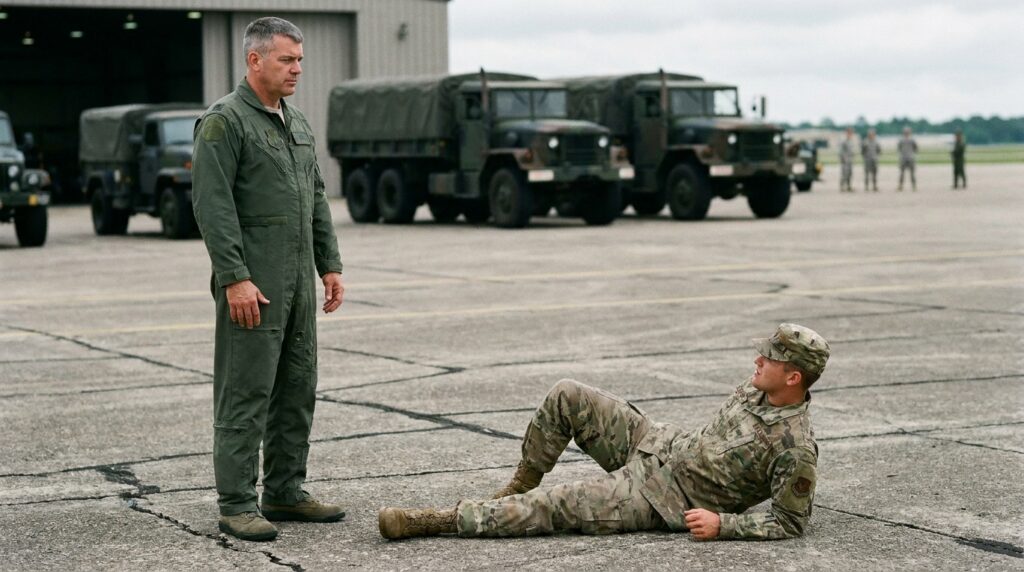
As Miller’s weight committed forward, the veteran executed a flawless, single defensive pivot. He dropped his center of gravity by two inches, his left hand snapping up to clamp over Miller’s wrist like a rusted iron vise, locking the joint. In the exact same fraction of a second, the veteran twisted his torso, guiding the young man’s aggressive, forward-driving energy past him. He swept his right forearm sharply across the back of Miller’s triceps, creating a devastating fulcrum.
Miller’s feet left the ground. The heavy, uncontrolled mass of the younger man rotated completely in the air, his own kinetic energy weaponized against him.
He hit the asphalt with a sickening, hollow crack.
The impact knocked the breath from Miller’s lungs in a violent rush. He bounced once, the rough concrete tearing the fabric of his shoulder and scraping a layer of skin from his cheekbone, before he settled into a stunned, paralyzed heap on the flight line.
Silence slammed down on the airfield. The only sound was the idle of the diesel engines and the ticking of the stopwatch in the veteran’s pocket.
The Senior Serviceman stood fully upright, unbothered, his breathing perfectly even. He hadn’t even taken a full step backward. He looked down at the younger man. Miller was gasping, his eyes wide and completely blown out with shock. The arrogance had evaporated in a microsecond, replaced by the terrifying realization of how easily he had been dismantled. The gap in their capability wasn’t a matter of age; it was a matter of lethal, ingrained discipline.
Around the trucks, the mechanics froze. No one reached for a radio. No one stepped forward. The absolute dominance of the single movement had rewritten the hierarchy of the entire tarmac.
The veteran looked down at the trainee, his face carved from stone. He didn’t offer a hand. He didn’t offer a lecture. But as he adjusted his stance, his boot brushed against the bottom crate on the pallet. The violent impact of Miller hitting the ground had shaken the stack, and the matte-black magnetic lock on the bottom case had fractured, the casing splitting open.
Through the crack in the composite shell, the veteran didn’t see telemetry hardware for a training run. He saw rows of densely packed, silver solid-state drives wired into a high-gain transmission relay—the kind used to broadcast encrypted base logistics to an off-site receiver.
The internal mechanism of the veteran’s logic seized. This wasn’t just a political stress test orchestrated by Vance to humiliate him. Vance was a bureaucrat; bureaucrats didn’t smuggle black-market transmitters on daylight manifests. Someone in this unit was actively bleeding the base dry, and the arrogant boy bleeding on the asphalt was either the courier, or the perfect, loud distraction.








