
CHAPTER 5: THE FRICTION OF DEPARTURE
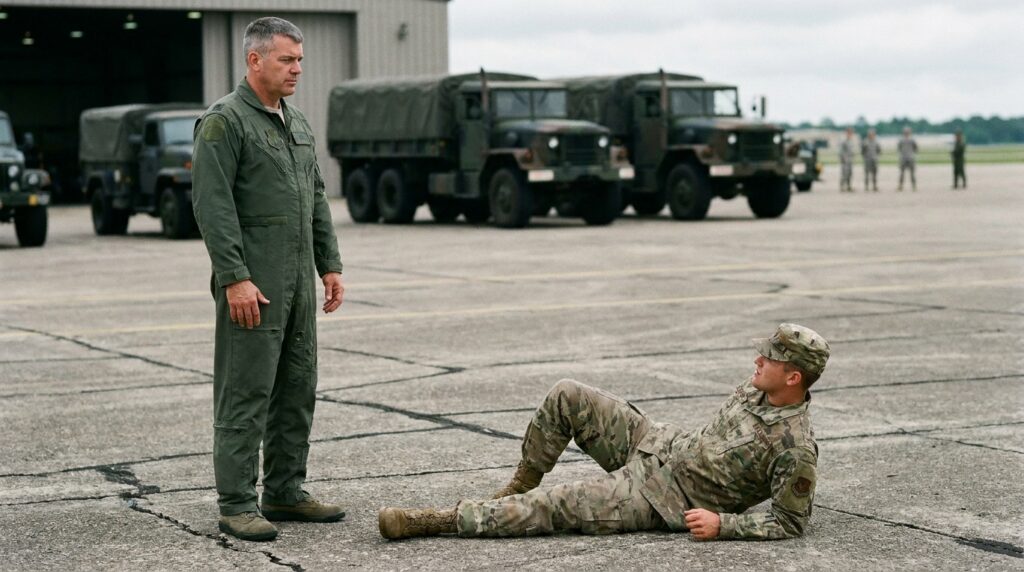
The shattered fragments of the matte-black tungsten seal glinted in the dust next to Trainee Miller’s scraping knuckles. The younger man remained pinned against the coarse asphalt, his ribs hitching as his lungs scrambled to reclaim the air his own momentum had squeezed out of them. A thread of dark crimson leaked from his scraped cheekbone, turning black as it mixed with the dry grease residue on the flight line. He did not reach for his cap. He did not look back up at the veteran.
The Senior Serviceman adjusted his aluminum clipboard under his arm, his boots planted exactly where they had been before the pivot. His knuckles were unblemished, but the rough green cotton of his flight suit hummed against his chest from the vibration of the idling transport trucks. He looked past the fallen trainee, his flint-like eyes moving along the row of olive-drab bumpers.
The witness layer had locked completely. The distant mechanics who had been leaning on their wrenches had vanished into the shadow of the truck beds, their silence absolute, frozen by the clinical finality of the drop. They had expected an argument; they had received a demonstration.
“I understand, sir.”
The words were barely a murmur, pushed out through Miller’s dry, split lips as his head lifted slightly from the pavement. The arrogance had been scrubbed clean from his tone, replaced by the raw, flat weight of institutional submission. He did not attempt to stand. He stayed grounded in the debris, his fingers curling into the loose gravel of the training lane, his entire authority structure turned to salt within a single fraction of a second.
The veteran didn’t offer an answer. He turned his heel away from the fractured composite crate, his gaze lingering on the silver solid-state arrays visible through the broken housing. He knew what happened to inspectors who stared too long at things they weren’t cleared to see. If Vance was monitoring this tarmac via the security lenses, then every second the veteran spent looking at that exposed transmitter was an admission of discovery. He needed to move before the perimeter gate closed.
He began walking forward down the training lane, his stride even, measured by the dry, metronomic tick of the silver stopwatch in his pocket. The heat off the tarmac beat against his shins, thick with the chemical stench of unwashed machinery.
Behind him, the airfield didn’t resume its noise. The mechanics remained fixed like rusted iron stanchions as he passed their stations. As his boots cleared the shadow of the final three-ton truck, a young specialist sorting brass fasteners snapped his spine straight, his right arm locking into a rigid, unprompted salute. The gesture rippled down the line—not out of regulation, but out of fear. They knew the flight suit was blank, but they had just seen the rank written in the asphalt.
The veteran reached the administrative threshold at the end of the line—a small, sun-bleached shack where the flight manifests were filed. The door was a slab of warped sheet metal, its handle rough with orange oxidation that left a metallic stain on his palm as he twisted it. Inside, the air conditioning was a dying rattle, failing to conquer the ambient heat.
He laid the aluminum clipboard onto the counter. The metal surface was pitted and scarred from decades of identical clipboards, the paint worn down to the bright, raw zinc underneath. He picked up the heavy black logging pen, his fingers stiff from the lingering adrenaline of the tarmac.
The trap had changed shape. If he logged the flight with the forty-two cases, he was certifying a smuggling run. If he refused the log, Vance would have the legal lever to terminate his advisory contract for insubordination before the hour was out. The active driver of the narrative couldn’t hide behind a standard report anymore; he had to move into the blind spot of the system.
He didn’t sign his name. Instead, he drew a single, clean line through the serial number of the bottom pallet—the one containing the fractured lock. He reached into his flight suit pocket and pulled out the old sheared airframe rivet he’d carried for thirty years. He dropped the small piece of iron onto the center of the ledger. It hit the paper with a dull, heavy thud, pinning the page open.
The door behind him creaked, the rusty hinges crying out under the weight of the wind off the runway. The veteran didn’t turn around. He could hear the high-pitched whine of an auxiliary power unit spooling up on the far side of the hangar—the pre-flight sequence for the fourteen hundred transport had already been pushed forward. They weren’t waiting for his signature. They were moving the cargo regardless of the audit.
He stepped back out onto the concrete porch of the shack. The sun had shifted slightly, throwing long, jagged shadows across the maintenance lane. Down the line, Miller was finally on his feet, his shoulder hitched high as two other trainees supported his weight, moving him toward the medical bay. But Vance wasn’t on the tarmac. The commander’s office window remained dark, the thick glass reflecting nothing but the desaturated glare of the western sky.
The veteran felt the stopwatch click against his ribs. The decoy secret—the idea that this was a petty institutional mutiny to run his old methods off the base—had been thoroughly shattered by the silver arrays inside the crate. He had won the physical confrontation against the boy, but every step he took now was drawing him deeper into a larger, more calculated system of systemic theft. The unit wasn’t just obsolete; it was compromised from the command desk down to the grease pans.
He cleared the porch, his boots finding the dirt track that led toward the primary communications bunker behind the secondary runway. He had less than twenty minutes before the transport taxied into the active lane. His active agency required him to cut the power to the telemetry grid before that aircraft could broadcast its encrypted coordinates to the civilian corridor, but as he reached the perimeter chain-link fence, he noticed the heavy brass padlock on the bunker door had already been sheared off. The lock hung loose, its cut face bright and free of rust, dripping with fresh, purplish hydraulic grease.








