
CHAPTER 6: THE CRUSH OF REVEALED LOGIC
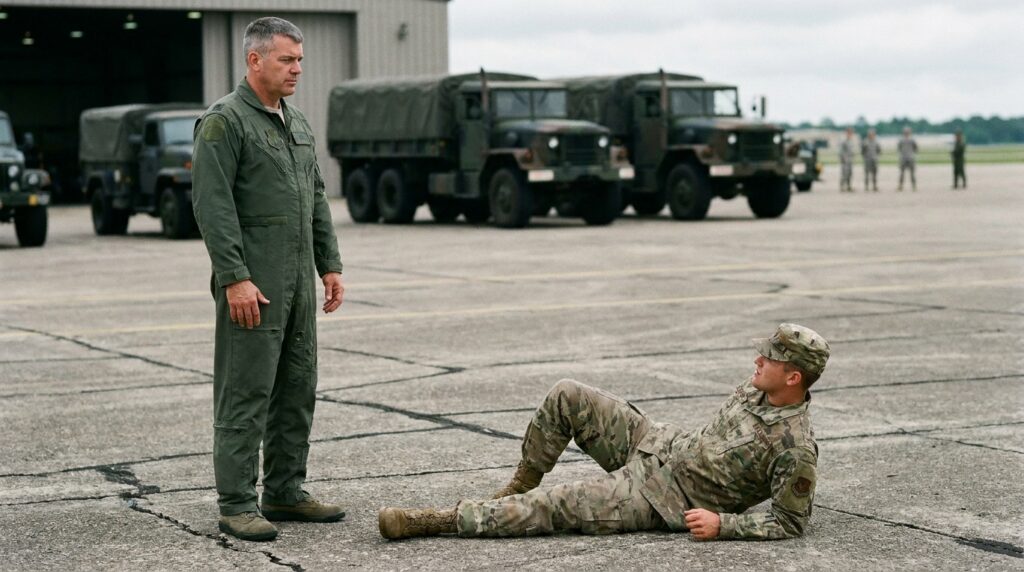
The raw, unoxidized meat of the sheared brass lock was cold against the Senior Serviceman’s thumb. The purple telemetry grease on the shackle had not yet gathered the fine white dust of the airfield, meaning the cut was minutes old—executed while Miller was still bouncing on the concrete lane. The veteran pushed the heavy sheet-metal door inward, its hinges groaning with the dry, high-pitched scream of neglected iron.
The interior of the communications bunker was a narrow vault of unpainted concrete, suffocated by the smell of scorched wire insulation and the flat, chemical chill of an over-taxed refrigeration unit. There were no green phosphor screens here; the primary tactical server rack sat in the center of the floor like a black iron monolith, its cooling intake grilles choked with gray lint and metallic shavings.
Commander Vance stood behind the central terminal deck, his starched uniform sleeves rolled up twice to reveal forearms covered in pale, thin skin. His fingers were flying across a mechanical input matrix, the heavy plastic keys clicking with a wet, erratic rhythm. He did not look up when the door scraped the sill. He didn’t have the time to look.
“The fourteen hundred transport is already clearing its chocks, counselor,” Vance said, his gaze locked into the cascading columns of amber code reflecting off his glasses. “You left your piece of iron on my desk as if a vintage rivet could stall an active deployment line. It doesn’t work that way. The manifest is signed.”
The veteran closed the heavy door behind him, the latch clicking into its slot with an institutional finality that excluded the entire flight line. He walked three slow steps forward, his boots finding the gritty lane between the concrete structural columns. He pulled his clipboard down, letting the aluminum frame scrape against the edge of a steel battery housing with a sharp, metallic ring.
“The manifest is a dummy sheet, Vance,” the Senior Serviceman said. His gravelly voice didn’t rise, but it carried the unyielding density of a hydraulic press. “The bottom pallet didn’t hold hydraulic seals, and it didn’t hold a routine training stress test. It held high-gain solid-state arrays wired to an unmonitored commercial relay. You aren’t testing my training manual. You’re bleeding the high-altitude logistics data for the entire western corridor.”
Vance’s fingers froze on the input matrix. The sudden termination of the mechanical clicking left the vault completely silent, save for the rhythmic, low-frequency hum of the primary transformer under the deck plates. The commander slowly stood up straight, his spine popping twice against the starched fabric of his shirt. He turned his face into the amber light, his mouth compressed into a thin, white line that looked like an old knife wound.
“You always had a habit of over-complicating a simple extraction,” Vance murmured, his eyes tracking the veteran’s relaxed, balanced posture. He didn’t look threatened; he looked exhausted, his shoulders sagging under the weight of an invisible ledger. “Miller was supposed to drop you on the tarmac, file an incident report for physical insubordination, and have your advisory contract revoked by fifteen hundred. It was a clean administrative retirement. You weren’t supposed to examine the locks.”
“Miller’s momentum belonged to me the second he stepped into my space,” the veteran countered flatly. He reached into his pocket, his fingers passing the silver stopwatch to trace the jagged edge of the old airframe scrap. “But Miller didn’t shear the padlock on this bunker. He doesn’t have the hand for a high-tensile cutter. You did this before the pre-flight briefing even started.”
Vance let out a dry, rattling laugh that stayed inside his throat. He turned back to the console, his palm flat against the cold iron frame of the server rack. “You think I’m selling the farm to a foreign buyer? You think this is some spectacular intelligence breach? Look at the destination protocol on the amber screen, old man. Look at the network bridge.”
The Senior Serviceman leaned forward, his flint-like eyes cutting through the amber glare. The numbers on the terminal weren’t routing to a commercial satellite or a hostile intelligence network. The decryption keys were being fed directly back into the Central Command logistics repository in Washington—but through an unlogged, dark-site gateway marked Project Sentinel.
The decoy secret—the idea that Vance and Miller were a pair of rogue actors running a black-market data ring—shattered completely. The failure was broader, structural, and entirely legal.
“The unit isn’t being stress-tested, and it isn’t being exploited,” Vance said, his voice dropping into a flat, pragmatic whisper that carried the cold truth of a ledger balance. “The unit is being erased. Central Command has already classified the entire high-altitude training program as an obsolete operational liability. They don’t want the data preserved, and they don’t want the personnel reassigned. They’re collecting the live telemetry to build the autonomous replacement algorithms, and then they’re closing the gates permanently. I’m not a smuggler, counselor. I’m the executioner.”
The veteran felt the stopwatch in his pocket click. The revelation didn’t bring validation; it brought a heavy, devastating failure of purpose. The institution he had spent his life defending wasn’t being attacked from the outside; it was systematically dissolving itself to save on maintenance costs, using his own presence as a historical baseline to calibrate the machines that would replace his dead friends. Every manual he had written was being digested by the server in front of him.
“The fourteen hundred transport isn’t carrying spares,” the veteran said, his voice dropping into a low rasp that sounded like gravel grinding under a boot. “It’s carrying the primary backup cores. If that plane clears the ridge line, the base server goes cold.”
“And the old guard goes home,” Vance said, his finger hovering over the terminal’s primary execution key. “Sign the clearance, or don’t sign it. The system doesn’t care about the name on the aluminum clipboard anymore.”
The terminal screen suddenly flared from amber to a bright, violent crimson. A localized diagnostic alert began to wail from the lower rack—a piercing, mechanical scream that signaled a high-voltage override inside the telemetry lines. The server hadn’t just finished its export; the transmission line had been seized from an external source on the airfield, and the data was now being redirected away from the Washington gateway toward a blind, civilian IP address three hundred miles to the west.
Vance stepped back from the console, his face completely drained of color as the crimson light washed over his glasses. “That’s not my script,” he whispered, his hands trembling against his starched trousers. “Someone else is in the line.”
The veteran’s face returned to its hard, unyielding stone. He looked down at the purple grease on the floor, then out through the narrow viewing slit toward the runway where the transport plane was already increasing its turbine whine. The boy on the pavement hadn’t been the distraction—he had been the terminal node.








