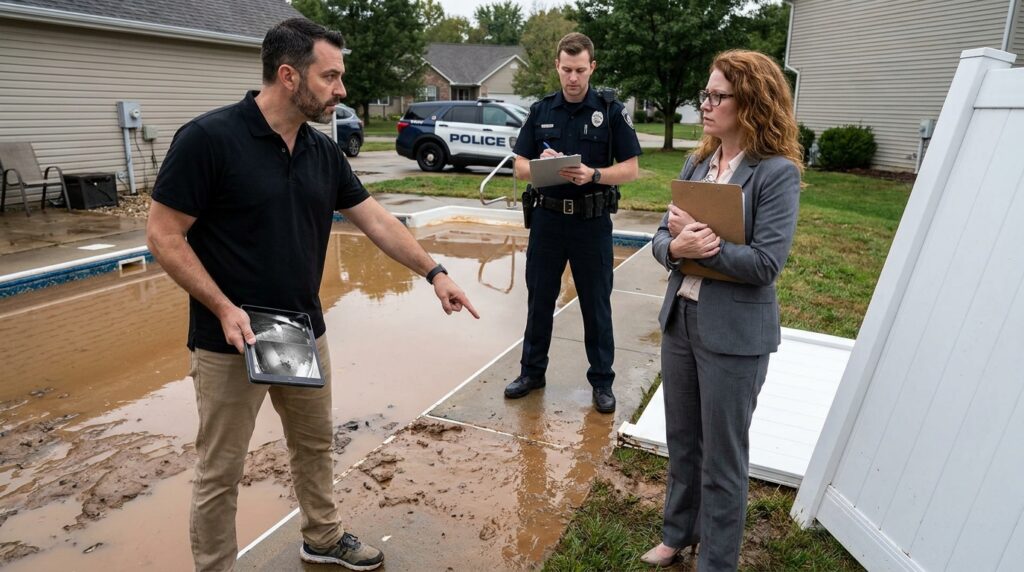
CHAPTER 8: THE RESIDUAL SANCTUARY
The light was failing now, dropping below the six-foot concrete perimeter wall in a long, cold slate of violet and rust. Mark didn’t drop the tablet. He stayed on his knees in the wet black mulch by the curb box, the moisture of the subterranean water pit chilling his lower shins to a dead, unfeeling numbness.
He didn’t look up when the heavy vacuum truck shifted into reverse, its backup beeper cutting the quiet subdivision air with a sharp, geometric chime that repeated every 1.5 seconds. He was looking at the red acceleration notice glowing on his glass interface. The text didn’t scroll; it pulsated, a digital execution code designed to lock his accounts before he could log a counter-claim with the provincial clearinghouse.
Time dilated, the mechanical thrum of the neighborhood settling into a slow, industrial drag. He could feel the fine, gritty aggregate of the asphalt beneath his fingertips, the precise weight of the iron lid he had lifted, the exact thickness of the copper grounding block inside his fiber hub. They had built a perfect closed loop. The mortgage default clause was wired directly into the HOA’s architectural violation log; one flipped switch in the database triggered the next in the banking system, a seamless cascade of corporate logic that required no human signature to complete its course.
Except the network didn’t belong to the association management company anymore.
Mark’s left thumb hit the terminal key sequence—the hard, unnumbered root access command he had retrieved from the mirrored water district node. He didn’t write an appeal. He didn’t file an injunction. He executed a vertical system override, routing the unredacted clubhouse files directly through an active federal infrastructure safety block.
“The asset allocation is locked, Mark,” Brenda said, her shadow stretching thin across the wet concrete until the dark tip of her outline touched the rim of his sneakers. She stood motionless, her gray suit losing its sharp edges under the expanding blue darkness of the cul-de-sac. Her clipboard remained tight against her ribs, but her pen was still, its chewed blue cap pointing down at the grass like a dead needle. “The system doesn’t have an override for a primary lien default. The ledger is closed.”
Mark didn’t lift his head. He watched the white timeline on his tablet screen turn from green to an unblinking, structural amber.
“The ledger is open to the Federal Energy Regulatory Commission, Brenda,” Mark said. His voice was a thin, level rasp that carried no heat, matching the cold aggregate beneath his knees. “The Delaware entity didn’t register the six-foot easement extension as a common easement. They logged it as an industrial freight transit corridor. In a master-planned residential zone, that’s a Tier-1 infrastructure security conflict. The automated foreclosure you triggered didn’t go to the mortgage holder. It hit the federal regulatory injunction block four seconds ago.”
Brenda’s shoulder dropped. The rigid, mathematical line of her posture fractured, her heels shifting half an inch back into the gravel utility strip as the screen on her own phone suddenly went dark, its battery icon replaced by a white, spinning system reset loop.
Officer Reynolds stepped between them, his heavy leather utility belt creaking under the weight of his stance as he looked down at his own handheld terminal. The blue glare from the screen had been replaced by a generic municipal emergency notification: All plat modifications for Blocks 1 through 12 suspended by federal regulatory decree.
Reynolds didn’t look at Brenda. He looked toward the unmarked vacuum truck, his arm rising in a flat, horizontal lane block that signaled the driver to cut the engine. The heavy diesel rumble died with a low, hydraulic sigh, leaving the street entirely silent, caught in the cold, clear perspective of the late evening.
“Clear the street, ma’am,” Reynolds said to Brenda. He didn’t pull his handcuffs, but his pen was still out, the carbon-copy trespass citation tucked neatly underneath the metal clip of his official book. “The county clerk just pulled the administrative variance. Your board credentials aren’t valid on this plat until the regulatory hearing closes in November.”
Brenda didn’t reply. She didn’t look at Mark, and she didn’t look at the neighbors who had begun stepping out onto their concrete driveway aprons under the automated yellow glow of the streetlights. She turned and walked down the asphalt curve alone, her heels making a flat, hollow click against the dry stones of the gutter until her gray suit was swallowed by the shadow of the cul-de-sac.
Mark stood up slowly, the cold, muddy water from the pit dripping from the hem of his khakis onto his sneakers. His joints ached with the deep, structural exhaustion of a thirty-six-hour shift, but his hands were steady as he slid the tablet back into his work belt.
He walked past the splintered white vinyl shards of his side gate, entering his backyard as the first stars began to break through the violet haze above the concrete wall. The pool was still brown, the mud-clay cloud resting at the bottom of the plaster basin like a dark sediment layer from a previous era. But the pump filter had stopped its high-pitched whistle. The mechanical hum had reset to its low, clean frequency, pulling the clear surface water through the skimmer faceplate in a steady, unhurried circle.
He sat down on the edge of the low wood porch, the timber cold through his pants, his eyes tracking the dark line where the old oak tree met the property marker. The boundary wasn’t three inches inside his lawn, and it wasn’t six feet behind it. It was exactly where he stood—a small, hard pocket of space he had paid for with his own labor, locked tightly against the collective grid.
The back door slid open behind him, a small, warm line of interior yellow light cutting across the dark concrete apron. Lily stepped out, her sneakers squeaking against the wood as she dropped down beside him, her small shoulders leaning lightly against his black sleeve.
“Is the water clean yet, Dad?” she asked, her voice small, clear, untouched by the calculation of the lines.
Mark looked down at the dark, reflective surface of the pool basin, watching the yellow light of the kitchen mirror itself in the center of the water. He reached out and wrapped his arm around her shoulder, his fingers feeling the warm, simple reality of her cotton shirt.
“The water’s fine, Lily,” Mark said, his voice dropping into a quiet, permanent register that didn’t need a terminal interface to verify its weight. “The fence is holding.”