CHAPTER 4: THE INTRUSION LOGIC
The galvanized iron lock on the side easement panel didn’t break; it yielded. A two-man crew in matching safety-orange vests and unbranded high-vis caps didn’t check the house for occupants before setting their stabilizer jacks into the soft turf bordering the shared utility strip.
Mark met them at the fence corner. The diesel exhaust from the idling flatbed out on the curb sat thick in the humid air between the lots, a greasy, yellow vapor that clung to the wet vinyl slats of his privacy fence. His hand remained flat against the ruggedized casing of his tablet, his index finger resting directly over the physical terminal interface toggle.
“The work order is stamped by the county district clerk, sir,” the lead worker said. He didn’t offer a clipboard. He pointed a gloved thumb toward a magnetic stencil on the truck door: Regional Hydraulic Mitigation Group. “We’re logged for an emergency isolation of the common line. Main line pressure dropped four points since the morning shift change. We have an unmetered bypass verified right behind this post.”
Mark looked past the man’s shoulder. Brenda stood thirty yards away on the asphalt curve, her gray pantsuit a rigid, geometric cross against the rounded line of the cul-de-sac. She didn’t look at Mark. She had a long-lens digital camera raised to her cheek, the motorized focus ring making a thin, insect-like click every time Mark took a step toward the fence boundary.
“The bypass is a dedicated three-inch intake for the sand pool filter,” Mark said. His syllables were flat, rhythmic, empty of tone. “It sits entirely on private plat forty-two. Check the county registry.”
“The plat was updated on the sixteenth,” the worker replied, his voice flat with the mechanical indifference of an outsourced contractor. He unclipped a heavy, steel-jawed pipe wrench from his utility harness, the iron teeth catching the grey sunlight with a cold, geometric flash. “The easement was reclassified as a shared flow corridor under the neighborhood environmental variance code. The board owns the air and fluid rights sixty inches down from the surface grade. We’re locking the intake valve.”
Mark didn’t argue the line. He turned his back on the crew, walking directly to the small fiberglass utility shed where his network hub was slung beneath the secondary electrical breaker. The structural velocity of their move was too fast for standard administrative procedure; it was an extraction sequence, designed to sever his property’s primary utilities before he could file an official injunction with the municipal magistrate.
He unbolted the aluminum faceplate of his router housing. The internal temperature gauge was operating within baseline parameters, but when he traced the physical fiber feed where it spliced into the external junction box, he found the anomaly.
A black, rectangular module—no larger than a car key fob—sat wedged between the fiber terminal and the master copper grounding block. It was drawing point-five milliamps directly from his local line, its small internal transmitter humming at a frequency that his standard system diagnostics had ignored as ambient electrical noise.
It was a local network mirror. Someone had physically tapped his hardware long before Brenda started measuring the basketball goal.
Mark attached his tablet’s auxiliary diagnostic lead directly to the tapped splice. The terminal window flickered, lines of machine-readable text scrolling upward in a white blur before stabilizing into a static file folder index located on a local IP mask.
The directory wasn’t labeled with property codes or HOA violation numbers. It was labeled: Project Horizon – Acquisition Blocks 1 through 12.
He opened the primary text file in the directory. It was an unredacted copy of the Whispering Pines master covenant, but the signature pages at the bottom were empty of community initials. Instead, they bore a corporate seal from a commercial development group based in Delaware, alongside an unsigned amendment dated six months before he bought his house.
The amendment didn’t adjust architectural guidelines. It altered the legal coordinates of the master plat map, carving out a six-foot strip from every backyard on the eastern ridge to form a contiguous corridor for an industrial freight line extension.
The decoy was the pool. The fines, the orange violation slips, the midnight dirt dumping—they were tactical chaff designed to keep him looking down at his own water filter while the legal foundation of his property was systematically uncoupled from beneath his feet. If they could force an occupancy revocation based on a health code violation before the corporate buyout became public record, the developer would acquire his lot at a forced judicial auction for pennies on the dollar.
The grinding sound of iron meeting iron cut through the backyard.
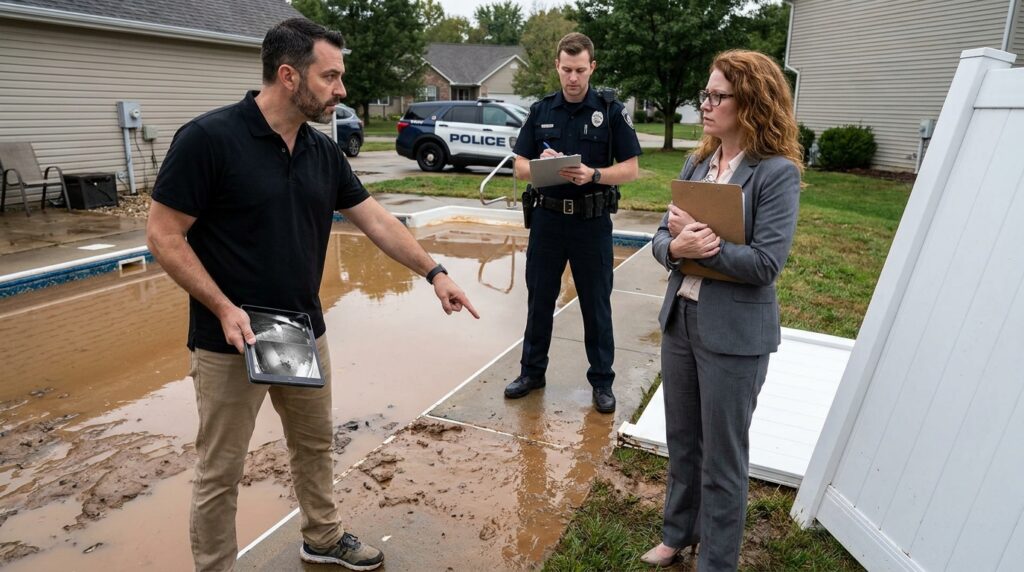
Outside the shed, the contractor had thrown his weight against the primary valve housing near the white vinyl fence, the wrench jaws biting deep into the old brass casing of the intake pipe. A thin spray of brown, pressurized water hissed out from the cracked packing nut, splashing over the loose loam where the orange survey pin lay buried.
“The stem is seized,” the worker shouted toward the truck, his boots slipping in the sudden slurry of mud and clay forming at the fence line. “Give me the pneumatic cutter from the flatbed box.”
Mark stepped out of the shed casing, his black polo catching the gray mist from the ruptured line. He didn’t yell to stop them. He pulled his phone from his khaki pocket, his thumb sliding down to a secure contact entry labeled with a four-digit extension that belonged to the municipal code enforcement division’s internal desk.
“Reynolds is already on his way back, Mark,” a voice spoke from the side gate before he could press dial.
It was Brenda. She had walked down the utility alley while the tools were running, her phone still raised at chest height, her thumb hovering over the display screen like a trigger on a dead man’s switch. Her glasses were splattered with fine droplets of the brown pool water, but her mouth was fixed in a wide, triumphant line.
“The health inspector signed the emergency order two minutes ago,” she said, her voice rising above the mechanical thrum of the flatbed’s diesel block. “An unmanaged industrial discharge into a common line triggers an immediate forty-eight-hour vacation notice. You can leave the tablet on the porch, Mark. The board will take custody of the security records during the remediation phase.”
Mark looked from her sunglasses down to the ruptured valve casing where the brown clay continued to spiral into his clean sod. He didn’t move away from his electrical master panel. He reached into his back pocket, his fingers pressing against the folded edge of the photocopy, his mind finalizing the counter-move.
“The order is based on an unsigned plat map, Brenda,” Mark said. He didn’t raise his voice to clear the roar of the machinery. He kept it precise, letting the tactical silence carry the weight of the statement. “And the Delaware corporation hasn’t cleared the municipal escrow block yet.”
Brenda’s finger froze over her phone screen, her shoulder dropping two inches as the geometric perfection of her stance fractured for the fraction of a single second.