
CHAPTER 6: THE MATRIX OF SUBVERSION
The sudden absence of the pneumatic whine left a hard, ringing void in the backyard. High above the fence line, a crow settled onto a transformer bracket, its dark feathers silhouetted against the stark white geometry of the subdivision’s identical rooflines.
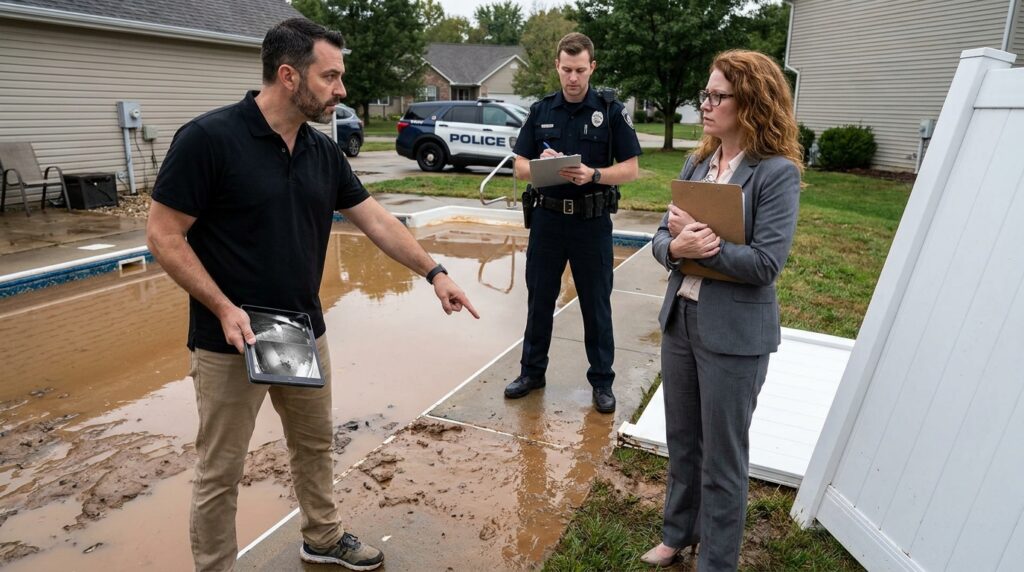
Mark didn’t lower the tablet. He kept his grip centered on the rubberized perimeter frame, his thumb resting lightly against the volume rocker. The glare of the late-day sun caught the glass at a low, acute angle, refracting into a razor-thin beam of emerald light that sliced across the wet, brown aggregate of the pool coping.
Officer Reynolds stood frozen, his eyes shifting between the blue terminal screen in his left hand and the high-definition video feed locked on Mark’s screen. The silence stretched for four full seconds, measured only by the steady, wet drip of pool water leaking from the severed intake casing.
“The server room is common property, Officer,” Brenda said, her voice dropping into a tighter, desperate octave. She didn’t retreat from the splintered vinyl fence post, but her knuckles turned a bloodless ivory where she clamped the aluminum clipboard to her ribs. “The security log requires a double-blind board authorization to clear the archive. He’s showing you an unverified local scrape. It’s an illegal data intrusion under our charter.”
Mark tilted the screen three degrees toward the officer’s utility vest. “The database isn’t common property anymore, Brenda. Look at the lower-left corner of the stream header.”
Reynolds stepped closer, his boots squelching into the mud slick. He leaned down, his face inches from the glass. The camera feed on the tablet was running a background diagnostic overlay, a scrolling column of green machine-readable data that verified the physical source of the transmission.
The IP address didn’t point to the clubhouse basement hub. It pointed to an active cellular gateway registered to a corporate entity named Horizon Land Holdco, LLC, registered out of Wilmington, Delaware.
“The board’s administrative console has been mirrored to an outside proxy for one hundred and forty days,” Mark said, his voice flat, level, and entirely devoid of heat. “Every fine, every architectural review, and every municipal health order issued in this subdivision since February has been pre-cleared through an infrastructure acquisition server before it hit the neighborhood mailboxes. The pool isn’t a maintenance violation, Reynolds. It’s a spatial clearance marker.”
Reynolds reached down and tapped his own terminal screen, typing in the corporate registry number visible in the tablet’s frame buffer. The system took three seconds to query the state division of corporations before a small red badge popped up over the record: Pending Acquisition Block – Right of Way Phase 1B.
The officer looked up from the screen, his gaze cutting past Brenda’s shoulder to lock onto the two workers in safety-orange vests. They had stopped moving entirely, their hands resting loosely on the handles of their pneumatic tools, their eyes tracking the sudden shift in the law’s gravity.
“Clear the yard,” Reynolds said. He didn’t raise his voice, but the casual, bureaucratic indifference was gone, replaced by the hard, specific cadence of an officer identifying a perimeter breech.
The lead worker didn’t ask for a supervisor’s sign-off. He dropped the heavy cutter into the grass, uncoupled the rubber high-pressure hose from the flatbed’s compressor, and turned back toward the side lane without looking at Brenda. The secondary worker followed two paces behind, his heavy leather work gloves stuffed into his pockets as his boots left a double track of grey mud across Mark’s lawn.
“Officer, the emergency remediation order is still active on the county desk,” Brenda whispered, her defensive stance finally fracturing as she took a single, unstable step back into the gravel utility strip. Her glasses had slid half an inch down her nose, the lenses reflecting the muddy soup of the pool rather than the sky. “The health of the aquifer takes precedence over a corporate registry dispute. If that pump isn’t isolated—”
“The health order was generated by an unverified automated script from an outside server, ma’am,” Reynolds cut her off, his pen clicking twice as he pulled his official clipboard from his duty belt. He didn’t look at her rules; his eyes were fixed on the state penal codes listed on the inside cover of his manual. “And you’re currently standing six feet inside a private residential plat with a construction crew that doesn’t have an execution warrant signed by a district magistrate.”
Mark watched her face. The corporate mask didn’t slip; it collapsed. The lines around her mouth deepened into hard, jagged shadows under the late sun, her posture sagging until the aluminum clipboard looked too heavy for her arms to carry.
“The bylaws protect the collective investment, Mark,” she muttered, her glare dropping to the splintered white vinyl shards littering the sod between them. “You think you can hold an individual lot against a regional logistics grid? If the block doesn’t clear unanimously, the county will declare the entire subdivision an eminent domain variance. Nobody wins here.”
Mark didn’t answer. He turned his back on her, his sneakers crunching on the dry aggregate as he walked back toward his filtration pad to inspect the physical damage to the copper intake. He didn’t need to finish the argument; the system log had already saved the transmission data to three independent cloud mirrors outside the subdivision’s gate.
Behind him, the rhythmic scratch of Reynolds’ ballpoint pen began moving across the carbon-copy forms, a dry, deliberate sound that marked the official transition from a neighborhood variance to a criminal trespass file. But as Mark reached the filtration shed, his tablet gave a single, low-frequency pulse—not a network update, but an automated alert from the main water meter at the front curb. The total volume indicator wasn’t dropping; it was accelerating, the numbers spinning forward at four gallons per second, indicating that while they had been calculating the boundary line at the pool, another valve had been opened manually beneath the driveway concrete.








