
CHAPTER 3: THE STRATEGIC PERIMETER
“The hoop violates the street-facing threshold by eighteen inches, Mark. I have the laser measure logged to the curb seam.”
Brenda did not blink. She stood on the narrow asphalt gutter at the base of his driveway, her silhouette framed by the stark, repeating rectangles of two hundred identical two-story homes. The mid-day sun hit her gray pantsuit, turning the synthetic fabric into a flat, metallic sheet. In her left hand, the aluminum clipboard gleamed; in her right, a small plastic housing with a red diode lens pointed directly at the heavy steel base of his daughter’s basketball goal.
Mark stayed three paces back, his sneakers firmly planted on his own concrete apron. He kept his hands out of his pockets, elbows slightly bent, his weight shifted over his insteps. He was watching the way her right thumb hovered over the record button of her phone. She wasn’t just measuring; she was fishing for a reactive gesture.
“The goal is weighted with sand, Brenda,” Mark said. His tone was a level, uninflected sequence of dry syllables. “It requires two people to clear the bracket safety pin. It stays behind the utility joint.”
“The joint belongs to the municipal easement, but the air rights above the concrete are governed by the architectural covenant,” Brenda replied. She stepped forward, her heels hitting the curb with a sharp, dry click. She didn’t look at the hoop; her eyes remained locked on the gray space between Mark’s collarbones. “Section Nine. No recreational structures may project over the visible driveway margin during non-designated hours. It’s an immediate fifty-dollar assessment per day. I’ve already entered the catalog entry into the central management system.”
Mark let the silence stretch. A car passed behind her—a white delivery van with an unmarked side panel, its tires making a sticky, tearing sound against the hot asphalt. He watched the driver’s side mirror. It didn’t slow down, but the brake lights flickered twice as it cleared his property line, a tiny anomaly he logged automatically.
“The covenant specifies street-facing visibility from the primary access boulevard,” Mark said, his voice dropping into the precise, rhythmic cadence he used for system audits. “The curve of the cul-de-sac drops this lot three degrees below the sightline of the entry gate. If you’re measuring from the boulevard, you’re calculating an imaginary plane.”
Brenda’s jaw tightened, a tiny, vertical muscle twitching beneath her ear before her face reset into a mask of smooth, corporate certainty. “The board doesn’t interpret angles, Mark. We look at the ledger. Your account has three open variances. When the fourth hits the system at midnight, the automated mitigation review triggers. You won’t be arguing about eighteen inches then. You’ll be explaining to the municipal escrow holder why your primary deed has a structural lien attached to it.”
She stepped back, her clipboard cutting a quick, diagonal line through the air as she tucked it back beneath her arm. She didn’t offer a sign-off slip. She didn’t have to; the digital stamp had already sent the notification to his router.
Mark watched her walk three houses down, her steps unhurried, perfectly calculated within the center of the concrete sidewalk panels. She was moving toward her own property, but her eyes never wavered from the clean, grey line where the turf met the stone. She was assessing the grid, house by house, verifying the margins.
He turned and walked toward his garage, the soles of his sneakers picking up the heat of the driveway. The internal air of the garage smelled of dry cardboard and recycled motor oil, a heavy, dead atmosphere that compressed his chest. He didn’t look at the basketball hoop as he passed it. He was focused on the low, mechanical rattle vibrating through the drywall near the water heater closet.
The pool pump was struggling.
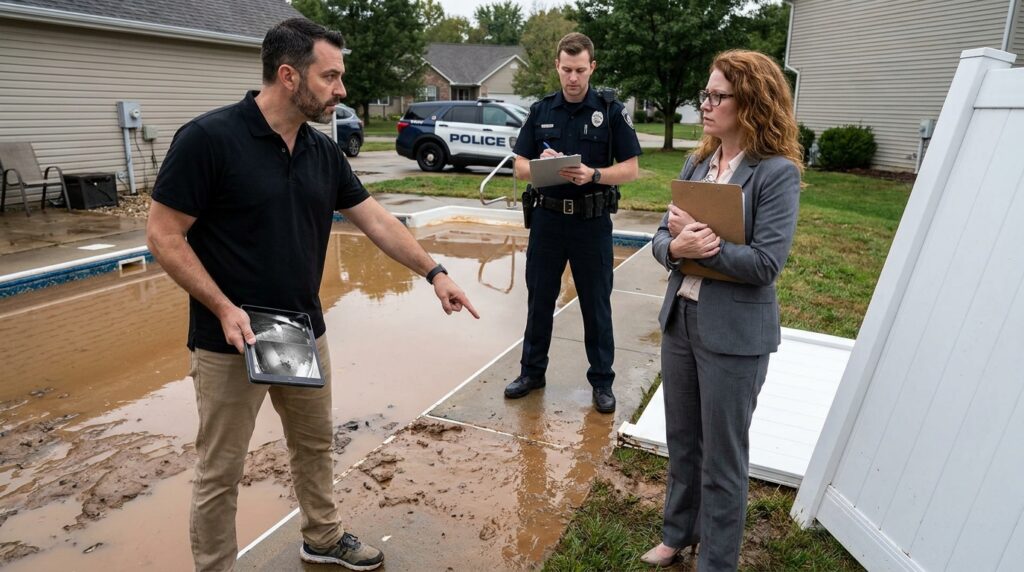
He walked around the side of the house, his shadow stretching thin against the white vinyl slats of the privacy fence. When he reached the filtration pad, he knelt beside the heavy plastic housing of the sand filter. The pressure gauge, usually resting comfortably at twelve pounds per square inch, was pinned at twenty-eight. The clear sight-glass at the top of the multi-port valve was no longer clear; a dark, oily sludge was swirling inside the glass dome, thick with the smell of river silt and decayed organic matter.
He touched the cold metal casing of the pump motor. It was hot—too hot to hold for more than three seconds—and the internal cooling fan was emitting a thin, high-pitched whistle that indicated a failing bearing.
Mark pulled the ruggedized tablet from the workbench ledge, his thumb sliding across the unmarred glass to pull up the system logs. The network traffic was ordinary, a steady stream of automated packet updates from his home server, but when he opened the background diagnostic for the tree-mounted camera, he noticed a drop in the frame rate between 2:00 AM and 3:30 AM.
The camera hadn’t shut off. The system had simply skipped three hundred frames every ten minutes, a clean, systematic deletion that could only be executed from inside the local network hub.
He leaned back against the concrete foundation of his house, his eyes tracking the thin, blue line of the pool’s water level. The brown cloud that had started from the main drain was expanding, turning the entire deep end into an opaque, reflective sheet that swallowed the light.
Someone didn’t just want him out of compliance. Someone had the administrative credentials to reach into his physical router and scrub the verification loop while the yard was dark. He reached into his back pocket, his fingers finding the sharp, folded edge of the unsigned photocopy. The hand-drawn asterisk over his water utility joint wasn’t an accusation from a bitter neighbor. It was a spatial anchor for a systematic extraction.
He stood up, his sneakers crunching on the dry mulch, and walked toward the master electrical box mounted near the meter. If the network was compromised from the inside, the digital logs were useless. He needed to verify the physical copper before the evening inspection.
As his hand touched the iron latch of the electrical panel, a low, rhythmic vibration started up through the soles of his shoes. It wasn’t the pump. It was the deep, heavy rumble of an engine idling at the curb outside his gate—the distinct, unhurried percussion of a commercial diesel block waiting for a gate to swing open.








