
CHAPTER 2: THE METRIC OF CONFINEMENT
The aluminum teeth of the telescopic pole clicked into place, a cold, metallic vibration that traveled up through Mark’s palms and settled in the joints of his shoulders. The backyard was still caught in the long, blue shadow of the eastern perimeter wall—a six-foot barrier of pre-cast concrete that the developer had marketed as an “acoustic shield” but functioned more like a vertical line on a ledger.
He lowered the nylon skim net into the deep end, the water breaking with a small, flat slap that disturbed the mirror reflection of the sky. He wasn’t looking for stray leaves. He was looking for depth.
He dragged the net along the smooth blue plaster of the pool’s basin, his eyes fixed on the black plastic disc of the main drain. The water was clear—painfully clear, the kind of transparency that cost seventy-four dollars a month in chemical stabilizers and three hours of manual labor every Saturday morning. It was a fragile clarity, maintained in a state of constant defiance against the creeping silt of the unfinished construction zone two hundred yards behind his lot.
His phone buzzed in his khaki pocket. A short, single pulse. Not a text. A system alert from the router in the hallway.
Mark didn’t stop his stroke. He drew the pole back, his movements measured, unhurried. He knew Brenda’s routine down to the minute; she wouldn’t make her secondary pass down the eastern access lane until the school buses cleared the main boulevard at 8:10 AM. He had twenty-two minutes of isolation left before the street became an active observation deck.
He set the pole down on the damp concrete coping, the aluminum clicking sharply against the aggregate. He pulled the folded photocopy from his back pocket. The paper had absorbed his body heat, turning soft and slightly damp at the edges, but the red ink of the drawn asterisk remained sharp. It sat precisely over the junction where his third fence post met the gray utility box owned by the county water district.
He walked over to the fence line. The white vinyl panels were cold to the touch, their hollow plastic frames retaining the night’s chill like blocks of engineered ice. He knelt in the damp grass, the moisture soaking through the knees of his khakis with a cold, creeping pressure.
The ground here was different. The sod had been laid three years ago by the previous owner, but right at the base of the post, the dirt was dark, loose, and lacked the fine web of roots that held the rest of the turf together. Someone had cleared the topsoil within the last forty-eight hours.
Mark reached down, his fingers tracing the edge of the vinyl post where it disappeared into the concrete footing. His nail caught on something hard buried beneath the loose topsoil. Not a root. Not a stone.
He dug down three inches, his fingers scraping against a cold, rusted surface. It was an iron survey pin—a heavy, four-sided spike driven deep into the limestone subgrade. It was painted a faded, industrial orange, the tip notched with a cold-chisel mark that pointed directly back toward his house.
He drew his fingers back, leaving the iron pinned beneath the earth. He stood up, wiping the black loam onto the grass, his mind already running the calculations. If this pin was the legal boundary mark, then his white vinyl fence didn’t sit three inches inside his property line.
It sat six feet behind it.
The realization didn’t come with a rush of adrenaline; it came with a cold, structural stillness. The entire layout of the backyard—the pool’s concrete apron, the underground intake lines, the filtration shed tucked against the rear wall—had been built based on a plot map that had been deliberately truncated. For three years, the HOA had issued fines for his tree placements and his patio extensions based on a line that didn’t exist in the county recorder’s office.
The heavy thud of a vehicle door closing in the front driveway broke the silence of the yard.
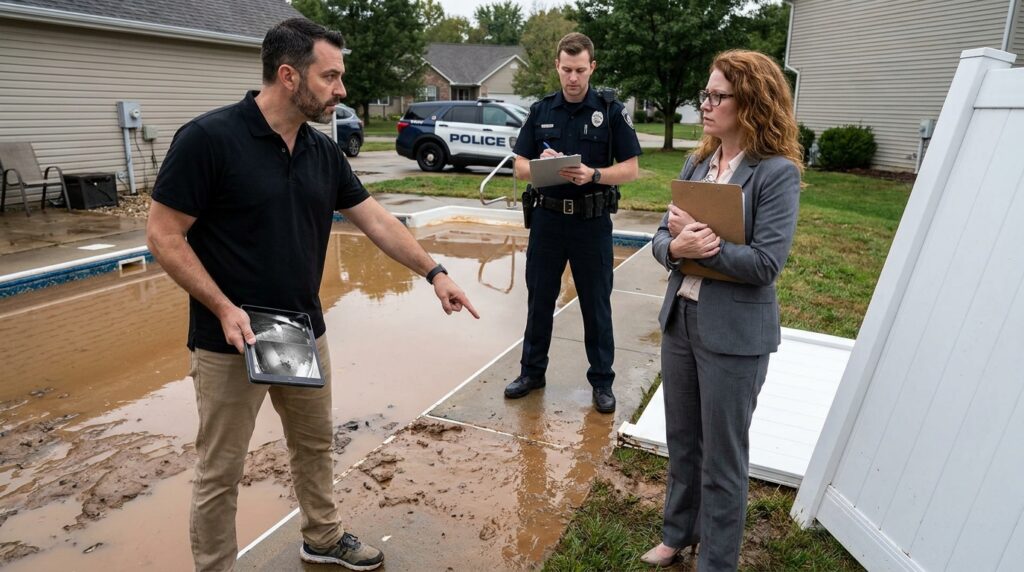
Mark turned his head toward the side gate. The latch didn’t rattle—whoever was out there knew how to handle a handle without triggering the internal spring. He stood perfectly still by the pool edge, his black polo absorbing the first direct rays of sunlight as they cleared the concrete wall.
A shadow broke across the white slats of the gate. It wasn’t Brenda’s heavy, deliberate silhouette. This shadow was wide, square-shouldered, the outline of a heavy tactical belt creating a jagged edge against the plastic vinyl.
Mark reached down and picked up his ruggedized tablet from the lawn chair, his thumb sliding across the glass to lock the interface. The screen remained dark, but the small blue LED in the corner continued its rhythmic, one-second pulse, recording the signal from the oak tree above.
“Mark?”
The voice was masculine, flat, carrying the dry timbre of someone who spent his mornings reading VIN numbers off abandoned trailers. It was Officer Reynolds. He wasn’t at the door; he was standing at the entrance to the utility lane, his hand resting on the latch of the gate, his dark uniform cutting a hard, vertical line against the white subdivision backdrop.
Mark didn’t move toward him. He kept his heels planted at the pool’s muddy edge, the tablet heavy in his left hand, his face caught in the cold transition between the shadow and the sun.
“The gate is locked from the inside, Officer,” Mark said. His voice didn’t rise. He kept it low, forcing Reynolds to step closer to the partition if he wanted to maintain the conversation. “The corporate boundary ends at the concrete apron.”
Reynolds didn’t drop his hand from the latch. His dark eyes scanned the length of the fence, stopping for a fraction of a second on the loose dirt at the base of the third post before settling on Mark’s face. “I’m not here about the apron, Mark. Your neighbor three doors down called in a report about an unsecured industrial hazard in the rear easement. She claims your pool pump is venting gray water into the common drainage line.”
Mark looked at the tablet screen. The network log was completely silent, but the hand-drawn asterisk in his pocket felt heavy, like a piece of lead pulling at his hip. “The pump doesn’t vent,” Mark said. “It filters. If there’s gray water in the easement, it didn’t come from my basin.”
“She’s got a photograph,” Reynolds said, his tone carrying no weight, just the neutral delivery of a man tracking an assigned ledger. “And she’s already filed the mitigation order with the county health inspector. They’ll be out here before noon to lock the valve.”
Mark’s grip tightened around the edge of the tablet. The plastic casing gave a tiny, internal creak. Brenda wasn’t trying to collect twenty-five-dollar fines anymore. She was moving to declare the entire property an active bio-hazard, a designation that would trigger an automatic occupancy revocation under the county health code. She was trying to empty the house.
“Tell her to bring the county surveyor when she comes,” Mark said, his voice dropping into a hard, metallic register that matched the iron pin beneath his feet. “Because the valve isn’t the only thing that’s going to get locked.”
Reynolds didn’t answer. He simply drew his hand back from the gate latch, his pen clicking once inside his shirt pocket as he turned back toward his cruiser. But as the patrol car’s engine caught, a low, wet gurgle rose from the deep end of the pool—the sound of air entering an intake line that should have been under twelve pounds of pure vacuum pressure.
Mark looked down. A thin, brown spiral of clay-silt was beginning to rise from the main drain, curling through the clear blue water like smoke in an empty room.








